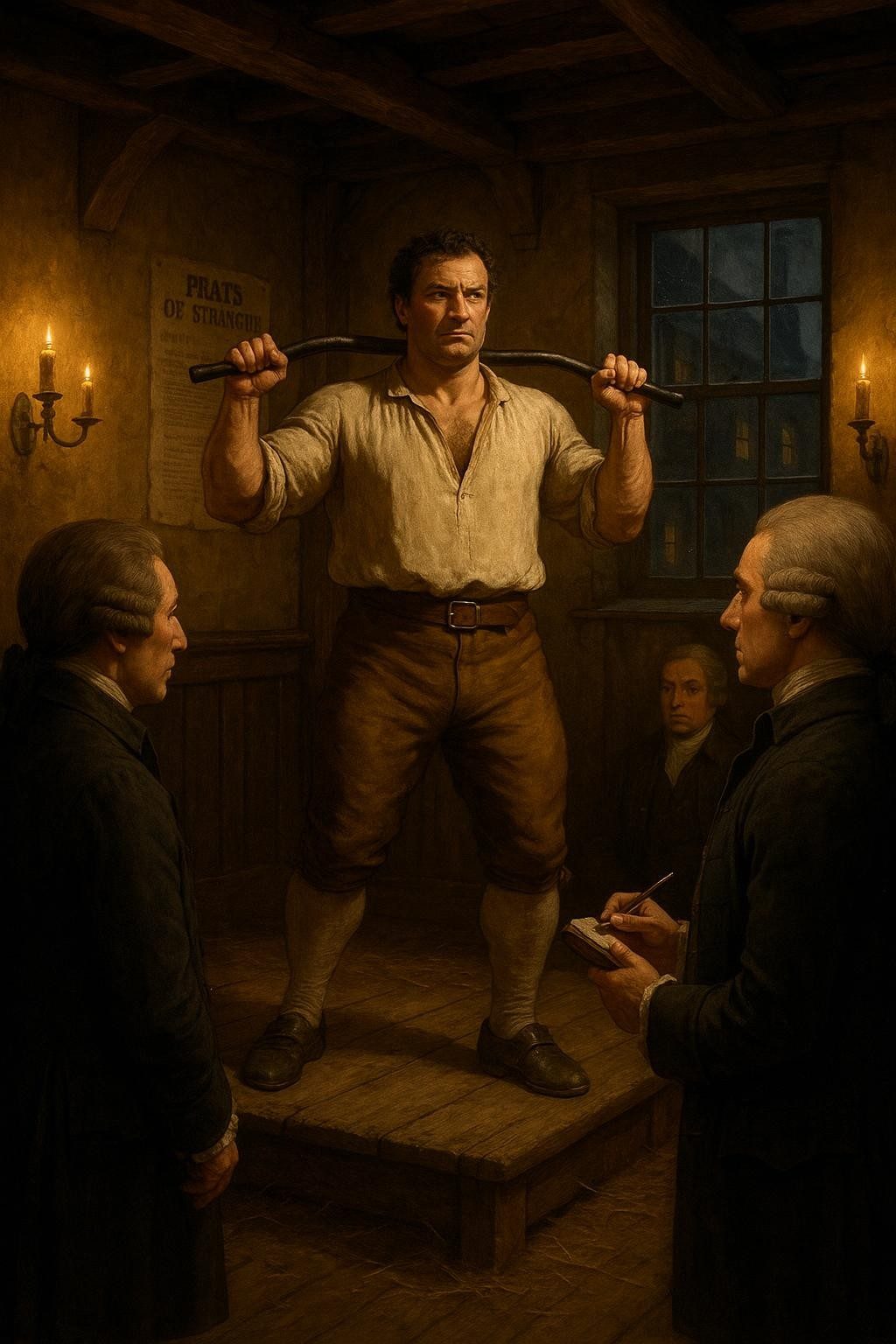
The damp earth was still settling around William Darby's grave when the heavy thud of booted feet could be heard in the churchyard, muffled only by the whisper of the night breeze through the yew trees. Lanterns flickered as shadows morphed and twisted across the ancient headstones, the hurried breath of men shattering the evening's stillness. They moved with purpose towards the freshly turned soil, eyes darting, ears attuned to any sound that might betray their illicit undertaking.
William Darby, the colossus from Ireland, whose feats of strength had once drawn the admiration of Londoners, lay mere feet beneath them. His enormous frame now silent and still, encased in a coffin lined with heavy lead — a desperate attempt to thwart what he had feared most. Despite his meticulous planning to protect his final resting place from the anatomists' blades, betrayal lingered closer than he'd imagined, within the circle of confidants he had once trusted deeply.
In life, Darby cut an imposing figure. The strongman, with shoulders as broad as an oaken door and arms like tors of thick rope, was a spectacle unrivaled in the bustling streets of Georgian London. Here, the cacophony of carriage wheels on cobblestones, the rattle of market cries, and the ever-present pungency of smoke and refuse were constants. Among these, Darby stood like a titan from legend, capable of bending iron like willow switches, of lifting weights that seemed absurd even to those accustomed to the marvels of the era.
Londontown buzzed with the exploits of Darby, dubbed by some as "The Irish Hercules." His performances were more than mere demonstrations of brutish strength — they were theatre, elevated by a presence that could silence a room with a mere glance. To see Darby perform was to glimpse the fantastical, an experience that even found favor among the aristocracy. His legend prompted whispers that echoed through the taverns and parlors alike, stories of his vast strength mingling with tales of his humility and deep, simple fears.
It was these fears that led to his insistence on the lead-lined coffin, paid for with the sweat of his titanic efforts, and the deep grave in the hallowed ground of a church. The price of such protection was steep, but to Darby, the cost was minor beside the imagined specter of dissection at the King's College or the surgeon’s operating table. The body-snatchers — or "resurrectionists," as they were ominously called — were a shadowy threat that loomed large over every Londoner not planted six feet deep and further hemmed about by the weight of lead.
Yet even the mightiest precautions crumbled when faced with human greed. As the night deepened its hold, the clumsily disguised figures at Darby’s grave were not professionals of the morbid trade, but men who had once clasped his hand in friendship. Perhaps they reasoned that Darby's body, larger than life even in death, would yield a handsome profit under the keen, unerring dissecting skills of London's leading surgeons. It was more than a body to them; it was a chance to capitalize, to change fortunes overnight, to walk away rich from the expense of their integrity.
The transaction was quick, unceremonious, and tinged with irony. Here was Darby — a man who riveted the crowd’s attention with the sheer force of his will and sinew — rendered helpless by the robbery of his own remains. The surgeons, eager and always too aware of the need for fresh "study material," had paid handsomely not knowing they were contributing to the desecration of a friend’s final wishes. As was the custom, Darby's body was reassembled on a dissecting slab, secrets of human anatomy prised open for the eager eyes of medical students and surgeons alike.
But Darby’s story doesn’t end under the cold lights of an operating theatre. Dark rumors of betrayal are carried on every rumor-spiced breeze, but who suspects that Darby himself will become a spectacle once more? His bones, wrested from ignoble revenge or opportunism, were assembled and placed on exhibit. The skeleton of the strongman became a traveling sensation, perhaps even more so in death than he had been in life, a grim echo of the powerful figure who once walked the streets unchallenged by man or fate.
Would such a fate have shocked Darby, or merely confirmed his worst fears? The itinerant skeleton brought in crowds from far and wide, bringing those who had only ever heard distant tales of The Irish Hercules face-to-bone with what had once been his reality. His name persisted in the annals of popular folklore, each articulation of the legend adding a new facet, whilst the details of his final betrayal shadowed the life that was.
Such stories as Darby’s invite reflection on the tenacity of human nature, grappling with redemption, betrayal, and steadfast denial of oblivion. They pose piercing questions of integrity, the price of loyalty, and the chaotic aftermath of decisions untethered by moral constraints. Darby, who feared the anatomist’s scalpel, perhaps could never have anticipated that it would be the tools of ambition, driven by those closest to him, which would lay his bones bare to the world. He teaches us that even giants can be vulnerable, that trust misplaced can bring a colossus low. In the framework of his skeleton, we can almost hear him whispering truths we may not find elsewhere, and in selling his story anew, we honor and wrestle with the complexities of his legendary life — the veritable secrets they left out of the textbooks.