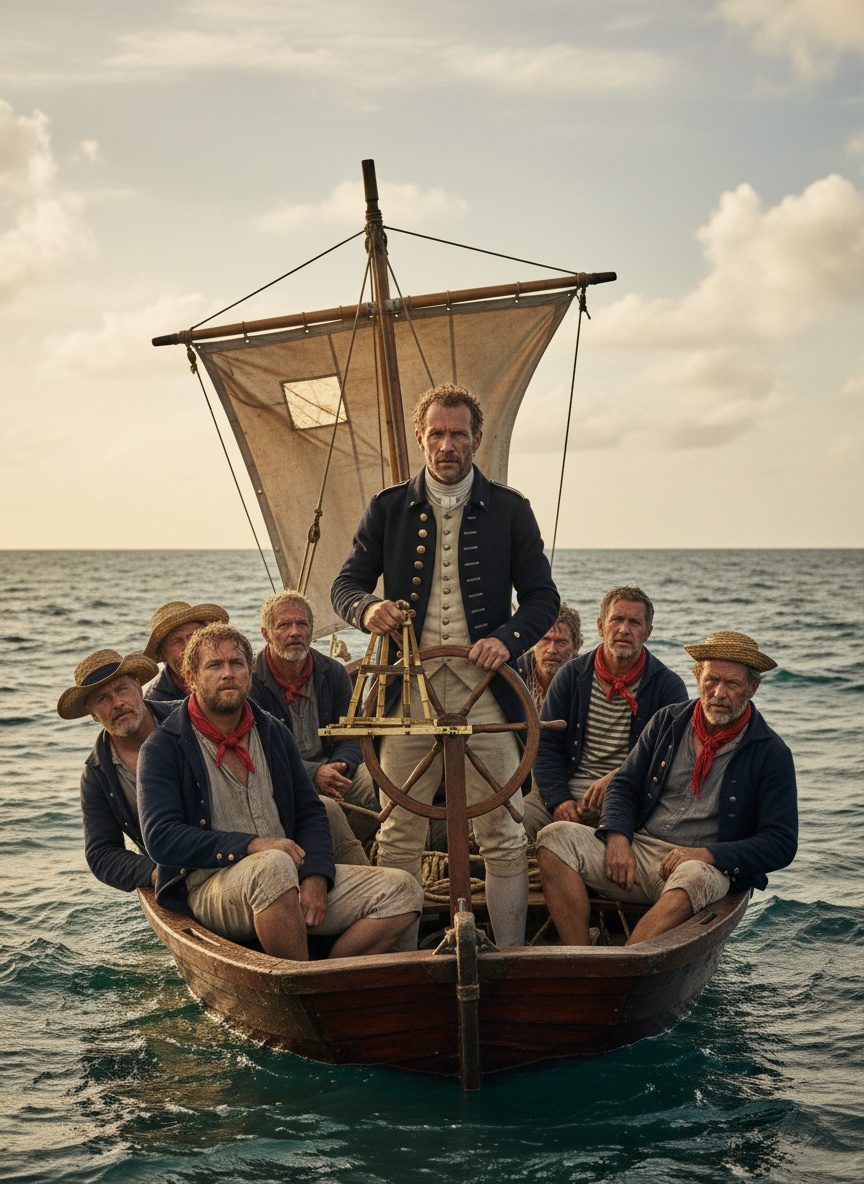
April 28, 1789. The waters of the Pacific Ocean lapped gently against the wooden sides of a small launch.
The Mutiny: A Betrayal at Sea
On that fateful morning, chaos reigned aboard HMS Bounty. Lieutenant William Bligh, a seasoned sailor known for his relentless pursuit of duty, found himself surrounded by a group of mutineers led by his once-trusted subordinate, Fletcher Christian. Bligh and eighteen of his loyal crew were violently cast adrift in a 23-foot launch—a fragile refuge in the vastness of the Pacific. They were left with meager supplies: a few pounds of hard biscuits, a small cache of rum and water, and the constant uncertainty of survival.
The mutiny was not unforeseen. Tensions had been simmering since departures from the relatively tranquil islands of Tahiti, where Bligh's stringent discipline clashed with the seductive allure of island life. While the crew succumbed to their yearning for freedom and comfort, Bligh remained unwavering in his mission. The tipping point was reached, and the mutiny sealed his fate—cast adrift, with nothing but his iron will and navigational prowess to guide him through the seemingly insurmountable distance to safety.
Navigating the Impossible: Skills of a Master Seaman
As the Bounty disappeared from view, Bligh took stock of their situation. With no charts or compass available, his navigation would rely solely on a sextant, a pocket watch, and his intimate knowledge of the seas. His navigation was more than a test of skill; it was a mental marathon that required not just calculation, but the sheer force of memory and experience accumulated over his years at sea.
Against all odds, Bligh demonstrated extraordinary seamanship under perilous conditions. His methodical approach to navigation had been honed through years in the Royal Navy and experiences such as serving under the great Captain James Cook. Bligh’s powers of recall allowed him to set their course using only the sun and stars, combined with his extensive mental map of the Pacific waters.
Survival in a Watery Wilderness
The open boat voyage was fraught with challenges that tested the limits of endurance. Food and fresh water were rationed to last the journey, while ruthless storms battered the launch and drove the men to despair. Despite these dire circumstances, Bligh’s leadership kept spirits from sinking into desperation. His ability to maintain discipline ensured that, remarkably, not a single man was lost at sea.
The harrowing 47-day ordeal was punctuated by encounters with hostile islanders, who looked upon the bedraggled crew with suspicion and occasionally violence. Each event tested Bligh’s resolve to maintain order and protect his men. His strategic decisions avoided further peril, and he managed to steer the crew clear of trouble, much thanks to his instincts and previous Pacific exploits.
The Shores of Civilization: Landing in Timor
After navigating an extensive stretch of the Pacific's treacherous expanses, hope glimmered on the horizon. On the 47th day, landfall came at the island of Timor, a Dutch-controlled territory. The men, sunburned and shrunken from deprivation, staggered ashore having completed one of the most remarkable open-boat voyages in history.
Their arrival in Timor was both an end and a beginning. The little band of sailors had survived the unimaginable, held together by Bligh’s indomitable spirit. His navigational ingenuity and unyielding faith in survival had brought them all to safety against seemingly insurmountable odds.
A Forgotten Legacy Reconsidered
In the annals of naval history, William Bligh’s remarkable journey often finds itself overshadowed by the infamous mutiny that preceded it. Yet the story of his survival, leadership, and unparalleled navigational expertise transcends the drama of betrayal. His voyage revealed the extraordinary resilience of the human spirit and underscored the profound capabilities of discipline and knowledge in the face of adversity.
The legacy of Bligh’s journey continues to resonate as a testament to the power of determination and skill. His feat, one of calculated risks and unparalleled resolve, remains a potent reminder that humanity, when faced with the boundless challenges of nature, can endure and navigate even the most profound tempests.