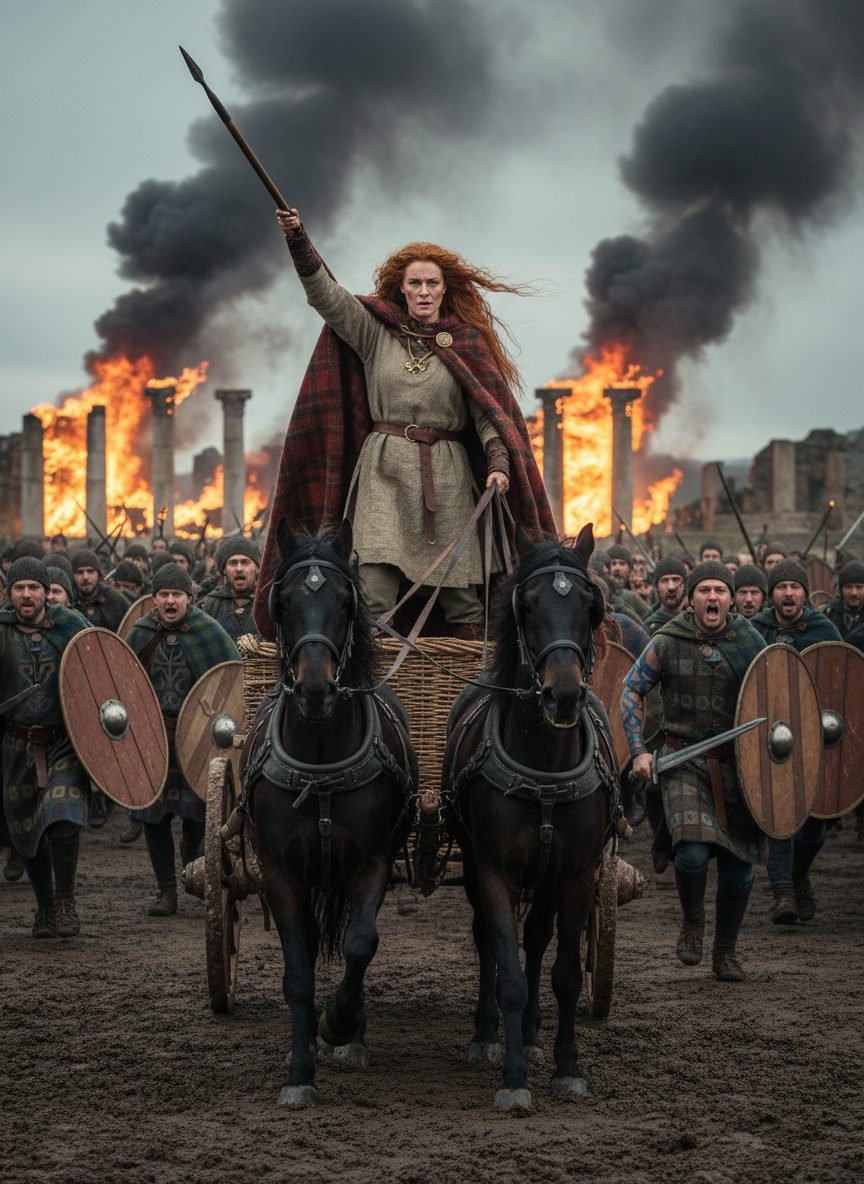
The acrid stench of smoke clawed its way into the nostrils of legionnaires huddled beneath their makeshift fortifications. Around them, the once-thriving city of Camulodunum lay engulfed in a fiery pyre. The clamor of their brethren's cries mingled with the cruel, taunting war chants of the Britons. This was no ordinary uprising. This was an unrelenting storm, led by a woman whose ire could rival the gods.
The Dragon of the Iceni
Standing at the head of tens of thousands of warriors, Boudicca of the Iceni was more than a queen; she was a fury incarnate. Just years before, the Romans had subjected her—and her daughters—to unspeakable ignominy. Her husband, Prasutagus, had been a staunch ally to Rome, hoping peace and cooperation would secure the Iceni's future. But upon his death, Roman greed betrayed his trust. Properties seized, families humiliated, and allies turned into foes. From this crucible of betrayal, Boudicca's resolve was forged.
Her rallying cry resonated deeply across the tribal lands. The Trinovantes, the Catuvellauni, and others knew the taste of Roman iron. Boudicca was a figure who transcended mere tribal loyalties. Her appeal wasn't just in her grievances but in the sheer symbolic force of a woman defying Rome's pactum de servitute. In her, the Britons saw a promise of divine retribution—a sacrifice through which the spirit of Britannia itself might be redeemed.
Camulodunum: The Eulogy of a Colony
Camulodunum, intended as a beacon of Roman might, stood arrogantly on the Essex plains—its temples and forums symbols of oppression to those whose lands had been snatched to construct such cityscape. When Boudicca's army reached its gates, the Roman settlers were ill-prepared for the wrath about to befall them. The visible panic among the residences was tantamount to the very fragility of their colonial endeavor.
Captured by the flames, even the defenseless Temple of Claudius could not shield them. It epitomized everything Boudicca's revolt stood against, becoming a gruesome stage for her wrath. For **days**, the inferno raged, leaving behind a haunting testament to the brittle facade of Roman omnipotence in Britain. The massacre echoed the potent shift—a shift that proved even an empire could bleed when faced with the resolve of the oppressed.
The Smoke that Choked Londinium
Fresh from their scorching success, the warriors set their eyes on Londinium, the nascent heart of Roman commerce and governance in Britannia. The residents had scarcely grasped the gravity of the threat before the Britons descended with the fury of nature unleashed. Governor Suetonius Paulinus, busy in far-off campaigns against the druids, could spare no legion to protect Londinium. His decision was a calculated retreat—a trade of one for future assurance. In his absence, the civilians left behind found themselves no match for Boudicca’s avenging force.
As Londinium burned, the blackened skies reflected the immutable anger of the displaced and the disenfranchised. Infrastructure meticulously cultivated over years—destroyed within hours. It was the absence of mercy that reverberated most profoundly. Statistically, it hurled the Roman world into chaos, compelling even Nero in his distant halls to ponder the island’s future in the folds of the Roman empire.
Verulamium: The Beacon of Defiance
Lastly came Verulamium, another prosperous Roman settlement. The lush lands, fertile and cultured through Roman intervention, shrieked under the chants of those who knew only land confiscated and freedom curtailed. Verulamium’s fall was not only physical; it was philosophical. Every strike upon its walls reverberated with a longing for a world before Roman chains—a world where their gods reigned, their ways endured.
Despite the heavy losses, news from the empire carried a different narrative. Propaganda painted britannic resilience as a temporary tumult. But the embers smoldering across the island beguiled that confidence. Boudicca had not just rallied warriors; she had awoken a sleeping giant, a collective consciousness keen on reclaiming their narrative from pages written by foreign hands.
In the aftermath, Boudicca’s campaign left an indelible imprint on the Roman psyche. Her tale is whispered down corridors of time not as legend, but as lived history—an unyielding reminder of what rises when suppression ignites resolve. It speaks to the power of unity against the oppressor; a tale that resonates even outside the bounds of its own time, whispering to those who listen—arms linked across ages separated by years but shared by struggle. Even indomitable Rome, mighty and vast, was reminded that no empire is immune to the rage of those they underestimate.