Tipu Sultan, often portrayed as a fierce and relentless warrior, also designed advanced flintlock muskets that could rival those of any European army. The man who embraced modern technology on the battlefield was the same leader who refused to yield to even a whisper of colonial domination.
The Unyielding Tiger
In the annals of resistance against imperial forces, few figures have burned as brightly as Tipu Sultan, the Tiger of Mysore. For over two decades, he was a thorn in the British Empire's side, a formidable foe whose resistance became legendary. Tipu was not just a warrior; he was a strategist and innovator, known for his audacity and modern military tactics inspired by European methods. Infamously, his troops' uniforms were striped like a tiger's pelt, reflecting his defiance and relentless spirit. Tipu's reign challenged British supremacy in southeastern India as he skillfully negotiated alliances with foreign powers like Napoleon Bonaparte, hoping to leverage their enmity with the British. Most Indian rulers cautiously balanced diplomacy and conflict; Tipu marched boldly where others hesitated.
The Fortress of Seringapatam
Seringapatam, Tipu's capital, was no ordinary city; it was a fortress designed to withstand the fiercest assaults. Nestled within the island formed by the River Kaveri, Seringapatam's formidable walls and strategic location made it a symbol of Tipu's indomitable will. In the spring of 1799, the British focused their military might on this citadel, determined to crush the heart of Mysorean resistance. Led by General George Harris, the British forces, supported by their Indian allies, laid siege to the city. For weeks, the cannon fire echoed across the land as Tipu's forces fought bravely, knowing that this was their stand against domination. Inside the fortress, Tipu's commanders prepared for the worst. Each day brought tighter encirclement, dwindling supplies, and mounting casualties. Yet, capitulation was not in Tipu's vocabulary. His resolve mirrored that of a predator defending its territory to the last breath.
The Siege That Shook an Empire
As British forces tightened their grip on Seringapatam, a chilling tension filled the air. Each day, the streets echoed with the clash of swords and the cries of battle, as Tipu and his men fought room by room, determined to extract the highest price for the city. He refused to surrender, turning down every offer that suggested submission. This siege was a clash not only of armies but of ideologies — the fervent independence of Mysore against the imperial ambitions of the British Empire. Tipu's knowledge of European military innovations played a crucial role. He developed numerous war rockets — innovative artillery that preceded the Congreve rockets used in later conflicts by the British themselves. His troops' precision and creativity with weaponry surprised their opponents more than once. With the fortress of Seringapatam on the brink of collapse, Tipu's undying loyalty to his land became a clarion call for Indian rulers to resist imperialism.
Tipu's Final Stand
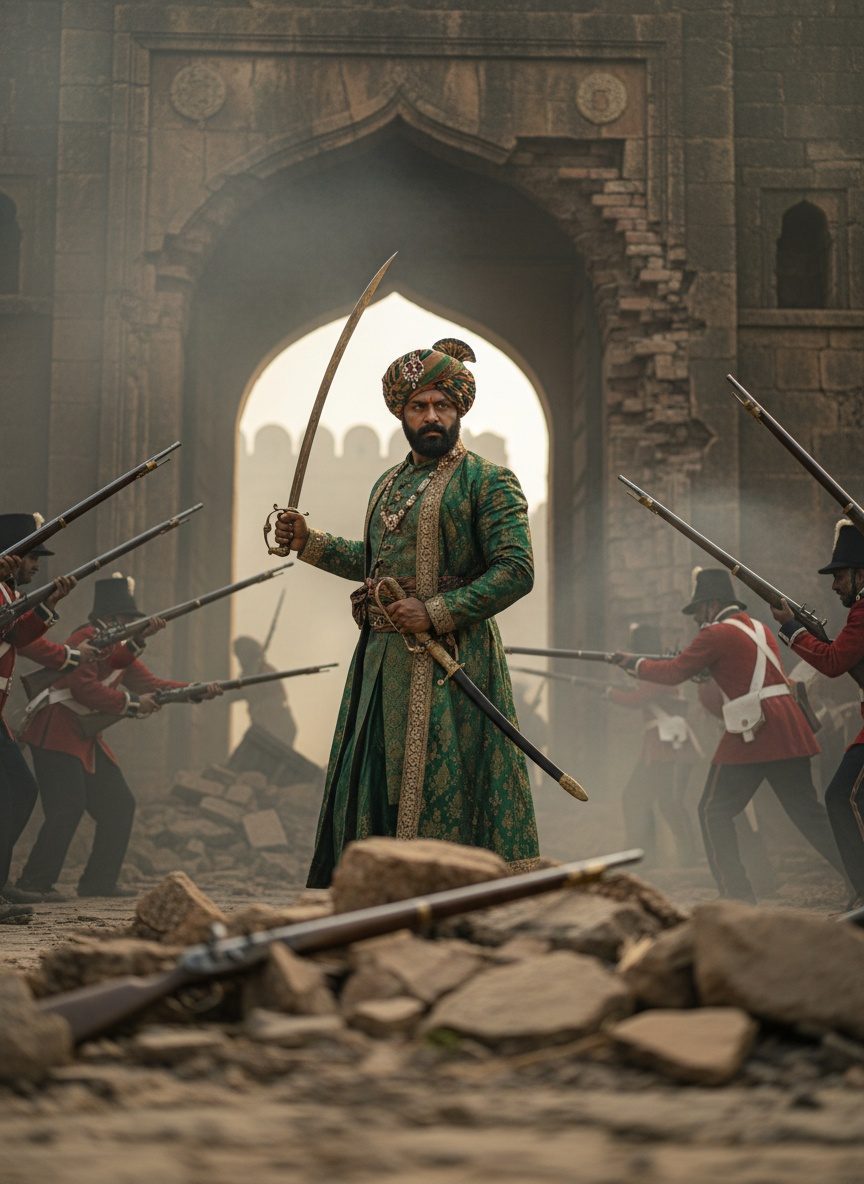
On the fateful day in May 1799, Tipu Sultan faced his destiny head-on. The British breached the walls, and chaos erupted as the invaders surged into the city. Tipu, defying fate, fought valiantly among his men. His sword marked every fierce strike, each blow a testament to his refusal to kneel. Tipu fell as he lived, with a weapon in hand, struggling to breathe the free air of Mysore until his last moment. His death was not just a personal loss; it was a blow to the soul of a region fighting for its autonomy. For the British, it was a victory shrouded in the grim cost of what was lost — not only a king but the passionate dream of a free Mysore, unchained from colonial shackles.
A Legacy Etched in Resolve
Tipu Sultan's story is one of defiance against overwhelming odds, a narrative of resistance that redefined what it meant to lead courageously against colonial forces. In resisting to the end, he became more than a ruler; he became a symbol of unyielding sovereignty. His death left lingering ripples, inspiring tales of courage that would echo through subsequent resistance movements. Remembering Tipu is not just about recalling a historic battle but understanding the profound legacy of those who stand firm in the face of encroaching empires. The tale of Tipu Sultan challenges posterity to reflect on valor's true essence — it lies not in easy victories but in the battles fought unwaveringly, regardless of the outcome. In Tipu's last stand, the enduring spirit of resistance remains an indelible chapter in the history of defiance against tyranny.