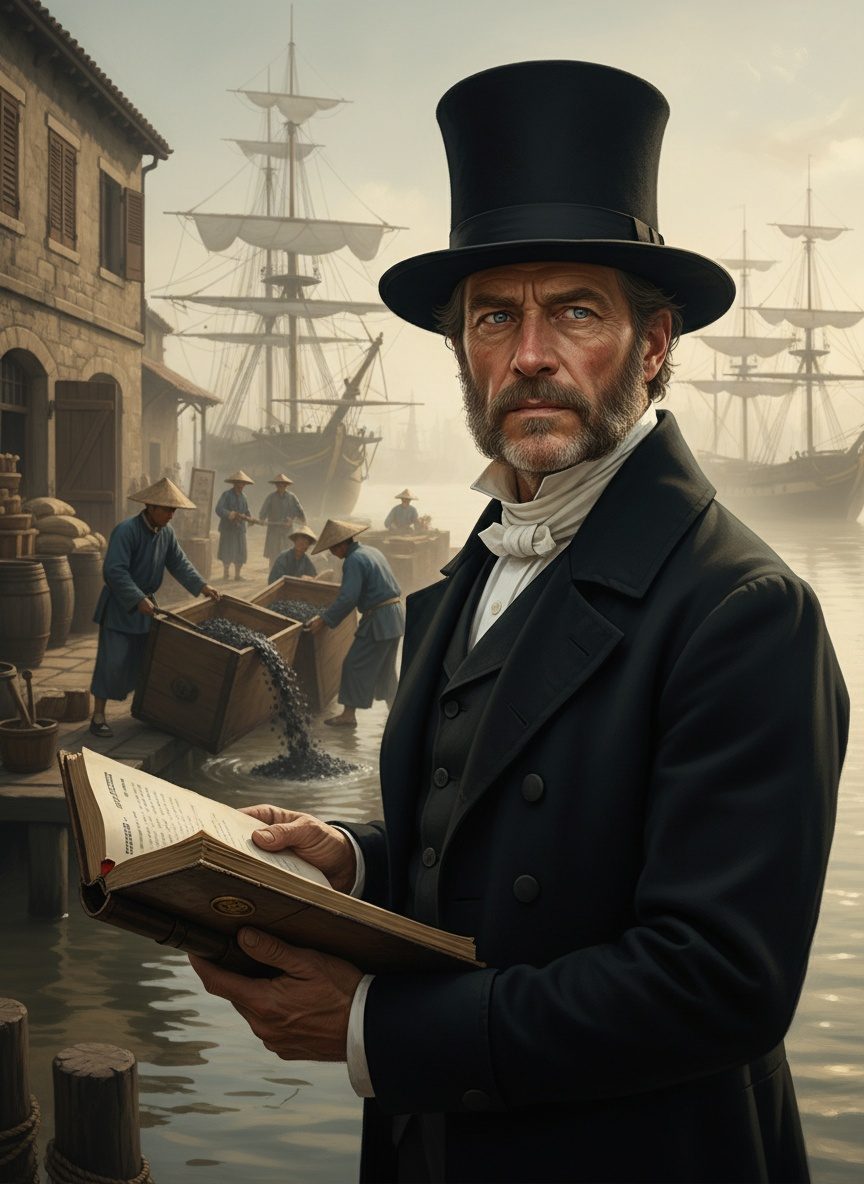
Spring, 1839. The damp mist hung heavy over the Pearl River.
The Gathering Storm in Canton
Canton, known today as Guangzhou, sat at the epicenter of a tumultuous global intersection. Here, in the bustling port city, cultures collided in a dance of commerce and subterfuge. For decades, British merchants had exploited China’s insatiable thirst for silver. In return, they fed the voracious appetite for Chinese tea, silks, and porcelain in the West. However, there was a dark undercurrent beneath this seemingly symbiotic trade relationship — opium.
By the time Thomas Sutherland’s clerk meticulously counted the shipments along the docks, opium had become the British East India Company’s primary lever in tipping the trade balance. Grown in British-controlled India, the potent drug was flooding into China, addicting millions and draining silver reserves from the Middle Kingdom. This insidious trade was conducted with diplomatic finesse and economic brute force, all while exploiting the fractured Chinese political landscape.
Enter Lin Zexu, a stalwart of Confucian morality and an unwavering guardian of the Chinese realm, appointed by the Daoguang Emperor amidst a crippling crisis of addiction and economic instability. Lin was not a man of half measures. He saw the opium trade as both a moral blight and an affront to Chinese sovereignty. His resolve crystallized in his historic order to halt the entry of the pernicious drug into his country.
As Chinese junks patrolled the waters and a growing sense of inevitability descended, the merchants could only watch in tense anticipation. Among them, Thomas Sutherland, a common if notable figure involved in facilitating the trade, stood troubled from across the river. The ledger in his office at the East India Company's warehouse — once incomplete with horizons of profit — now chronicled what would become the remnants of empire-driven avarice.
An Unyielding Directive
The morning was as still as the merchants were silent, broken only by Lin Zexu’s booming voice as it cut through the haze. He was determined to take a stand that would echo across continents. The edict was simple yet profound: all opium in Canton was to be seized and destroyed. The sheer scale of the operation was daunting. Estimates suggested that Commissioner Lin's man had between them some twenty thousand chests, each chest containing approximately 133 pounds of the drug, stacked as far as the eye could see.
Witnesses lined the banks of the Pearl River, a thrumming anticipation in the air as workers began the massive task at hand. Under Lin’s stern gaze, every chest was pried open, its contents destined for the churn of the tides, rendering thousands of pounds of opium into nothing more than silt. Despite their proximity, the British merchants were bystanders to a narrative slipping from their grip. They watched each chest go under, symbolic coffins for the fortunes of many.
Among them, one could spot increasing anxiety, for the destruction represented not just a staggering monetary loss but an affront to British pride and imperial trading ambitions. The opium — valued at a staggering two million pounds sterling — was fodder in an unfolding geopolitical altercation, spurred by differing worldviews on trade, sovereignty, and morality.
Lin Zexu’s actions were both a calculated show of force and a desperate bid to save his people from the grip of addiction, sending ripples across oceans, with intimations of conflict looming dense like the opium smoke that had once filled Canton’s air.
The Ripple Effect
The destruction of the opium in 1839 was not merely an isolated defiance by China against its imperial oppressor. Rather, it marked the flashpoint of escalation from trade wars to outright military conflict, setting off the First Opium War. The British government's response was swift and severe, their reaction driven by both economic interests and a bruised national ego. Naval and military might were marshalled with intentions clear — to subdue and open, to dominate and trade.
While Lin Zexu may have emerged as a Chinese hero, revered for his uncompromising stance against colonial exploitation, his efforts were to be met with mixed success. The war eventually led to the Treaty of Nanking in 1842, a sobering reminder of the imbalance between the two empires. Concessions were wrested from China: ceding Hong Kong to Britain, establishing a precedent for a century of unequal treaties and the port opening that laid the foundations of modern extraterritoriality.
The actions in Canton reshaped historical trajectories. The Western narrative praised opium destruction's boldness yet still painted it as a folly of Chinese resistance. Yet, historical hindsight reveals a poignant counter-narrative — a manifestation of determination against imperial hegemony, a precursor to future nationalist apprenticeships.
As the mists of the Pearl River swallowed the residue of that fateful day, they symbolized an empire's resilience and the tragedies of colonial ambitions. For today's reader, the lesson is stark: commerce and morality are intertwined threads within the loom of history, where actions motivated by ethics and principles can redefine power dynamics and recalibrate society's moral compass, resonating far beyond their immediate reverberations.