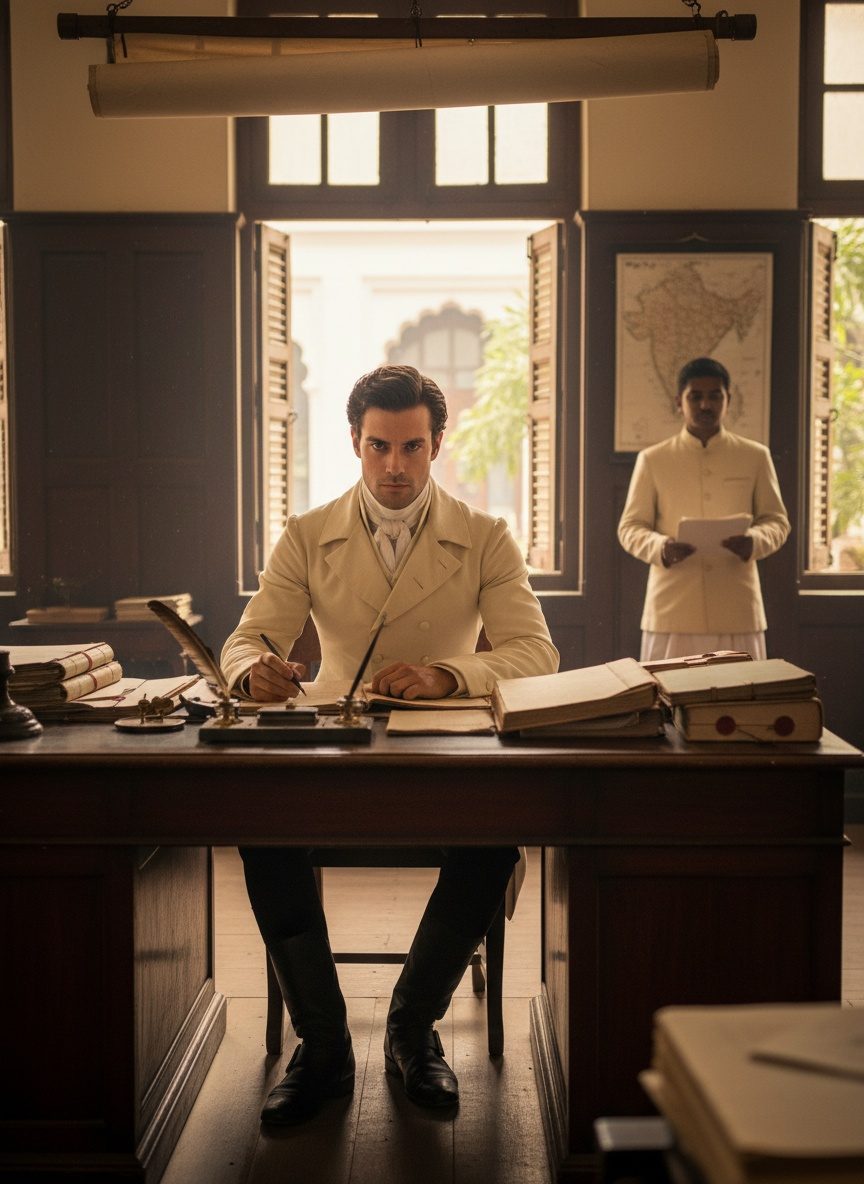
The sun hung low over Calcutta in 1835, casting elongated shadows across the bustling streets. The air, thick with the scent of jasmine and the faint aroma of spices, shimmered with heat. The city was alive with a cacophony of sounds—hawkers peddling their wares, the occasional clatter of horse-drawn carriages, and the murmur of conversations in a dozen different languages. This vibrant, teeming metropolis was about to become the stage for a transformation with far-reaching consequences, one that would leave its mark on a continent and the lives of millions of people. At the center of this unfolding drama was a young British politician named Thomas Babington Macaulay, whose vision of education would challenge the very fabric of British India.
The Scholar and the Empires
Thomas Babington Macaulay was no ordinary man. Born into a family steeped in reformist zeal, he carried within him a fierce belief in the civilizing power of knowledge. An eloquent writer and orator, Macaulay had already garnered attention as a member of the Governor-General's Council. To him, the idea that only the privileged few should access the wells of wisdom was an anathema. In Calcutta, he found himself amid a swirling debate: should Western or traditional education govern the minds of Indian students?
The educated elite of India, schooled in the ancient traditions of Sanskrit and Persian, held steadfast to their heritage. But Macaulay saw a different future, one where Indian children could stand shoulder-to-shoulder with their British counterparts, armed with the same knowledge and mastery of the English language. He envisioned a nation not wrapped in the ancient texts of Asia but introduced to the revolutionary ideas erupting from Europe—liberty, equality, and fraternity.
A Single Document of Destiny
In February 1835, Macaulay sat in a cramped room, the air heavy with tension and expectation, as he drafted what would come to be known as the "Macaulay's Minute on Indian Education." This document, not lengthy but deeply significant, laid the foundation for a new educational policy. Macaulay argued vehemently for the establishment of English as the medium of instruction across India. He believed that a class of English-educated Indians could serve as cultural and intellectual intermediaries—interpreters—as he famously put it, "between us and the millions whom we govern."
Macaulay's vision was one of assimilation, not just of language but of ideas and values, integrating India into the broader currents of the British Empire. His plea was simple yet profound: access to knowledge should not be shackled by geography or class. But even with his compelling rhetoric, Macaulay faced immense resistance. The committee overseeing education in India, steeped in tradition and occasionally skepticism, cast a vote against him, preferring indigenous learning systems over European models.
Appeal to Authority
Macaulay was undeterred. Realizing that his persuasive powers alone might not win the day, he turned to the one man whose influence could change the tide: Lord William Bentinck, the Governor-General of India. Bentinck, a visionary in his own right, had already instigated several progressive reforms, abolishing the ancient practice of Sati and supporting economic changes. Together, Macaulay and Bentinck were a formidable pair.
The tension came to a head when Macaulay presented his case to the Governor-General. He painted a picture of an India transformed, a land where ancient traditions could harmoniously meet new ideas, fostering a society of thinkers, poets, and scholars who could shape the future. Lord Bentinck, seeing the potential for an educated class that could facilitate governance and trade, lent his full support. With Bentinck's endorsement, Macaulay's vision became policy, sparking the proliferation of English-language schools that would ripple through the subcontinent.
The Seeds of Controversy
While Macaulay's reforms heralded a new era of education in India, they were not without controversy. Critics argued that this approach marginalized indigenous education systems, subjecting them to neglect and decay. In many ways, the introduction of English created a cultural chasm, elevating Western ideals while diminishing the invaluable heritage of local traditions and languages. Yet, for many Indians, English education was a double-edged sword. It offered unprecedented opportunities, opening doors to careers in administration and law while alienating them from their own cultural roots.
Though intended to create a class of "interpreters," the policy inadvertently sowed the seeds of independence. The very class educated under this system would become instrumental in India's struggle for freedom, wielding the English language as a powerful tool for communication and negotiation worldwide. Figures like Mahatma Gandhi, Jawaharlal Nehru, and B.R. Ambedkar emerged from this system, influencing not just India but the entire world.
Today, the legacy of Thomas Babington Macaulay's educational reforms is complex and layered, much like the nation they sought to transform. The language of Shakespeare and Locke lives on in the subcontinent, intertwined with the rich tapestry of its many tongues. Even as India navigates the waters of the 21st century, the echoes of that 1835 decision resound in its classrooms, universities, and public discourse. This is not merely a tale of an empire expanding its reach, but of a nation reclaiming its voice and crafting its destiny from the ashes of colonial ambition. In the interplay of history and identity, Macaulay's legacy is a vivid reminder of how a single policy can shape the destiny of millions.