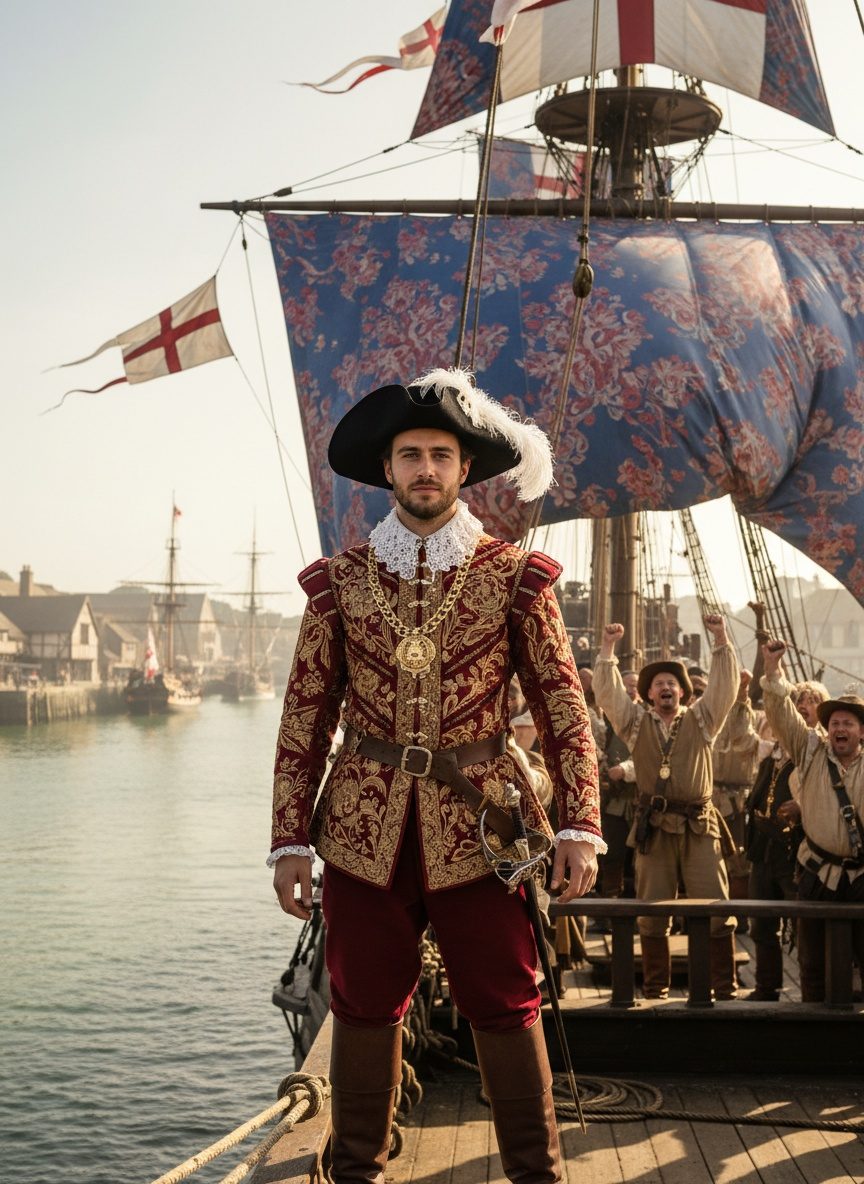
He was twenty-eight years old, and his vessel gleamed like no other ship on the seas. Its sails were woven from Chinese damask, a shimmering tapestry caught by the winds. Thomas Cavendish returned to England in a fashion that befitted an Elizabethan adventurer, redefining the boundaries of possibility.
The Unlikely Architect of Adventure
Despite his youth, Thomas Cavendish embarked on a journey that would cement his place in history. Born into a family of minor gentry in Trimley St. Martin, Suffolk, Cavendish was no stranger to privilege. However, financial difficulties spurred him towards the sea in search of fortune and reputation. Captivated by the tales of seafarers like Sir Francis Drake, Cavendish decided to attempt something no one before him had — to circumnavigate the globe not by chance, but by design.
Cavendish's ambitions burned brightly against the backdrop of Elizabethan England, a realm vibrating with maritime enthusiasm. Although he might have seemed an unlikely hero with limited naval experience, his intuition and daring made him more than just a man of inherited wealth. His expedition was meticulously planned, a testament to his aspiration to eclipse even the legendary Drake.
The Voyage Begins: From Hesitation to High Seas
On July 21, 1586, Cavendish set sail from England with a small fleet, his flagship being the Desire. While maritime voyages were perilous and unpredictably treacherous, Cavendish saw the world’s oceans as his path to grandeur. His decision to outfit his sails with luxurious Chinese damask and his men with gold chains was not simply a statement of success; it was a declaration of cunning and achievement.
The journey tested every ounce of skill and leadership Cavendish possessed. Navigating the vast expanse of the Pacific Ocean required shrewd decision-making and a fearless heart. Each port brought potential peril, from hostile Spanish forces guarding their American colonies to the ever-present threat of betrayal from the seas themselves. Yet, Cavendish and his crew persisted, plundering Spanish settlements and ships along the way, amassing wealth and goods previously unseen in England.
The Golden Ship: Riches Beyond Imagination
Arguably the most significant moment of his journey came when Cavendish captured the Manila galleon, Santa Anna, off the coast of California in 1587. It was a stroke of fortune, akin to finding a golden needle in an expansive maritime haystack. The Spanish galleon was laden with treasures from the Orient, including precious stones, spices, silks, and far more. The wealth further allowed Cavendish and his men to literally wrap themselves in gold and luxury, transforming their vessel into a floating city of opulence.
The capture of the Santa Anna was not just a coup in terms of treasure. It proved Cavendish’s tactical brilliance. Where others saw obstacles, he saw opportunity. His daring audacity and strategic cunning were qualities that no gold could buy, depicting him as a formidable figure whose reputation now glittered as brightly as his ship.
Homecoming: Triumph Amidst Tension
Returning to Plymouth in September 1588, Cavendish’s entrance was dramatic. As the news of his return spread, the ambiance in England was electric. His triumphant arrival coincided with another momentous event for the nation: the defeat of the Spanish Armada. While England found relief from foreign threat, Cavendish's homecoming was its own spectacle of imperial promise, a testament to individual valor in the high-stakes game of burgeoning empire.
His crew paraded through Plymouth, garbed in exotic silks, the air shimmering with tales of adventure. These men, who had once faced the fury of the seas and the specter of death, now embodied a new era of English ambition. The spectacle was not only a celebration of their accomplishments but also an assertion of England’s rising dominance on the global stage.
A Legacy Woven into Sailcloth
Cavendish’s successful circumnavigation did more than cement his personal legacy; it heralded a new confidence in England's maritime potential. His voyage set an example for future expeditions, inspiring explorers to unravel the world’s mysteries while boldly staking claims for their queen and country. Thomas Cavendish became a symbol of ambition that refused to be bound by the horizon.
Yet his life also serves as a cautionary tale. The wealth and fame proved as fleeting as the winds that carried his damask sails. Amidst the glory, the very forces that elevated him — ambition, daring, and conquest — would ultimately foreshadow his end. But for that singular moment as he returned to Plymouth, he encapsulated the untold legend of an England on the cusp of empire, charting its destiny with sails made of silken dreams.