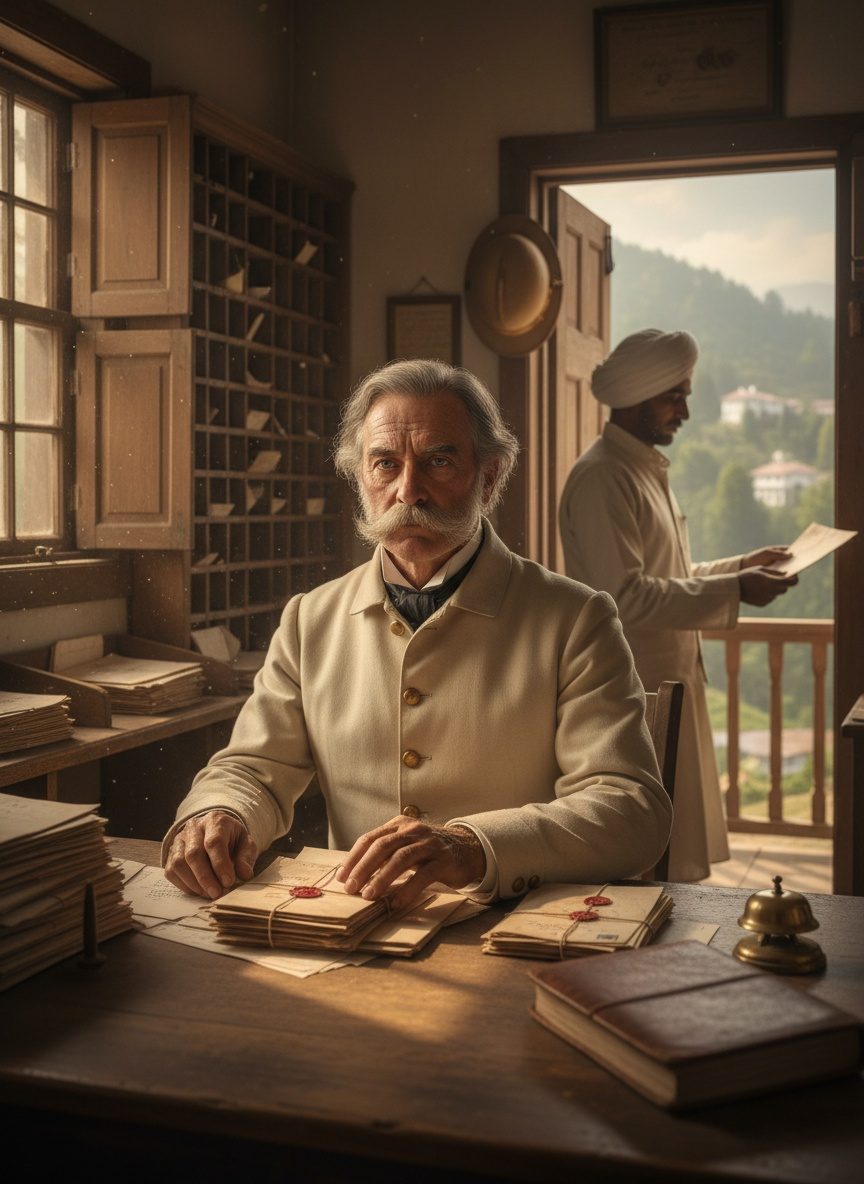
Most letters travel quickly. For the Raj's summer capital in Simla, they did not.
A World Built on Letters
In the summer of 1864, the British Empire's administrative core uprooted itself from the sweltering plains of India, making its annual pilgrimage to the cool sanctuary of Simla, nestled high in the Himalayan hills. Here, amidst the pine-scented air and sweeping vistas, life breathed easier. Yet, beneath the tranquil surface of this idyllic retreat lay a bustling nerve center, where the weight of governance and social life depended on the humble envelope. Everything meaningful rode on the scritch-scratch of pen on paper — letters that carried longing, love, and, at times, unbearable news over ten thousand tumultuous miles.
The Simla post office, modest in size but grand in its role, became a critical hub for communication. Overseen by a solitary postmaster, this modest facility was charged with the Herculean task of connecting a temporary city filled with expatriates to their distant homeland. Each day brought unassuming packets from far-off lands, each sealed letter an imprint of personal history and a conduit to the lives left behind. This solitary figure held a unique position of insight — a silent sentinel who knew the news of births before grandparents did, who carried the unfortunate missives of loss, and who knew which family's son had not written back.
The post office itself was hardly a building one would expect for the linchpin of an empire's communication. It was an intimate place painted in colonial white, with the aroma of fresh ink and sealing wax permeating its wooden walls. Through its doors, the clatter of horse hooves and the gentle thrum of human anticipation reverberated, echoing the timeless rhythm of hope and regret. In this northern refuge, it was far more than a stop for collecting mail; it was the lifeline that tethered expatriates to the loved ones in their motherland.
The Art of Waiting
Waiting was perhaps the unspoken art perfected in Simla. With summer days blending into each other, the gentle hum of anticipation filled households. The journey of a letter was perilous, a transcontinental trek that faced monsoon storms and rebellious uprisings in its path. When the daily dispatches from England finally reached the hill station, they were worn by time and travel, but the emotions within were still vibrantly alive.
In this intricate web of words and paper, the postmaster was a confidant to the stories unfolded in each letter he handled. Though he was sworn to silence — a vault for a town's collective consciousness — his role quietly shaped the social tapestry of Simla's summers. As each resident visited the modest post office, hope accompanied them and despair often left their side. At times, however, the most tender of experiences were encapsulated in a mere envelope: the first tentative promise of romance, the rekindling of familial bonds strained by distance, the parchment sorry for a loss they had not yet perceived.
To the officer's credit, his role went beyond the call of dutiful service. It danced on the edge of emotional stewardship, a delicate balance where he came to be both a medium and mediator. As much as he knew of official overseers and their political intrigues, he was steeped in the genuine pulse that beat through those thin layers of paper. Each letter seemed to echo with the nostalgia and dreams of England, creating a poignant tension between daily imperial tasks and personal yearning.
The Enduring Link
These letters served not only as personal connections but were the backbone of an era's intricate negotiations and maneuvers. Correspondence paved ways for landmark decisions and imperceptible influences that echoed throughout the empire. Yet the power of the letter was not in its political clout alone; it rested in the transformational ability to reduce insurmountable distances into the human scale. Each wax-sealed document bridged cultures, continents, and years, creating bonds that were more profound than any legislate decree.
Life in Simla inked itself into the broader history of the Empire with every incoming and outgoing letter. It was a choreography both complex and simple, carried out in the rolling hills above the vast Indian subcontinent. The paper forms held implicit faith in tomorrow — the notion that even the furthest-separated souls could still intertwine across the continuum of breath and ink. They shaped the texture of lives lived in realms and regions alien to home, capturing tales of triumphs, trials, and timeless truth.
In an era where distance could spell the end of affection, these delicate letters held a profound power, echoed in the silent corridors of Simla's post office. This connection, alive through ink and paper, was the heartbeat of an empire. It reminds us, even in our digital present, that none of the exchanges we now so easily take for granted were built on insignificance, but rather on a legacy of waiting, of knowing, and of longing — the very dimensions of what it means to be human.