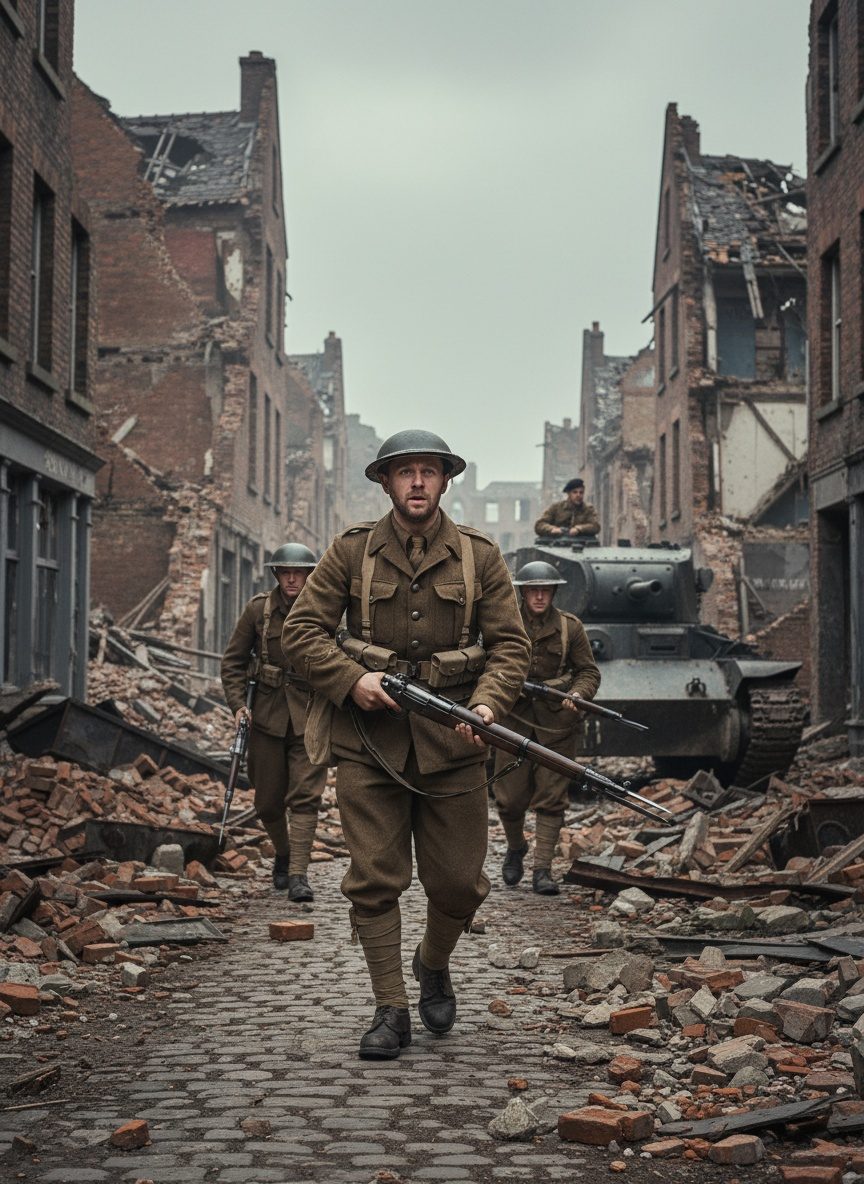
The mist lay heavy over the fields south of Lübeck, a lingering pallor that muted both the light and the sounds of morning. Underneath that dense fog, the landscape seemed to stretch endlessly into the ether, cloaked in a greyness that offered no hints of what lay beyond. In this stillness, broken only by the distant, muffled rumble of artillery, the soldiers took a moment to scan the horizon. For those on this forgotten edge of the war, each step forward was a journey into the uncertain scope of history’s last bloody siege. This isolated stretch, dotted with stubborn clutches of resistance, stood as one of the few remaining bulwarks of a crumbling Reich.
The Calm Before the Storm
In the waning days of the Second World War, time seemed to distort in the grim theatre of Europe—a continent on the brink of liberation not yet free from its relentless dread. The 2nd Battalion of the Wiltshire Regiment found themselves amid a fog that was both literal and metaphorical. These men were part of the ever-advancing tide of Allied forces poised to crush what was left of Nazi Germany’s defensive will. Yet, as they moved into position south of Lübeck on the 2nd of May 1945, they had no inkling of the war's imminent conclusion. Only the task at hand existed—clearing the path to Lübeck, silencing the last defiant echoes of a defeated regime.
Behind them, the mechanized might of the 6th Guards Tank Brigade loomed; their Churchill tanks, named for the indomitable British leader, were machines of resilience and firepower. The ground trembled under the weight of these armored behemoths, their engines a growling reminder of the destruction they could unleash. To any observer, this combination of infantry and armor was a fearsome sight, a testament to tactical perfection born from years of hard-fought lessons across Europe.
The men of the Wiltshire Regiment advanced slowly, their senses sharpened by the uncertainty that accompanied each cautious step. They knew the terrain, a flat expanse intermittently broken by copses of bare trees and villages that marked the ache of German soil—a soil that had borne witness to the march of armies for generations. The Wiltshires, veterans of campaigns in North Africa and Italy, bore these ghosts too, etched into their souls after years of relentless war.
An Ironclad Offense
As the fog lifted, it unfurled to reveal the scale of their task—stubbornly entrenched German troops, remnants of an army that refused to concede, lay waiting to defend the road to Lübeck. Though the veneer of the Wehrmacht’s might had cracked, the fighting spirit of its soldiers remained a potent force, buoyed by desperation and the distant sound of artillery that never seemed to fall silent.
The Churchill tanks advanced in concert with the Wiltshires, their steel carapaces echoing the hard resolve of the men they carried. Each tank was more than a tool of war; it was a mobile fortress, bristling with the implements of destruction that the Allies had honed over years of warfare. As they rumbled forward in unison, the tanks’ main guns would periodically bark alive, sending blasts into enemy strongpoints that refused to yield.
In contrast, the Wiltshires moved with a cautious agility, fanning out to cover and secure territory once the tanks had made their redoubtable presence known. They would take advantage of every lull, measuring their progress in yards rather than miles. Each step represented a steady erosion of German control, every paused breath a reminder of the lives riding on this collective push forward. Yet, in their hearts, skepticism remained. Rumors abounded about the end of the war, tantalizing in their hopefulness but ultimately dismissed as wishful thinking until official confirmation was received.
The Last Ground Taken
The struggle to clear the route to Lübeck unfolded in a gritty ballet of aggression and strategy. Infantry companies moved house to house, woods to woods, as they engaged pockets of fanatical resistance that had chosen to fight to the end rather than surrender. Here, the dance of war was an intimate affair, where courage intermingled with fear under an overcast sky. Those who bore witness to the Wiltshires and their Guards allies witnessed something more than a military operation, more than the advance of a uniform phalanx—they saw the spectrum of human emotion enacted on a grand stage.
Each maneuver carried the weight of an epochal shift. Unknown to those present, every fleeting victory would herald the inevitable collapse of the Nazi state. For the Wiltshires and the Guards, their mission was not to deal the final blow, but to place the last stones in the arc of fate that had shifted against the Axis. As the regiments forged their way into Lübeck, they laid bare the last thresholds of the German defense.
And then, as suddenly as it began, the roar of resistance ebbed. Messages started to wash through the ranks—unbelievable but undeniable—the conflict that had consumed so much of their worlds might finally be nearing its curtain. By the close of May 2nd, the air was thick not with the acrid fog of battle, but with a weightless anticipation. The moments stretched out, savored by every warrior for the release they ultimately offered.
So stood the men of the 2nd Battalion Wiltshire Regiment and the 6th Guards Tank Brigade, not as mere soldiers, but as witnesses to the end of an era. The road they cleared into Lübeck marked not just tactical achievement, but a monumental pivot toward peace. Their legacy speaks to the quiet resolve that turned the tide of history—a resolve too often overshadowed by the clamor of larger battles. In clearing that road, they paved the way not just for victory, but for a future shaped by the lessons of sacrifice and unity— a chance to walk down avenues not of conquest, but of rebuilding and hope.