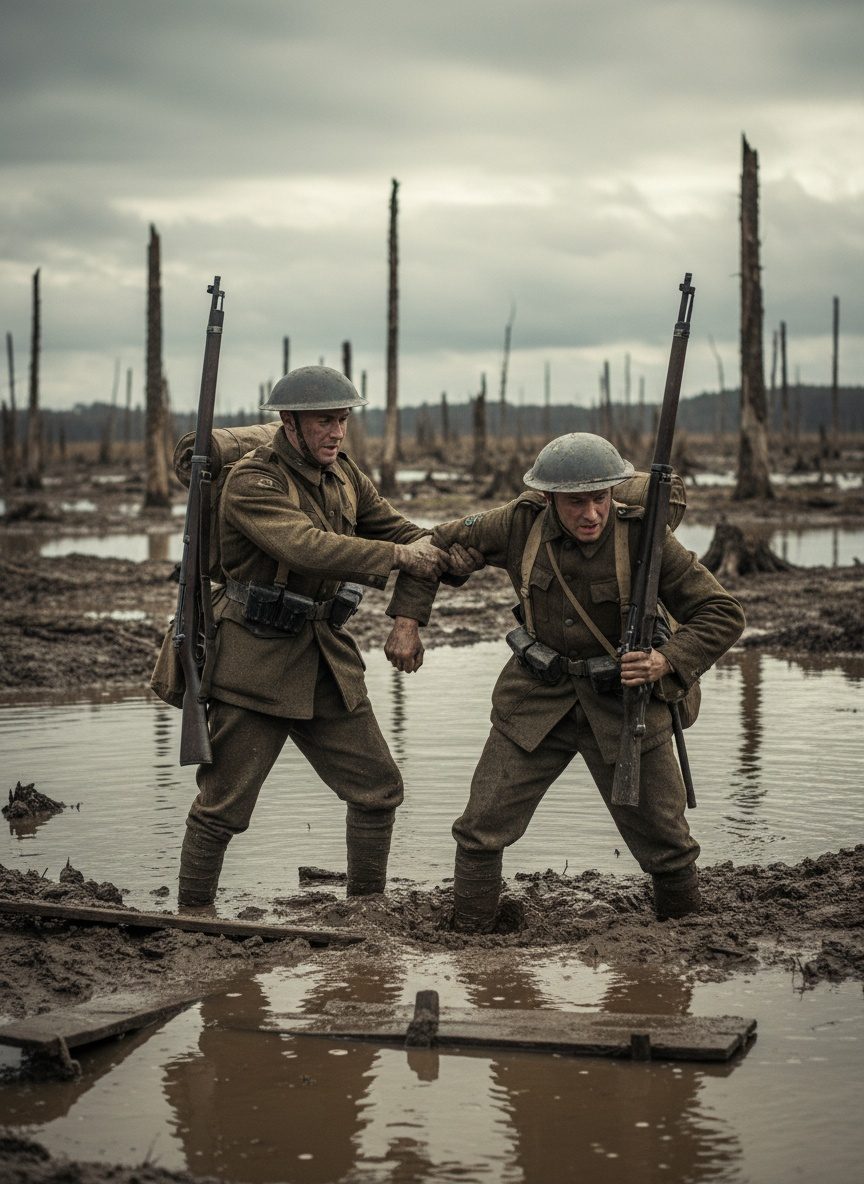
The muck clung to his boots with the tenacity of a starving beast. Each step sank deeper, sucking at his legs, pulling him down into the earth. The crack of artillery split the air to his left, but his eyes were fixated on the shimmering quagmire ahead—a sea of mud pockmarked by craters where men could disappear with a scream swallowed by the squelching ground. It was July 31, 1917, and the battle for Passchendaele had begun, not just against the German guns, but against the land itself.
Ypres, Belgium. The very name now synonymous with both courage and calamity. The battle here was supposed to signal a breakthrough; a decisive punch through enemy lines. Two weeks of relentless bombardment by British artillery were intended to obliterate the German defenses, tearing them open for the advancing troops. Instead, they pulverized the landscape beyond recognition. When the rains arrived, as though summoned by some wrathful deity, it transformed the battlefield into a monstrous parody of the world—an endless expanse of mud capable of drowning steel and spirit alike.
The intricacies of military strategy quickly devolved into chaotic improvisation as soldiers stumbled through the thick, treacherous sludge. The rain came in torrents, weaving a constant gray curtain that blurred the lines between friend and foe, between ground and sky. The ground—already saturated from the unceasing barrage—could no longer hold. Trenches collapsed, becoming waterlogged morasses of despair where even a seasoned soldier's grit was not enough.
The born-again landscape felt almost sentient, a shifting, grim leviathan. Men trudged with the grim knowledge that a single misstep could prove fatal. Shell craters, hidden beneath the brown murk, became stagnant pools that devoured any who faltered. Those who fell in faced a horrific struggle; the mud acted with the hands of a drowning man in reverse, pulling victims under rather than letting them swim free. Tales spread through the ranks like wildfire, speaking of comrades enveloped by the earth itself, claimed by the battlefield before an enemy bullet could find them.
Stories emerged, too, of unexpected saviors among the mire. Mules, lesser-sung heroes of the Great War, strained under burdens that no man could bear, traversing the mud with a stubbornness that defied the elements. They hauled supplies, artillery, and the wounded over terrain that should have repelled all hope of passage. Yet even these steadfast creatures were not immune to the ground’s hungry grasp, sometimes refusing to move forward, their instinct warning them where men could not fathom.
Human ingenuity, limited though it was in such conditions, found ways to resist. Soldiers began using duckboards, wooden planks laid over the mud to provide some semblance of a stable path. Walking across these precarious walkways required dexterity and nerve, each step placed with the care of a surgeon lest they fall into the abyss below. But even the best efforts to stay dry and secure were often undermined by artillery shells that obliterated what meager infrastructure existed.
As the weeks dragged on into months, the desperation increased. Reports flowed back home of battlefield horrors seemingly too grotesque for reality. Men who had trained and drilled for traditional combat found themselves enduring a protracted dance with death in the most inhospitable of settings. Veterans of Passchendaele would later speak of the incessant rain that painted the landscape in tones of despair and the ceaseless mud that was not just an annoyance, but an omnipresent nightmare capable of engulfing even the fiercest soul.
Against this hellish backdrop, valor and futility intertwined. The deadlocked push for Passchendaele yielded stories of unimaginable bravery. Men leaped into action not just against the enemy, but against a pitiless environment that seemed determined to claim all life. Amidst the deafening roar of war and the silence of mud, they fought with resolve, sometimes advancing inches that felt like miles, never knowing if the earth itself would become their unholy sepulcher.
The campaign trudged on until the eve of November, when the village of Passchendaele was finally seized. Yet in those three grueling months, the earth had redefined what it meant to be a soldier, reminding them that Mother Nature wielded her own artillery—unpredictable and indiscriminate. The cost of this Pyrrhic victory was staggering, the toll marked not only by the lives lost but by the countless more who returned home carrying not just physical scars but the indelible weight of a battlefield transformed into a living nightmare.
As time marched on, the battle of Passchendaele slipped respectfully into the annals of history, a testament to human resilience and the capriciousness of fate. Today, it stands as a somber reflection on the limits of man’s ambition when faced with the brute force of nature unfettered. It serves as a grim reminder that war is not waged in isolation from the land it touches, and sometimes, the mightiest adversary is not flesh and blood but mud and rain. This is why Passchendaele matters—not just for the lesson in strategic folly, but for the echoes of courage heard through the whispers of the mud. The battlefield that swallowed men whole remains a silent witness to the endurance of the human spirit against nature’s rage.