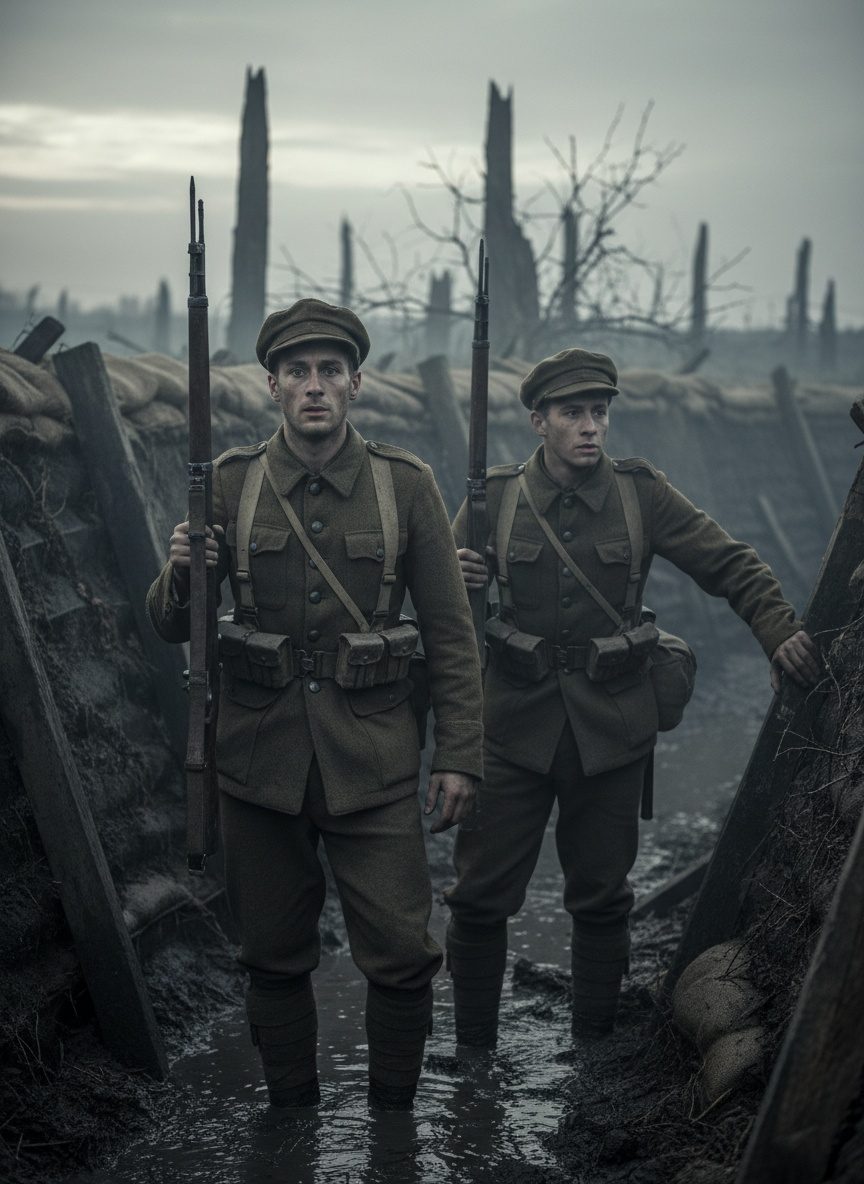
He was only a trench soldier, drenched in mud and exhaustion. Before that November, he had never imagined holding the line meant standing in water for days, fighting not just the enemy, but the earth itself.
The Waterlogged Battlefield
In November 1914, the fields of Flanders became the ultimate test of human endurance, as the onset of harsh weather conditions turned the landscape into a quagmire. The Great War's inhumanity wasn’t just in the fierceness of conflict, but in the churning mud of the Ypres salient, claiming the unwary and the unlucky. The 1st Cameronians, a Scottish regiment with a storied history, found themselves mired in this watery hell. Ordered to hold a flooded trench that barely qualified as such, these men were thrust into circumstances that defied the conventional image of warfare.
The trench was no protective ditch but a grave dragging with icy fingers. Shells from enemy artillery blasted repeatedly, causing walls to cave in and turn into mudslides. The 1st Cameronians stood their ground in waist-deep, bone-chilling water, often swept off their feet by the cascade of muck. Their clothing clung to them, their boots laden with water and mud, making every movement a struggle. Yet, they continued to stand their ground, driven by duty, a sense of history, and sheer willpower.
Historians tend to highlight the brutal infantry charges and heroic stands, often overlooking the more mundane, insidious killers — hypothermia, trench foot, and sheer exhaustion from such conditions. The men drowned not from the enemy’s bullets, but by the earth they sought refuge in. In these unyielding floods, the 1st Cameronians displayed a fortitude that, though often omitted from textbooks, forms the unwritten backbone of military valor.
A Trial by Water
The story of the 1st Cameronians is inherently about survival against all odds. Imagine standing shoulder to shoulder in an overfilled ditch, shivering uncontrollably as freezing rain mercilessly pelts down, interspersed with the jarring thuds of explosions. Food and supplies ran thin, while replenishment remained a distant hope. The men were reduced to scavenging whatever scraps remained, sharing what little warmth human companionship could afford. Each moist breath was a fleeting signal of resilience, every smudge-coated face a silent testament to indomitable spirit.
As the days dragged on, the relief that was anticipated seemed increasingly unlikely. Discouragement nipped at their heels as their resolve was wrung from them by every soggy hour that passed. The engineers’ attempts to siphon off water were battered by the continued shellfire, and their conditions deteriorated further. Communication lines often sloshed to silence, and the drip of water from soaked helmets was the only sound beyond the distant rumble of conflict.
Yet faced with despair, there surfaced acts of quiet heroism. Men reinforced each other with shouts of encouragement, offered shoulders to lean on, and smiles in the face of adversity. It wasn’t until six days later that the 1st Cameronians saw respite. Reinforcements eventually arrived, but by then, many had succumbed to the trench’s inescapable peril, little markers along the strewn earth recalling their sacrifice.
The Invisible Conflict
The battle for the Ypres trenches encapsulates what is often obscured by broader narratives of WWI: the war within the war. Whereas history often glorifies battlefield heroics, rarely does it acknowledge the simple act of enduring. For the 1st Cameronians, the realm of conflict was an unglamorous pit of mud and misery, yet it was here they displayed the most profound of all triumphs — the human spirit’s resilience even when victory seems improbable.
The events around the Ypres salient serve as a vivid reminder that bravery does not always involve going over the top with a bayonet in hand. Sometimes it is the silent suffering, the refusal to yield to the elements or despair, that defines true courage. In the endless slog of rain-soaked days and frigid nights, the 1st Cameronians embodied the determination that defies easy quantification or honor yet remains crucial. The mud of Flanders was a silent, treacherous enemy that claimed many, but it was also the arena of an invisible conquest — a stance against the odds, unrecorded in texts, yet etched in the annals of the heart.
Such stories incorporate the broader human experience into the tapestry of war, highlighting the conditions that innumerable soldiers faced but few lived to recount. The 1st Cameronians' tale is a reminder of the overlooked struggles of those who stood firm in the face of adversities that were both brutal and banal. In the trenches of history, it is these ephemeral acts of endurance that whisper the loudest, urging us to remember the depth of their sacrifice and to honor the unsung battles that shaped the outcome of a world at war.