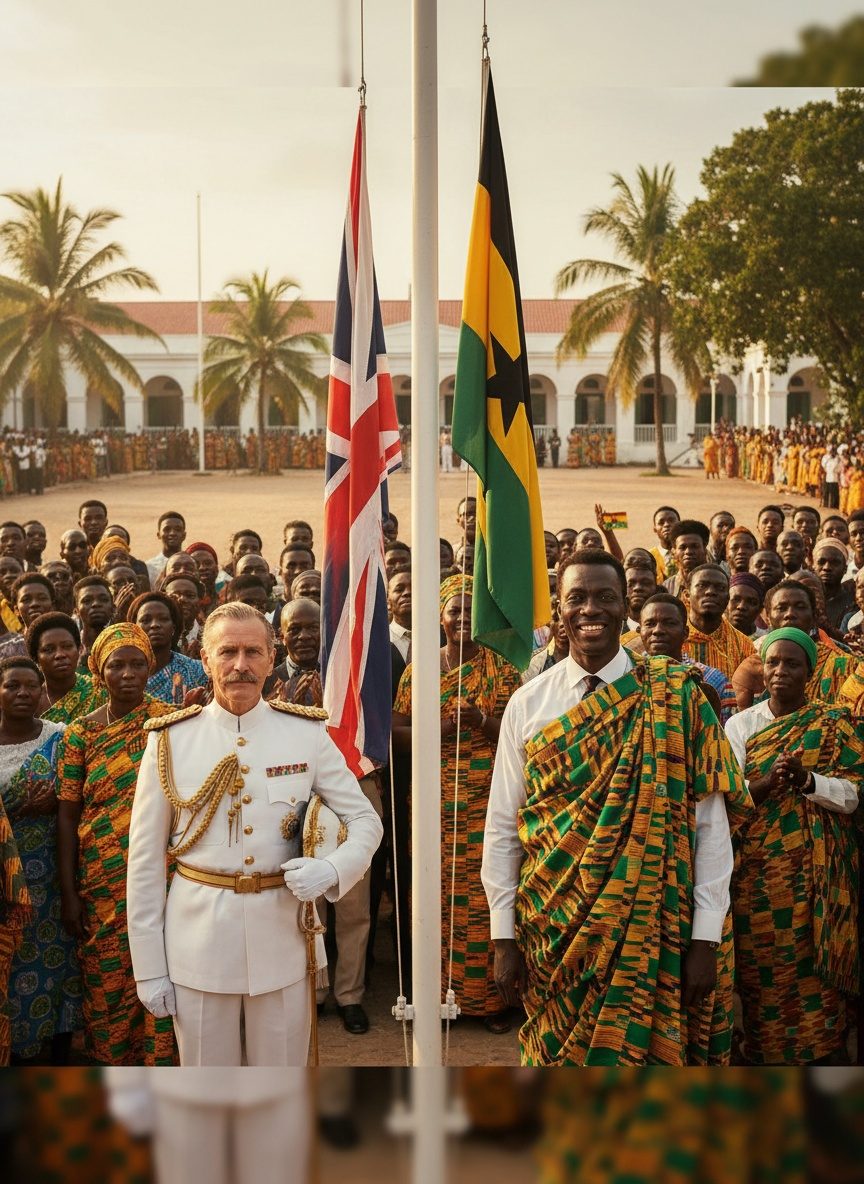
He was a British aristocrat. Yet, his tearful farewell to a young African nation was genuine and heartfelt.
The Last Days of an Empire
March 1957. On a humid day in Accra, the excitement was palpable. Thousands gathered, their spirits buoyed by the promise of true autonomy. The Gold Coast, a British colony since the 19th century, was to become Ghana—an independent nation. In this charged atmosphere, Sir Charles Arden-Clarke, the last British governor of the Gold Coast, prepared to perform a task unlike any before in his career. His mission was clear: to ensure a smooth transition of power to the man he had once jailed for sedition, Kwame Nkrumah.
Arden-Clarke’s governorship began during a tumultuous period. In 1946, amid growing demands for independence across African territories, Britain’s hold on its colonies was slackening. During Arden-Clarke’s tenure, the Gold Coast simmered with both anticipation and unrest. It was a time of fervent nationalism, with Nkrumah emerging as a prominent and sometimes incendiary figure leading the charge for self-governance.
A Governorship Like No Other
For seven years, Arden-Clarke remained at the helm of the Gold Coast, navigating a landscape rife with political upheavals. His approach to governance marked a departure from the heavy-handed tactics of some of his predecessors. Instead of meeting nationalist demands with repression, he opted for dialogue and understanding—a choice not always favored in colonial circles. He recognized the winds of change.
In 1950, just a year after he became governor, Arden-Clarke faced a critical moment. Kwame Nkrumah, the vociferous leader who was agitating for independence, had been imprisoned by Arden-Clarke for his political activities. Yet, only three years later, the governor seemed to grasp a radical concept: you don't imprison the future. By 1954, he had released Nkrumah, positioning him as a key political partner rather than an adversary.
Such a decision was revolutionary. Nkrumah, now emboldened and out of prison, went on to win the overwhelming support of the Gold Coast's people. It became clear to Arden-Clarke that the inevitable path was towards independence, and he, unlike many colonial administrators, openly supported this transition.
The Handshake That Made History
As the clock ticked towards midnight on March 5, 1957, the city of Accra buzzed with a blend of jubilation and uncertainty. The Union Jack, symbol of British imperial might, was to be lowered for the last time. As the new flag of Ghana took its place, a profound silence enveloped the throng. Sir Charles Arden-Clarke, with a lump in his throat and a tear in his eye, approached the podium.
There, he stood next to Kwame Nkrumah—the former prisoner now hailed as a liberator. As the strains of the national anthem rang out, marking the birth of Africa's newest nation, Arden-Clarke extended his hand to Nkrumah. The handshake that followed was more than ceremonial; it embodied reconciliation, progress, and the peaceful transfer of power. It was a moment that defied the long history of colonial animosity—a harbinger of hope and cooperation amidst the shadows of an empire's end.
The Dawning of Ghana
The newly minted Ghana held powerful symbolic importance. It was the first sub-Saharan African colony to shed its colonial chains and declare independence. In the eyes of the world, and most importantly of Africa, Ghana's birth signaled a new era. It was not just a celebration of freedom but a declaration of possibility—that Africans could govern themselves, shape their destinies, and redefine their identities.
For Nkrumah, this moment was the culmination of years of relentless struggle. His vision for Ghana transcended mere political independence; it was a call for economic freedom and cultural renaissance. With his charismatic leadership, Nkrumah aimed to inspire neighboring colonies to pursue their own sovereignty, crafting a narrative of Pan-Africanism that would resonate across the continent.
At the forefront of this movement stood Arden-Clarke, championing the support of Britain's parliament for the new Ghana. His advocacy for a fair and peaceful transition for the Gold Coast did not go unnoticed and set a precedent for other colonial territories seeking freedom.
The Legacy Beyond Borders
When Sir Charles Arden-Clarke relinquished his governorship, he did so with a melancholic acknowledgment of history's favor shifting beyond the British Empire's grasp. Yet, his departure marked more than just the end of an era. It redefined the narrative of colonial withdrawal, showing that compassion and foresight could reshape the relationship between imperial powers and their former colonies.
The significance of that moment resonates in today's world, where the notion of reconciliation continues to challenge modern political discourse. Readers might wonder how different the world might look if more departing colonial leaders had followed Arden-Clarke's example of humility and collaboration. The Gold Coast's transformation into Ghana was not just the passage of a baton—it was an opportunity for introspection and justice.
As flags change and empires evolve, the story of Kwame Nkrumah and Charles Arden-Clarke remains seared into history. It teaches us that the bonds of governance can transform, that old wounds can heal, and that every handshake between leader and liberator, once fractured by cultural divides, is a promise of unity.