The Union Jack came down over Kuala Lumpur. It was not the end of everything.
A World on the Brink of Change
The sun rose over Kuala Lumpur on the 31st of August 1957, casting golden rays across the assembled throngs in Merdeka Stadium. This was no ordinary dawn; it was a day that would be etched forever into the annals of history, a day when an entire nation would step into the light of self-governance. Among the dignitaries present were Tunku Abdul Rahman, the soon-to-be Prime Minister of a fledgling Malaysia, and Sir Donald MacGillivray, the last British Governor of Malaya. Their presence signified the day's paradox – a celebration of independence for some, a graceful exit for others.
As the final strains of God Save the Queen faded into the warm morning air, anticipation and emotion mingled. For more than a century, Britain had woven its influence into the fabric of Malaya's landscape, cities echoing with the remnants of colonial rule. Rubber plantations stretched like green seas under the tropical sun, railways snaking through the dense jungles, and ports bustling with commerce had all borne the capitalist fingerprints of the Empire. British rule had undeniably left its mark, for better or for worse.
Yet, against this backdrop of imperial history were stories less frequently told. The inhabitants of Malaya, deeply diverse and robust, woven with threads of Malay, Indian, and Chinese heritage, had steadfastly nurtured their cultural identity. British administration, with its staunch proponents of order and efficiency, faced protests and discontent stirred by nationalist movements. Through decades of negotiation, promises for gradual independence had been made, and now, at last, that solemn promise was about to be honored. Sir Donald MacGillivray, poised and dignified, stood at the center of this delicate transition, a symbol of an ending rather than a termination.
The Ceremony of Transformation
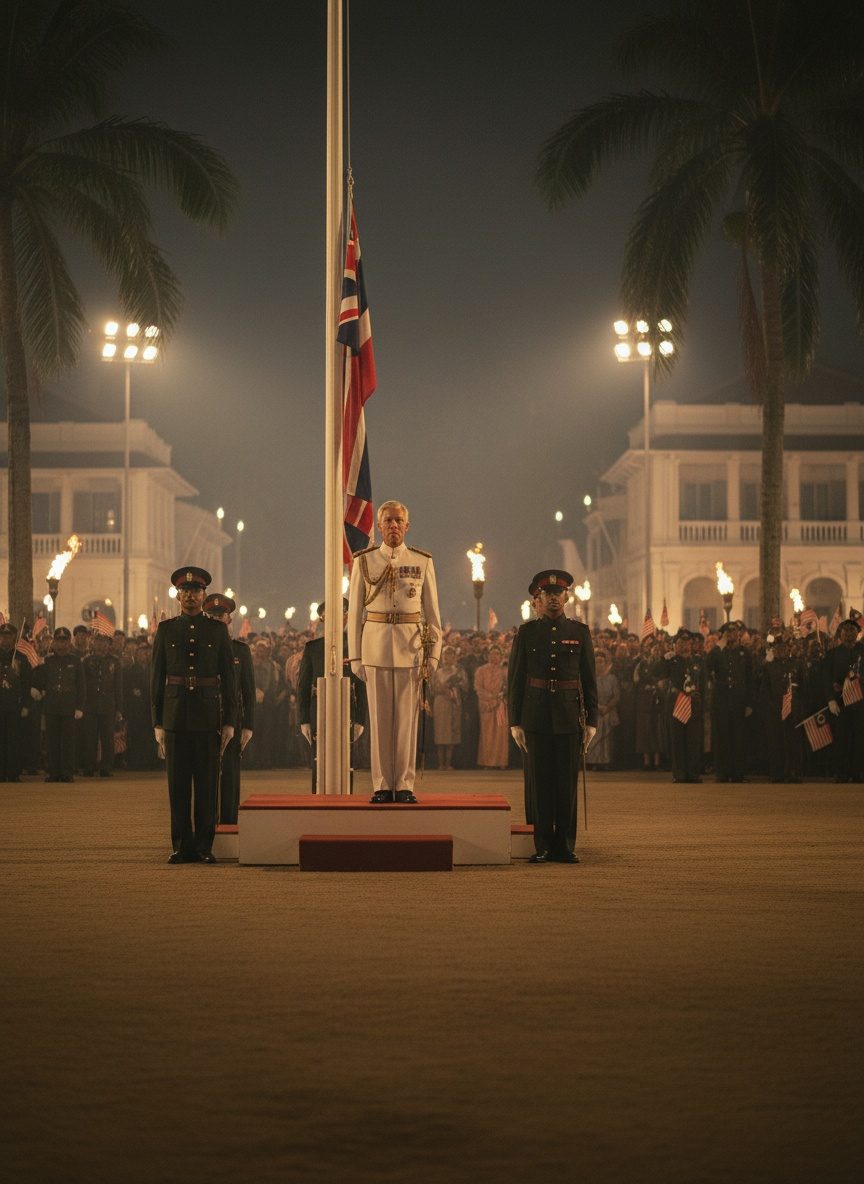
The flagpole stood as a timeless sentinel, waiting for the moment that would change everything. Thousands of eyes were riveted on the ropes holding the Union Jack aloft, where the symbol of colonial dominance had fluttered for decades. The ceremony was meticulously orchestrated, with every movement steeped in symbolism and intent.
Amidst this choreographed orchestration, Sir Donald MacGillivray's presence was calm yet profoundly significant. Erect and stoic, dressed in the impeccably pressed uniform of his office, he represented not just his post but the countless stories and lives caught in the empire’s wake. As the governor, it was he who had been tasked with navigating the complexities of independence negotiations—negotiations that were challenging yet necessary, seeking to stitch together disparate ideologies and expectations into a viable future for Malaya.
At the pivotal moment, the Union Jack began its descent. Attendees felt the weight of history pressing upon their shoulders—the descent of an empire, an offering of good faith, and the hopeful dawn of a nation striving to chart its own path. In the silence shared between echoes of past triumphs and murmurs of future achievements, MacGillivray did not look away. His composed expression veiled what many described as a surge of emotion; a rare tear might have glinted momentarily in his eye as the flag reached its journey’s end.
Immediately, another flag—Malaya's own standard—rose with grace and silent authority. The roar of the crowd swelled like a wave collapsing over the stadium, voices raised in cries of merdeka, “freedom,” louder than ever before. It was a moment heavy with jubilant hope but edged with the bittersweet knowledge of separation and an uncertain future.
An Ending Giving Birth to Beginnings
As Sir Donald MacGillivray prepared to leave his post for good, the symbolism of his quiet demeanor was undeniable. There was no air of defeat, no resentment for what had transpired. Instead, there was recognition—perhaps appreciation—of the inevitable tides of history. MacGillivray’s departure was not marked by grand proclamations but by a simple salute to the raising of Malaya’s flag, an acknowledgment of a commitment fulfilled to both his own nation and to Malaya.
The journey to this point had not been an untroubled one. Post-war aspirations, political complexity, and socio-economic challenges had tested the resolve of both nations. Yet, the moment was a testament to how such transitions, no matter how intricate, could be navigated with dignity and respect. The governor’s silence spoke volumes where words would have faltered. It was an understated nod to all the lives entwined with the British Crown, of triumphs and tribulations, of shared fates now setting upon distinct journeys.
In the broader tapestry of decolonization, Malaya was crafting its narrative, a chapter resounding with the voices of its people, not as a tale of descent into chaos—as some had feared—but of poised steps into modern statehood. What transpired that August day in 1957 was more than mere independence; it was a harmonious nod to the past intertwined with bold strides toward an uncertain, yet promising future. To see the British flag descend for the last time was a moment pregnant with meaning—a tangible end, yet a beginning nurtured in hope and mutual respect.
Today, amidst the changing tides of global dynamics and the legacy of that era, Malaya’s story remains a potent reminder of how history is lived. It’s a testament to the deftness of human spirit, the fluency of narratives shared between colonizers and the colonized, contributing to the broader human chronicle. Just as Sir Donald MacGillivray did not look away, we too are invited to look back—not from sentiment or nostalgia, but with clarity and understanding towards what was, what is, and what might yet be.