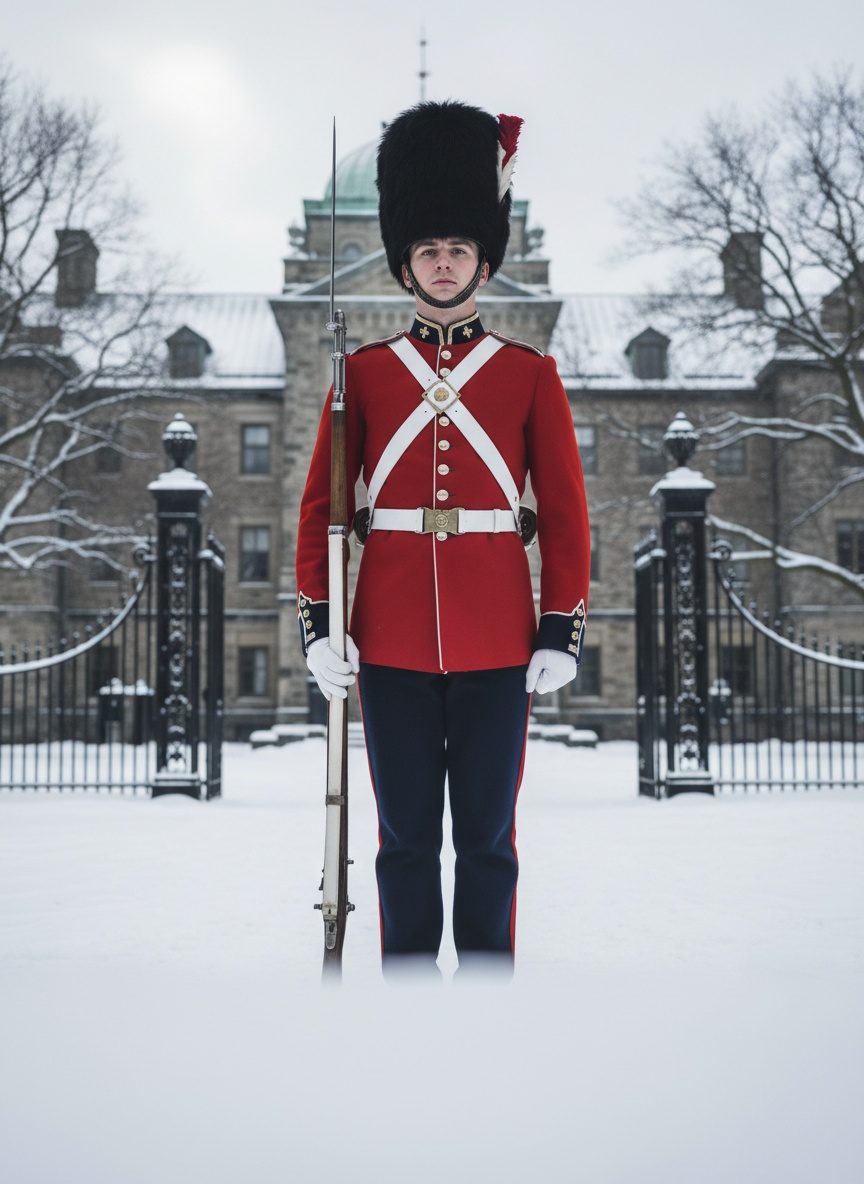
Canada was a new Dominion in 1867. It seemed like an old colony in a fancy suit.
The Scarlet Statement
In the early days of confederation, as the nation sought to define its identity, the creation of the Governor General’s Foot Guard was not merely an act of military organization but a dramatic theatrical production. This new guard, modeled on the storied Grenadier Guards of Britain, was Canada’s sartorial salute across the Atlantic, declaring its allegiance with crimson flair and ceremonial might. The guards donned the red tunics and bearskin caps that were as symbolic as the burgeoning nation's new confederate status.
The logic was simple: if Canada was to be taken seriously on the world stage, it needed the symbols to match its aspirations. The Guards were a striking visual testament to Canada's ties with Britain, ensuring from the outset that the Dominion looked every bit the part of a loyal extension of the Empire. Each ceremonial stride along the cobbled pathways of Rideau Hall echoed with an inherited sense of duty, a vivid reminder of the colonial force that shaped so much of Canadian life.
The Pageantry of Loyalty
To be a member of the Governor General’s Foot Guard meant embodying a profound connection, not just through dress but in demeanor. The history of the Foot Guard was steeped in a rich blend of British tradition and Canadian flair. Modeled scrupulously to resemble the famous guardsmen of the United Kingdom, these soldiers didn’t just carry rifles; they carried the weight of British heritage and Canadian aspiration on their shoulders.
Touchstone events in Canadian life were graced by their presence. From royal visits to national celebrations at Rideau Hall, the Guards were both an emblem of duty and a magnet for public admiration. Their duties extended beyond the purely ceremonial; they were also a subtle assertion of order in a city finding its feet. It was an exercise in optics; to the world and to Canadians themselves, those vibrant uniforms said, “We are more than lumberjacks and fur traders; we are a nation under watchful protection.”
The Men Beneath the Bearskins
While the Guards’ presence projected an air of regality and continuity, the men themselves were diverse and often ordinary citizens thrust into positions of guarded honor. Among their ranks could be found farmers, clerks, and craftsmen—a cross-section of Canadian society embodying the very essence of the nation’s young spirit: industrious, loyal, and aspirant.
Training was rigorous, instilling not only military precision but fostering an esprit de corps that transcended social and economic lines. Yet under the looming shadow of their impressive bearskin caps, these guardsmen were a mosaic of personalities and ambitions. To Canada’s citizens, they were more than just symbols, they were husbands, sons, neighbors; individuals interwoven with the community fabric yet distinct in their role, symbolizing unity and vigilance in a new world.
A Brass Band Legacy
The ceremonial flair did not end with uniforms and marches. The soul-stirring sounds of their regimental band became the soundtrack of many a Canadian event. The brass and reed resonances were more than mere accompaniment; they were the call-to-arms of a culture eager to harmonize old ties with burgeoning freedoms. People gathered not just to see the Guards but to hear them, as their music weaved patriotic pride with the harmony of newfound independence.
Through balls, ceremonies, and parades, the Governor General's Foot Guard and their music signified Canada’s duality: a brimming sense of nationhood inextricably linked with an empire’s grand narrative. Their presence and sonorous performances left marks on the collective Canadian memory. They served as reminders that the nation’s roots were mixed and reminding all who watched and listened that the essence of Canada could never stray far from its origins.
In retrospect, the Governor General's Foot Guards were more than a ceremonial show of allegiance; they were a reminder of identity amidst transformation. As Canada navigates its plurality and autonomy today, the story of those early Guards at Rideau Hall prompts a reflection: beneath every bearskin cap and scarlet coat lies a narrative of nation-building, resilience, and legacy. The Guards’ legacy, with its blend of pomp and duty, offers insights into how symbols shape, and continue to shape, a nation’s journey toward maturity.