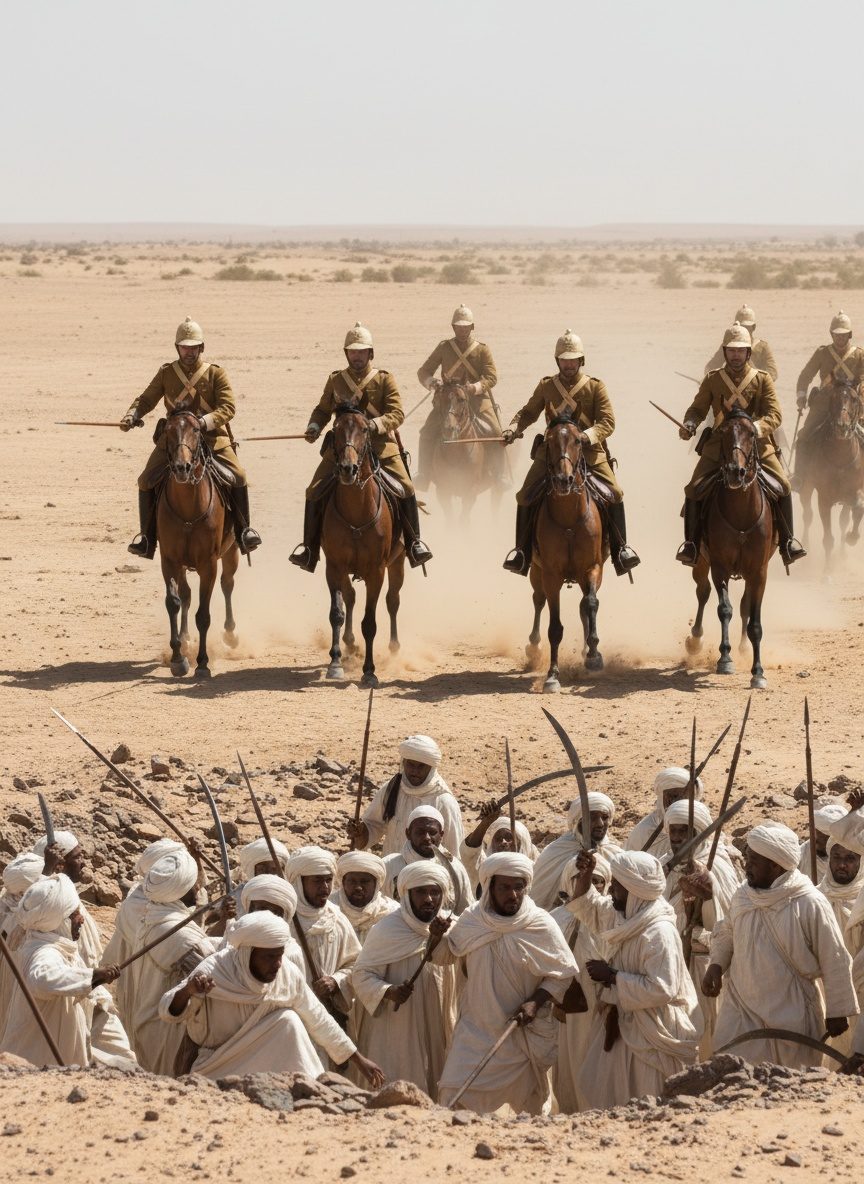
The thunder of hooves roared like a tempest, and the earth trembled beneath the charge. Dust clouds rose, swallowing the horizon as the 21st Lancers leaned into the gallop. Their mission was clear—charge down the dry riverbed and clear the way for the advancing British forces. But as their steeds pounded toward the unseen obstacle, the Lancers were on a collision course with a terrifying truth buried beneath the sand.
This dry riverbed, deceptively innocuous from a distance, was a trap laid with alarming precision. The path the Lancers chose was already a funnel, guiding them unwittingly into the jaws of an ambush. As they thundered forward, the ground seemed to part, revealing a dense mass of human fury. There, beneath the cover of the earth, emerged the fierce warriors of the Mahdist Army, 2,000 strong and ready for the reckoning.
What followed was a scene of chaotic brilliance that words scarcely capture. The moment of realization spread like wildfire through the Lancers' ranks, but braking a galloping horse is no immediate task. The initial barrier was the shock—thrown men, falling mounts, cries of anguish mingling with the clash of steel on spear. This was not a mere skirmish; it was a slaughterhouse under the unrelenting African sun. In just 120 breathless seconds, 21 men lay dead, cementing the encounter as the bloodiest for their regiment at the Battle of Omdurman.
Yet, amid the grim tally of life lost, there flickered tales of incomprehensible courage. The regiment's resolve did not crumble; instead, it steeled itself. Even as troopers were knocked from their mounts or skewered by the fierce Dervish spearmen, others pushed forward, driven by a sense of duty and the instinctual need to protect their brothers in arms. It was here, in the shadows of impending defeat, that the seeds of legend took root. Three Victoria Crosses would eventually be earned that day, each a testament to valor transcending instinct.
The atmosphere was suffused with adrenaline, as if the desert itself had conspired to see this moment, to witness the epitome of human struggle against insurmountable odds. The British Empire's cavalry, caught in a paradox between the romantic image of chivalrous cavalry charges and the horrifying reality of modern guerilla warfare, found themselves redefining courage. One could almost hear the clang of medals being forged amid the clamor of chaos and bravery.
When the dust settled, the landscape was a tableau of devastation; lifeless figures dotted the horizon, interspersed with the fallen steeds. Survivors regrouped, many bearing fresh wounds—a visceral mark left by their ordeal. The Lancers who returned to the fray, defying instinct for self-preservation, were not simply soldiers but harbingers of an era that still sought meaning in valor despite the encroaching shadow of mechanized warfare. Their bravery resonated through the ranks, a balm to the wounded pride and spirits staggered by the unexpected ambush.
This clash not only seared an indelible mark on military history but also exposed the often-glaring gaps in intelligence and the dangers of hubris within the British ranks. Here, more than on any field, the limitations of Victorian military strategy were laid bare—a sobering reminder that no empire is immune to the chaos of unforeseen combat. The charging 21st Lancers, their ranks decimated, had unwittingly unearthed a fundamental truth of war: that the strength of empire is often tested at the fringes, where the enemy lies unseen, waiting with an ancient patience.
Beyond the battlefield, the tale of the 21st Lancers' fateful ride into the hidden army is imbued with deeper questions about imperial ambition and the very essence of heroism. It evokes introspection about the nature of loyalty and sacrifice, and the complex motivations that drive people to risk everything in the crucible of combat. History, often penned by the victorious, must not overlook such episodes where valor is forged as much in defeat as in triumph.
In remembering the specter of the 21st Lancers charging toward an invisible foe, we are reminded of the fragile veneer that separates strategy from chaos, ambition from recklessness. The Battle of Omdurman stands as a somber tableau of the costs of military miscalculations and the human spirit's defiance against overwhelming odds. Such stories, left out of textbooks but captured in whispered legacies like those of the 21st Lancers, underscore the profound and often untold narratives of empire—a testament not just to the might of the victors, but to the eternal complexities of the human condition.