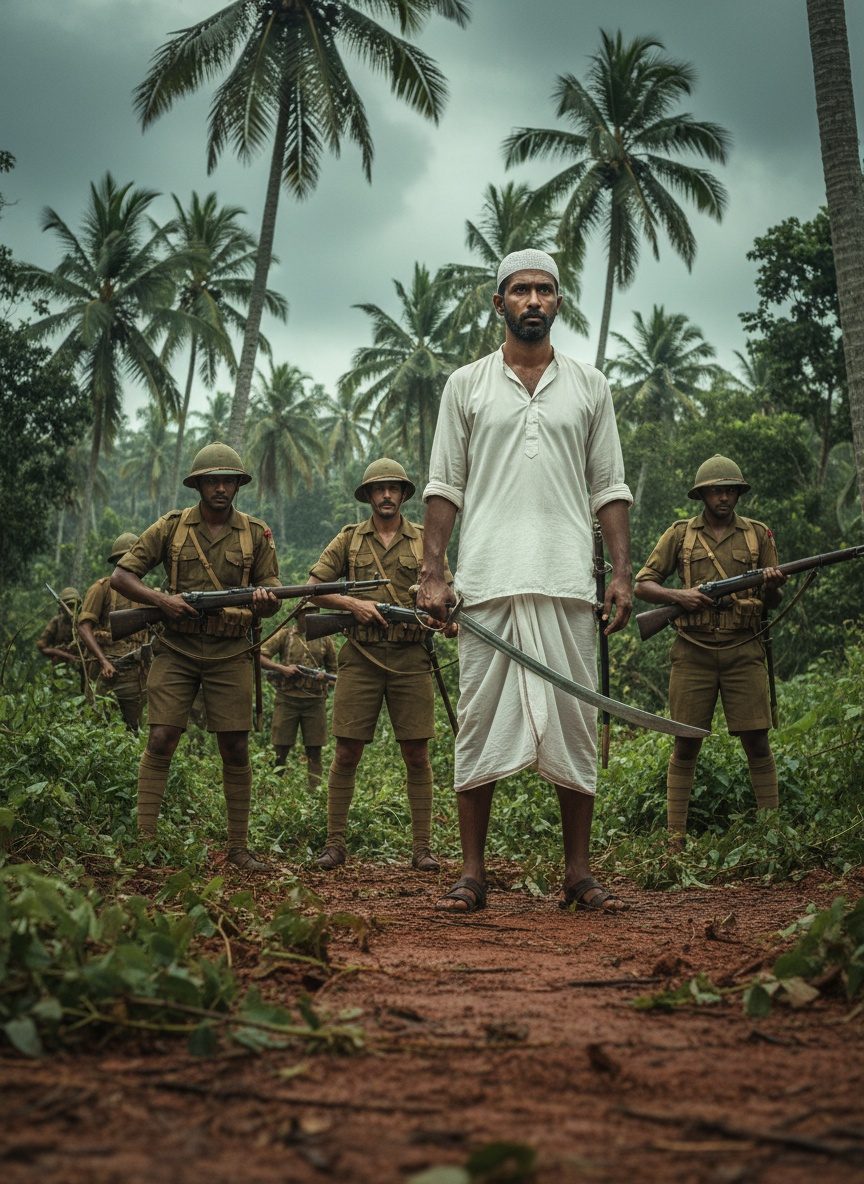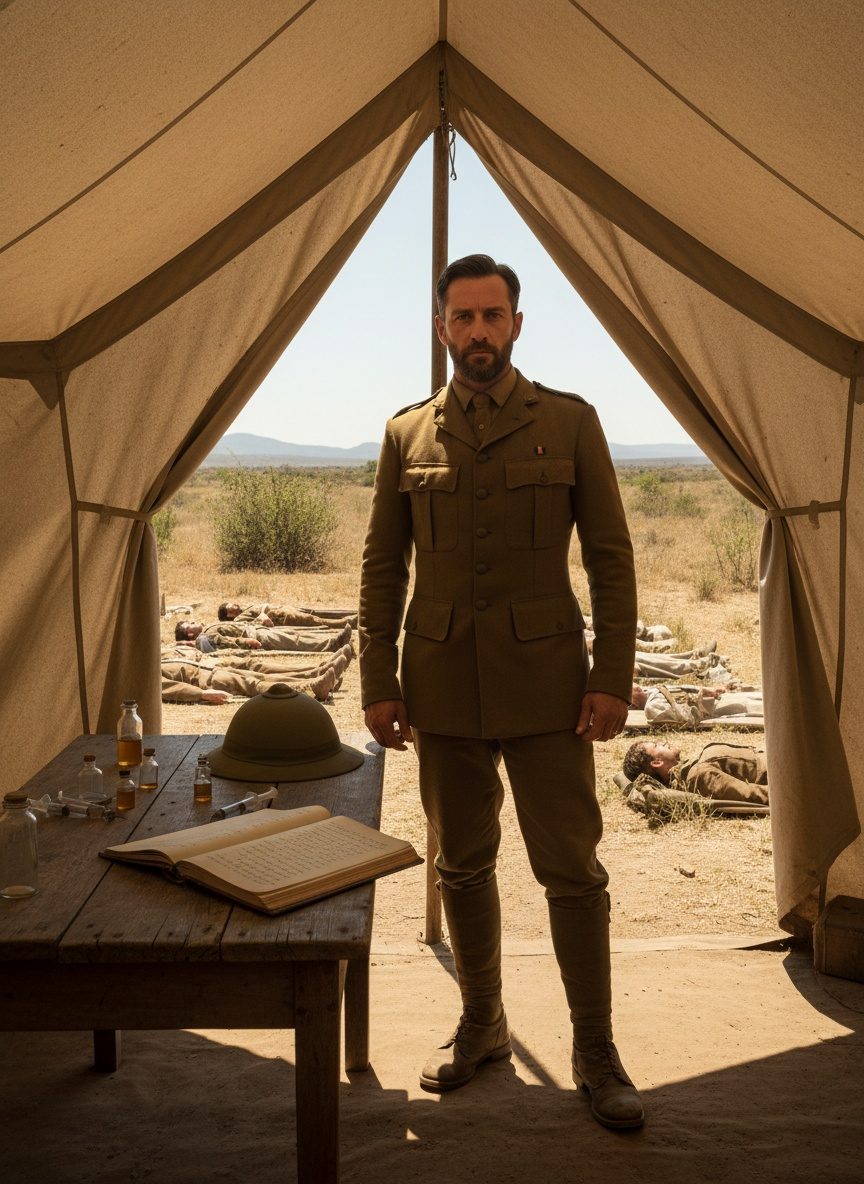
Almroth Wright vaccinated himself against typhoid. The British Army ignored him and lost thousands of men to the disease as a result.
Almroth Wright: A Man of Medicine and Conviction
In the prelude to the grim realities of the Boer War, a silent scientific revolution was unfolding in the mind of Almroth Wright. A pioneer of bacteriology and immunology, Wright was on the brink of a discovery that promised to save countless lives: a vaccine for typhoid fever. Contrary to popular tales of vanished empires and courageous soldiers, this tale centers around a laboratory rather than a battlefield, and it’s a story defined by foresight and tragic neglect.
Wright's determination was born from an era when infectious diseases claimed more lives than any enemy bullet. The numbers were stark and sobering: more British soldiers died of disease than combat during the Boer War. Armed with this knowledge, Wright developed an experimental typhoid vaccine, ready to be deployed as a shield for the men marching into the South African veldt. The vaccine had already proven effective in trials, its potential to prevent devastation waiting only for the army’s approval.
Taking extraordinary steps to demonstrate his faith in his work, Wright injected himself with the vaccine. In an age of uncertainty about vaccines, this was more than a bold statement—it was a challenge. Despite his daring gesture, British military leaders balked at the idea of mass vaccination. The ingrained rigidity of military tradition and adherence to outdated protocols overrode the promising science presented by Wright. This refusal marked a critical decision point, where life-saving innovation was met with obstinate reluctance.
The narrative of Wright, his vaccine, and the army’s refusal is not just one of scientific discovery betrayed by bureaucracy, but also one of a man passionately advocating for reason amid chaos. It is the shunned path of potential that makes this chapter of history hauntingly poignant, as it pivoted on choices that ultimately resulted in needless graves far from home.
A March Into Tragedy: The Army Ignores the Cure
The scene on the South African battlefront painted a grim picture. Beyond the cracks of rifles and the cannon’s roar, an unseen enemy lurked in the water and food that sustained soldiers. Typhoid fever ravaged the encampments, its spread insidious and deadly. Symptoms of high fever, exhaustion, and intestinal discomfort felled men who had set out to fight a visible foe but found themselves victims of microbial warfare.
The British Army, carrying the burden of tradition and an often erroneous belief in the fraternity of past military virtue, tragically opted against Wright’s innovation. Generals sent troops into the furnace of disease unequipped to handle such a challenge. The oversight was catastrophic. A staggering fourteen thousand soldiers fell not to Boer bullets but to the relentless advance of typhoid. These deaths were preventable, a bitter footnote in military history where the enemies were old ways of thinking and bureaucratic inertia.
The devastation within the camps is difficult to overstate. Medical tents overflowed with the afflicted, and resources stretched thin by the folly of ignoring science. The stench of sickness overpowered the air; it was a tangible representation of a high command’s failure to embrace the future. As the war dragged on, the human cost was borne heavily by families and communities who received the words of loss scribed hundreds of miles away.
The sadness of such a loss is deepened by the knowledge of what might have been. Had Wright's counsel been heeded, had the generals looked beyond their conventional mindset, lives might have been preserved, and the course of the war altered not only in headcounts but in strategic advantage and morale. This is not merely conjecture; it is a reality neglected by those in power. The deadliest enemy was not the Boer but a belief in the permanence of tradition over evolution.
The Unheeded Lesson of Preemptive Action
The gravity of Wright's failure to persuade remains a cautionary tale, emphasizing the danger of silencing innovation in the face of entrenched ideologies. History is littered with like instances, yet few exemplify the tragedy of ignored innovation with such chilling clarity. Almroth Wright continued his work, his successes in immunology casting a long shadow over this saga of loss, maintaining a legacy both brilliant and bittersweet.
In the years following the Boer War, Wright’s vaccine principles found widespread acceptance, if belatedly. The scars of war served as a profound motivator for adopting preventative measures in future conflicts. With the onset of World War I, the British military re-evaluated its stance, incorporating modern medical practices that Wright pioneered. Though awakening too late to save the men of the Boer War, it ensured later soldiers were shielded from what could have been their most lethal adversary.
This stark lesson remains a relevant discourse today, urging reflection on how often contemporary innovations encounter the roadblock of skepticism and resistance. As we navigate an ever-evolving world, wherein new challenges rise to test our resilience, the story of Almroth Wright teaches the virtue of open-mindedness and the courage to learn from past oversights.
The tale of Wright and his unutilized vaccine is more than a footnote in military or medical history. It is a narrative that underscores the power of asking “What if?” in the face of passivity. As Ralph Waldo Emerson once asserted, “All life is an experiment. The more experiments you make, the better.” And so, through the enduring work of Wright, we see the light of future possibilities—those that thrive when enlightened by the lessons of the past.