August 1810. The mist hugged the Thames like a shroud in the early morning light.
The Unseen Contract: A Journey Begins
In the bustling hub of London, with its narrow cobblestone streets and hurried clatter of horse-drawn carriages, Saartjie Baartman arrived across the sea from the Cape Colony. Originally from the Eastern Cape, she embarked on this journey with a promise murmured in a language she could not fully grasp. Before her was a contract—a binding agreement sealed without comprehension—effectively scripting her destiny in a world enthralled by the exotic and unfamiliar. At this time, these contracts often veiled the true intent: exploitation under the guise of opportunity.
On the foggy docks of England, voices from the past and future felt impossibly distant. A city alive with ambition and stark contrasts unwittingly positioned her as the center of controversy—symbolized by the vivid posters that would soon adorn the streets, advertising her as “the Hottentot Venus.” These posters hinted at the macabre exhibition to come, with Baartman’s body being displayed as a curiosity, an objectified novelty in the heart of a city lasciviously eager for the spectacular.
Exhibition at Piccadilly: A Gaze Untamed
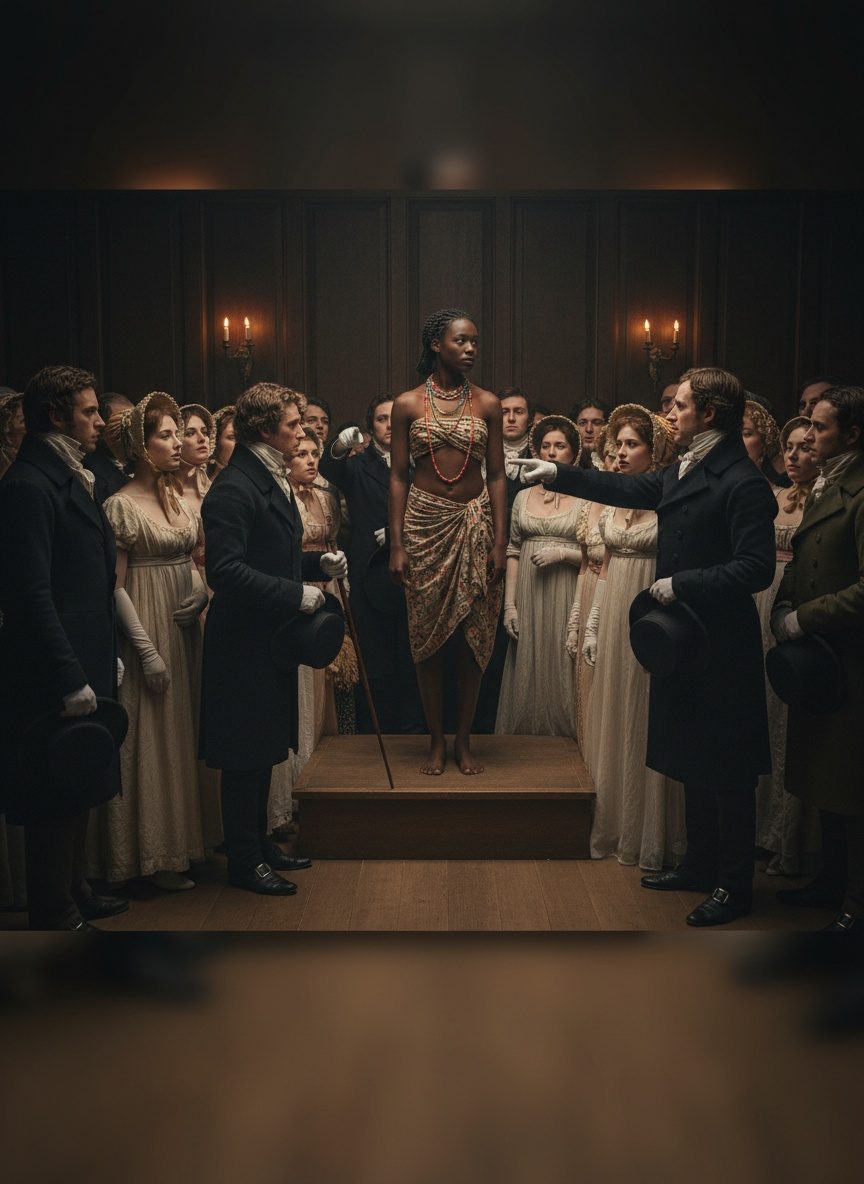
Inside the bustling exhibition halls of Piccadilly, thousands gathered. Prominent among them were the nobility and bourgeoisie, all jostling for a glimpse at the so-called anomaly. They gawked at her with eyes that sought only to decipher what they could not understand. The venue, dimly lit with gaslight and echoing with whispers, transformed human curiosity into a commodity. For many Londoners, this was their first chance to observe the widely rumored "Hottentot Venus"—a term that, while sensationalized, dehumanized Baartman entirely.
Her presence in this foreign environment was marked by shows that displayed her as an 'other,' where her body type, perceived as unfamiliar by European standards, was subjected to intense and often invasive scrutiny. Observers, equipped with a rudimentary understanding of colonial pseudoscience, crowded to see what they believed was nature’s peculiarity, showcasing the prejudices and exploitative curiosities of the age.
A Harrowing Journey: From London to Paris
The transition from English settings to the grandeur of Parisian salons offered little respite. By late 1814, she found herself in Paris—a city vibrant with revolutionary fervor yet tethered to imperial legacies that were all too ready to objectify. There, scientific communities took an infamous interest in her anatomy, with the medical fraternity perceiving her not as a person with a history and a culture but merely as a scientific specimen.
Even in Paris, Baartman's treatment was dictated by the curious and the callous. In salons steeped with opulence and theories of racially-driven science, her humanity was an afterthought, overtaken by her forced representation as an ethnographic study. Even amidst these invocations of enlightenment and curiosity, she remained painfully alone, oceans away from the home and heritage she knew.
The Final Days: Misunderstanding and Misery
Saartjie’s journey was tragically brief. By 1815, at the age of just 26, she succumbed to an illness exacerbated by neglect and destitution. Far from the sweeping landscapes of her homeland, her body was left unnamed and forgotten amidst the bustling labyrinth of Paris. For years, only whispers of her tale echoed haphazardly through the very hands that had exploited her image.
After her death, an even darker chapter ensued. Her remains were dispatched to the Musée de l'Homme in Paris, pronouncing her still under the guise of scientific inquiry, where they were displayed for nearly 200 years. Such treatment remains a stark reminder of the inhumane legacy of colonialism—a stark example of how human stories were disregarded under the weight of imperial curiosity and spectacle.
The Road Back: From Curiosity to Courage
When whispers turned into cries of justice, history began to take note. It took immense effort and sheer endurance from a democratic South Africa, aided by iconic figures like Nelson Mandela, to bring about change. Only in 2002, after years of diplomatic persistence and a gesture of reconciliation from the French parliament, were Baartman’s remains finally repatriated to her homeland—a place that had cried invisibly for her.
In considering Saartjie Baartman’s story, it unfolds not only as history’s reckoning but as a reflection of ongoing dialogues about identity, belonging, and the complex narratives that surround humanity across cultures. Her return to South Africa symbolized more than restitution; it was an acknowledgment of the wrongs endured and a step towards honoring voices so often muted by history itself. As we remember her in the realm where nature meets history, we are invited to view her not through the broken lens of colonial spectacle but with the humanity she deserved.