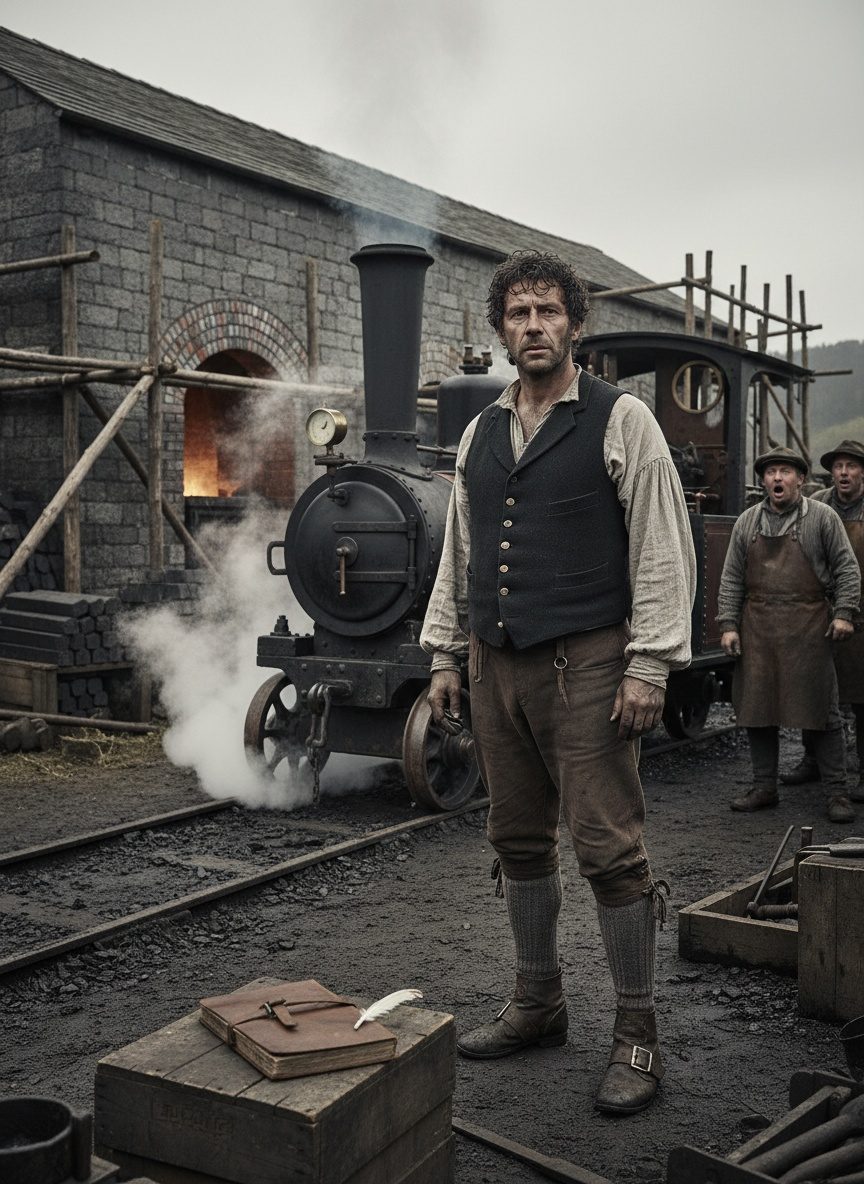
The furnace roared like a dragon awakening from centuries of slumber, showering sparks against the grey winter sky. Steam billowed from beneath the contraption's iron belly as Richard Trevithick, a man whose mind raced faster than the locomotive he had envisioned, checked the gauges with steadfast eyes. He glanced at the huddled group of workers, their breaths visible in the frosty air, and signaled. It was time to conjure the impossible.
Across the Rails of Destiny
In the biting chill of a February morning in 1804, the sound of clanking hammers and murmurs of anticipation filled the narrow valley of Merthyr Tydfil in South Wales. The task at hand was monumental: the first-ever attempt to transport iron using a steam locomotive. Trevithick's invention stood ready on a track of iron rails, looking to defy both gravity and skepticism. The stakes couldn’t have been higher — not just for Trevithick, but for Samuel Homfray, a local ironmaster whose daring bet on Trevithick's mad idea could redound to either ruin or glory.
The nine-mile stretch wound through the valley, holding not just physical weight but the weight of future possibility. This event was supposed to be the harbinger of a new era. Ten tonnes of iron had been loaded and secured, and those present held their breath as engineering and imagination prepared to dance an uncertain duet. The promise of transformed trade routes and industrious efficiencies was both frightening and exhilarating. Like Galileo before the pendulum, Trevithick was about to test the laws of physics with the world as his observer.
The Man Who Whispered to Engines
Richard Trevithick was no stranger to the world of steam. Hailing from the rugged, windswept coast of Cornwall, his formative years were spent surrounded by the mining culture of the area. Steam engines were the lifeline of mining operations, fueling the Phoenix of industrial progress from shore to shore. But where others saw limitations, Trevithick saw potential. His towering figure often loomed over the innovations he envisaged, as his mind fathomed ways to harness the furious energy of steam to conquer land as well as under it.
While typically credited as the father of the steam railway, Trevithick’s grand vision extended beyond simple mechanical puzzles. He viewed the transportation of goods, especially iron, as a spine in the body of commerce, one essential to fueling the growth of the burgeoning British Empire. Yet, what set Trevithick apart from many of his contemporaries was not merely his vision; it was his fearless ability to challenge convention and champion the cause of perseverance over doubt. The steam locomotive was just one of many audacious gambles for a man often dwarfed only by his ambition.
Iron and Steam: A Revolution Rolls
The locomotive groaned, and the ground seemed to groan back as the heavy load trembled on the brink of movement. The hum of steam exhaled into a higher pitch, a giant mechanical inhale, before the assembled marvel and apprehension turned into belief. With the first lurch of motion, a future unbound by the constraints of muscle and the elements materialized. The iron beast crept and then rolled more confidently across the rails — a trailblazing stride into the possibilities of industrial ingenuity.
This trial journey may have only been nine miles long, but it carved pathways through books, mindsets, and eventually, continents. With this success, Trevithick not only wrote a new chapter in the annals of engineering but helped redraw the logistics map, crafting what would become the arteries of trade for the industrial age. Trains would eventually span thousands of miles, revolutionizing the way goods, and thus wealth, traveled across nations. The outcome was an increasingly interconnected empire, fueled by coal and governed from the hearts of factories.
The Echoes of Progress
The success at Merthyr Tydfil resonated far beyond that chilly day in 1804. The way that railways would come to define the subsequent industrial era cannot be understated. Richard Trevithick had struck a philosophical chord in the symphony of progress, a melody that would reverberate through centuries. Iron rails began connecting cities, countries, and entire continents, with consequences that echoed through every level of society. What began as a daring trial transformed factors of distance and time, accelerators of cultural exchange and economic expansion.
Yet, beyond its obvious economic and technological impact, Trevithick’s achievement spoke of the human condition — of curiosity, perseverance, and the very engines that drive us. Here was a case of ingenuity beginning in the abstract corners of thought and forging a tangible path. While he never achieved the fame and fortune that some of his inventions might have warranted, his legacy traveled with every train, etched with the iron of possibility and the steam of determination.
As we look to our past to frame our future, Trevithick’s engine reminds us of the power of vision and innovation. While facts may root the story in a time and place, the narrative is universal — a testament to our ability to imagine beyond immediate constraints and, with iron and steam, move the world.