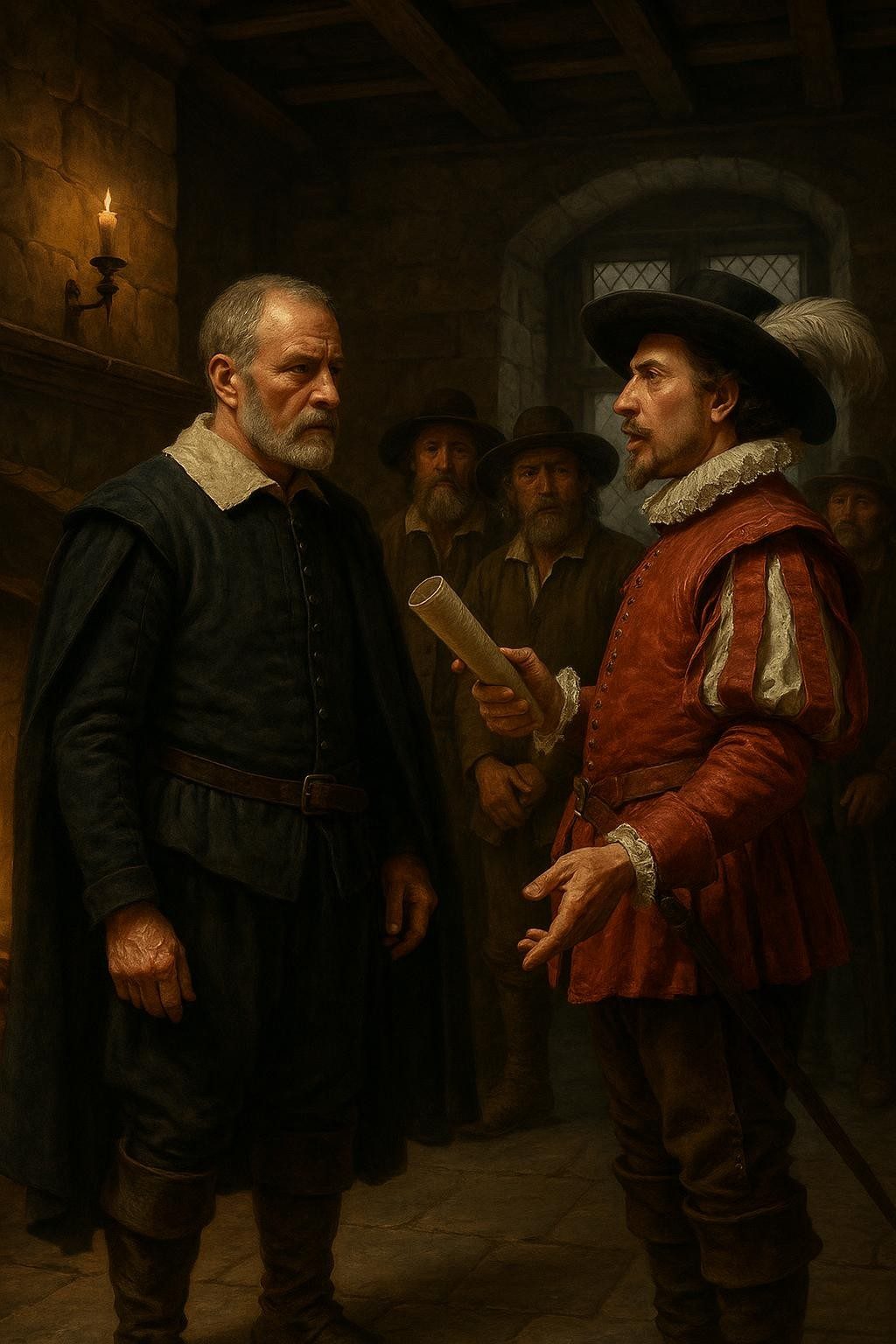
November 10, 1629. The chill of autumn seeped into the stone walls of Lismore Castle, Richard Boyle's fortified sanctuary in County Waterford.
The Ascent of Richard Boyle
Richard Boyle, Earl of Cork, was a figure carved out of ambition and shrewdness, a man whose life could have been plucked from the pages of a daring play. Rising from obscurity, Boyle transformed himself into one of Ireland's most powerful landowners, stemming from his early ventures in the Munster Plantation during the late 16th century. The son of a Kentish cleric, Boyle grasped the opportunities that the unrest in Ireland offered with tenacity, establishing a domain that stretched across the province and beyond.
This empire was not merely built on land but on the backbones of those who cultivated it—his Protestant tenants. The spectrum of Boyle's influence crossed societal thresholds, engaging with familiar names of the British upper echelons. He even constructed for himself a patriarchal seat in the English House of Lords, leveraging his wealth to secure his family’s future among the aristocracy. But with great power came inherent threats, and the greatest of these loomed in 1629.
The Crown's Ultimatum
The early 17th century was a turbulent time for Ireland, caught between its own Gaelic traditions and the expanding ambitions of the English Crown. The Lord Deputy of Ireland during those years, a staunch advocate of Crown interests, brought with him the full might of royal policy, aiming to consolidate control by ensuring loyalty from subjects like Boyle.
In the halls of Dublin Castle, these policies were often discussed and dispensed. The viceroy's demands were blunt and brooked no dissent; he saw Boyle's growing autonomy as a potential fault line. Boyle had given his Protestant tenants a solemn vow of protection—an assurance that stood at odds with the Crown's demands for greater conformity to its domination strategies.
The ultimatum was stark: subjugate his tenants to the Crown's cause, dismantle the liberties he had given them, or suffer the ramifications. To Boyle, this felt like more than just a political threat. It was a personal affront, a challenge that tested the integrity of his word and the very fabric of the society he had woven from hardship and perseverance.
A Defiant Resolution
Richard Boyle's response was as decisive as it was dangerous. He refused to comply. To him, the promise to his tenants was a sacred trust that could not be bartered away under duress. It was a commitment rooted not only in loyalty but also in the pragmatic understanding that his tenants' prosperity ensured his own.
The stakes for Boyle were extraordinarily high. Disobeying the Lord Deputy could result in financial ruin, the loss of his estates, and perhaps worse. Yet the social contract he held with those on his lands was non-negotiable. This defiance was not born out of simple obstinacy but from a profound calculation and deep sense of duty to those who worked his lands.
Even as the Viceroy sharpened his threats—seeking to clip the wings of this upstart noble—Boyle’s resolution strengthened. Standing firm, he absorbed the slings of political retribution and intrigue, knowing that his stance was not just about maintaining his power but also about ensuring the very survival of a nascent Protestant community in an Ireland reeling from religious and political upheaval.
The Cost of Integrity
The personal costs for Boyle were significant. As tensions reached a crescendo, his financial affairs were closely scrutinized by the Crown, seeking weaknesses to exploit. This was not just a battle of titles and deeds but of dignities and livelihoods. It was a war where the casualties were not just counted in coins but in the shift of allegiances and the severance of longstanding alliances.
As each tenant maintained their freedom under Boyle's protection, the subtle machinations of power played on. The support within the English court wavered, pushing him to the brink. Yet, despite these pressures, the tenants not only stood by him but prospered under the protective shadow he cast. This defiance etched itself into the rural landscape of Ireland, leaving scars that bore testament to Boyle’s unwavering commitment.
Despite losing favor and wealth, Boyle’s legacy endured. His act of defiance ingratiated him with his tenants, and this loyalty ripple through generations, intertwining their fates with his own. He may have withstood the political storm lessened in fortune, but fortified in the indelible mark he left on the land and people.
Why It Matters Today
The story of Richard Boyle and his principled stand holds up a mirror to each generation. It illuminates questions of leadership and the ethics of wielding power. Here was a man who chose conviction over compromise, whose legacy was not measured in acres or gold but in the lives he impacted. Boyle's defiance reshaped the narrative for those who toiled under his dominion into one of mutual resilience.
In today’s world, where integrity often walks a tightrope, this tale reminds us of the enduring power of keeping one’s word and standing firm against coercive forces. It highlights that sometimes the scales of justice are balanced not in courtrooms but in the hearts of those bold enough to defy the sway of easy comfort for the hard-won respect of posterity. The Earl of Cork's defiance did not just save his tenants; it enshrined him among the ranks of those rare historical figures who choose principle over peril.