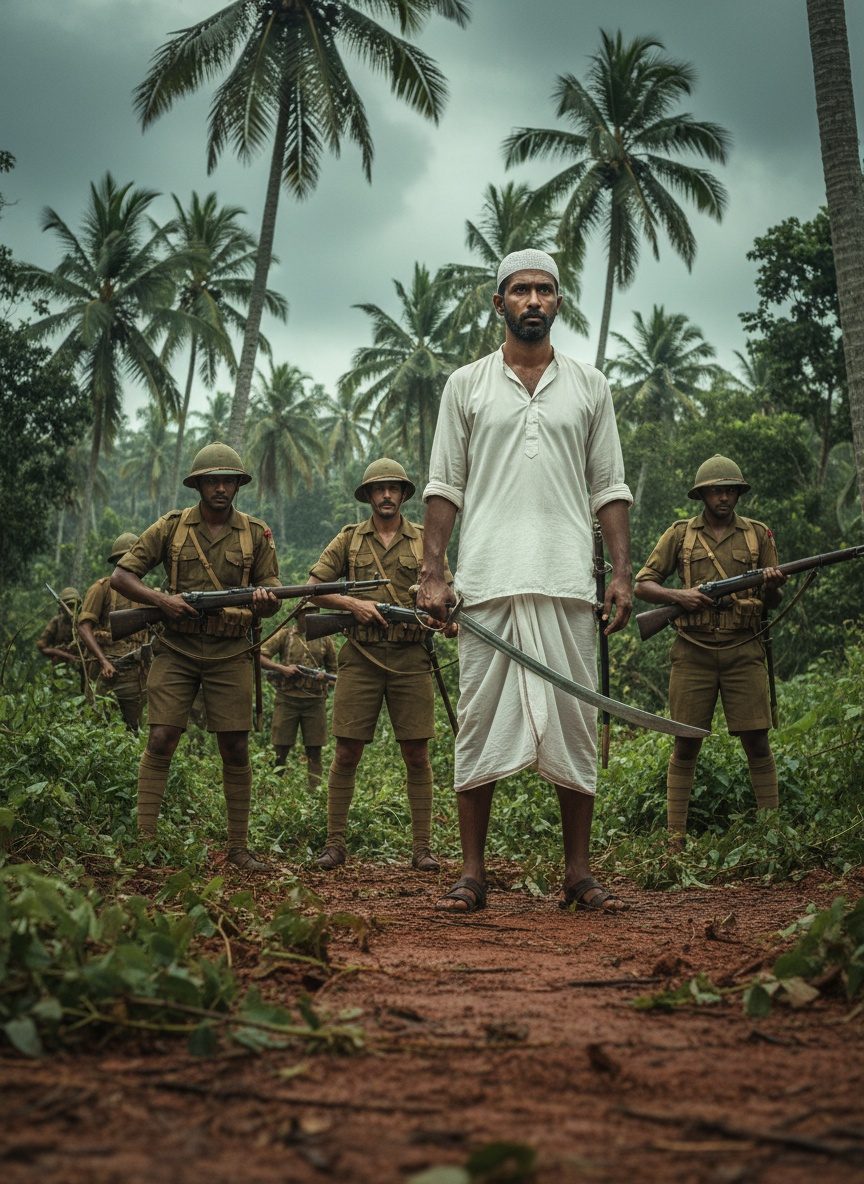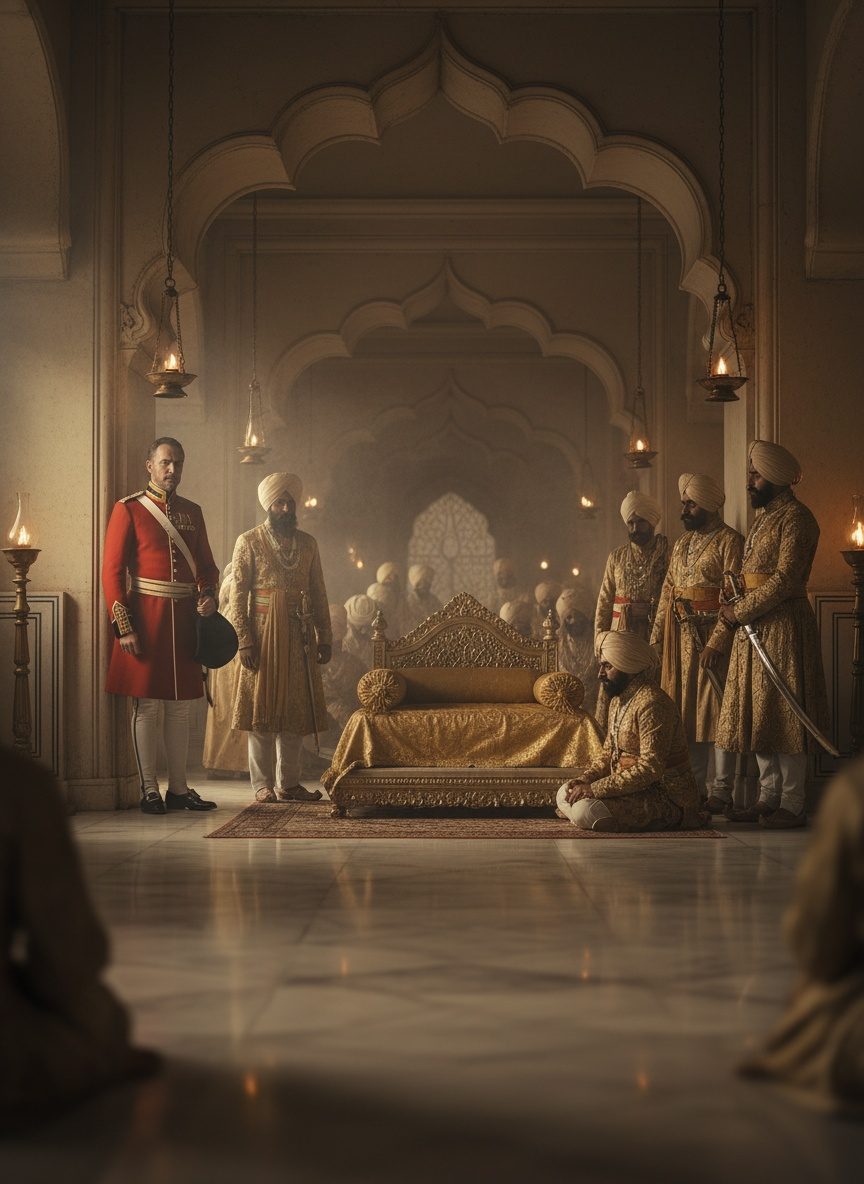
The summer of 1839 in Lahore was suffocating—the air thick with humidity, the sun an unblinking eye piercing the dusty sky. In the Darbar Hall of the famed Lahore Fort, a place of whispers and silk, the atmosphere was charged, every muffled footstep absorbed by the beautifully worn marble floors. The rippling heat touched the courtyards and arched balconies that once glimmered under Ranjit Singh’s keen watch. But now, a curtain was falling over the jewel of the Punjab. The Lion was dead, and the empire stood breathless at the precipice of uncertainty.
The Wounded Lion and His Kingdom
Ranjit Singh, born on a November night in 1780, rose from a world scarred by ceaseless conflicts. Amongst his contemporaries, he was a figure of uncommon resilience. Smallpox left him with a single eye, yet it was his vision of a united Punjab that captivated the world. At just ten years old, he galloped beside his father on the battlefield, molding his spirit in the fires of warfare. When his father died during his formative years, Ranjit assumed leadership over the Sukerchakia Misl. By the time he controlled the reins of power, he had already outmaneuvered the tide of intrusions from Afghanistan, halting Zaman Shah's ambitions with strategic genius.
By 1801, Ranjit had been proclaimed Maharaja—in Lahore, a city he would transform from a symbol of turmoil to one of imperium. Through diplomatic cunning and martial prowess, he quilted together a patchwork of warring states, forming the Sikh Empire, an unyielding fortress against foreign dominions. As the architects of empires eyed the east, his singular presence offered a formidable line of defense, a backbone buttressed by not just armies but character.
The Flickering Flame of Succession
Ranjit Singh’s death on June 27, 1839, unveiled the fissures beneath the imperial facade. While his empire was vast, the question of succession loomed unanswered. Sons he had in numbers, yet none possessed the blend of authority or reverence he commanded. Kharak Singh, his eldest, was a pale reflection of the strength required. Unlike his father, whose consolidations were masterpieces—stories painted on the canvas of conquest—Kharak’s tenure promised a different tale, one of vulnerability.
In Ludhiana, across the border, the British East India Company watched with calculating anticipation. Far from Lahore's emotional turmoil, they saw opportunity rather than an end. The power gravitas tilting between Lahore's dilemmas and the Redcoats turned Ranjit's death into a pivot point—a shift aligning the stars for British expansion into a buffer zone long considered impenetrable. The Punjab was the shield; with the sword of Ranjit Singh broken, the barrier leakaged.
The Cracks Widen
What could have been years of transformation and stabilization became a procession toward discord. Within the erstwhile serene palaces, the echoes of loyal courtiers’ desperate arguments signaled the rise of infighting. Meanwhile, the populace, once shepherded by Ranjit Singh's iron hand, felt the strain of ineffectual governance.
The British, seasoned in the art of indirect rule, maneuvered with proficiency. They spoke in diplomatic niceties, words drawing maps that ensnared vassals and cardinals alike. All the while, the landscape of alliances and faiths shifted swiftly. Increasing unrest fueled by palace conspiracies led to multiple successions within years, each ruler less secure than the last.
By 1845, the Sikh Empire, once synonymous with fierce independence, stood fragmented, its strength sapped by internal dissension rather than external force. The First Anglo-Sikh War loomed, its roots reaching back to this moment of unmoored leadership. The outcome was inevitable: regions that resisted so fiercely under one-eyed Ranjit succumbed to division and subjugation. This inadequacy reshaped borders and destinies, not just for the Sikhs but for the subcontinent.
Why This Matters
In the shadow of an era fraught with conquests and capitulations, the legacy of Ranjit Singh and the fall of his empire represent more than a chapter in a textbook. They are a reminder of how fragile the bulwarks of power can be. Empires unmake themselves not only through foes but by the vacuum left when visionary leadership dims, exposing ambitions and frailties.
Ranjit Singh crafted an art of governance—with pen as mighty as his sword—that bridged cultures, languages, and faiths. Yet, his absence made way for the unraveling of ideals too entangled with his persona. A mere decade after his passing, his formidable empire lay at the feet of the British, testamenting both the impermanence of empires and the enduring gravitation towards power.
The tale of the Punjab's transformation from sovereign to colony is pertinent even today, reminding us how the strength of a leader can cloak vulnerabilities that only become clear upon their absence. Understanding this not only enriches our grasp of history but compels reflection on the present, prompting questions about succession, foresight, and the fates of nations beyond their golden ages.