She was fluent in languages that most Indians at the time barely knew, including Sanskrit, the ancient tongue reserved for the elite Brahmans. Yet Pandita Ramabai was far from privileged. Her life was a tapestry of resilience woven with the threads of personal tragedy and relentless defiance against oppressive norms.
The year was 1889, the setting—Poona, a city under the shadow of the British Raj, where colonial and indigenous powers often clashed over control not just of the land, but of the mind and spirit of India. In this context, widows were more than just unfortunate. Within the rigid confines of Hindu society, they were condemned to lifelong mourning, stripped of jewelry, their hair shorn, and their status reduced to near-servant-like existence within their own households. For child widows, often married off before puberty only to lose their husbands to illness or age, the future was a barren landscape of neglect. In this world, Pandita Ramabai emerged as a fierce advocate, determined to overturn the scales of injustice.
Ramabai herself was not immune to sorrow; her husband had passed away when she was still young, leaving her a widow and mother in a society where both were stigmatized. Educated and articulate, she could have chosen a different path, one less fraught with conflict and resistance. Yet she saw in her own struggles a reflection of countless other women and girls, and refused to stand by silently.
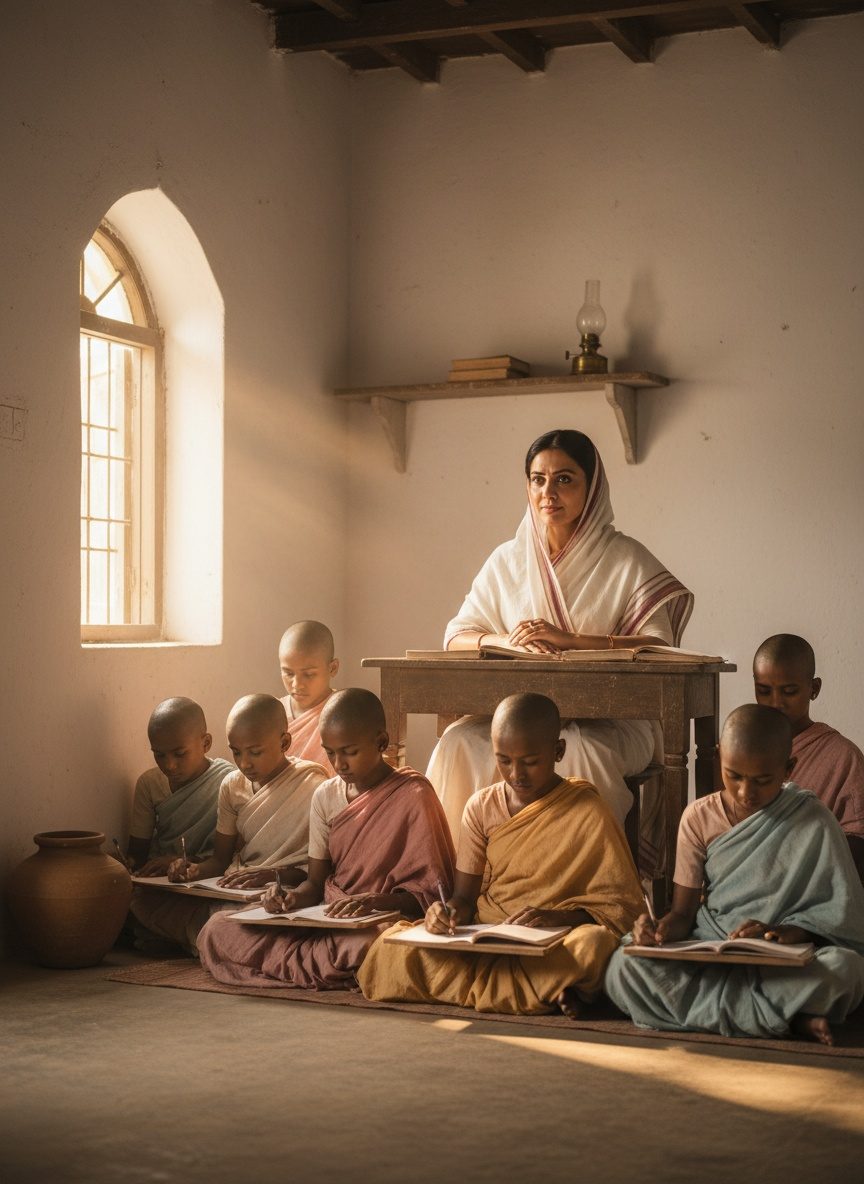
Thus was born the Sharada Sadan in Poona, an institution unlike any before it in India. It was to be a refuge, a school, and a home for widows—especially child widows—who had nowhere else to turn. In an era when education was considered unnecessary and even harmful for women, Ramabai envisioned a haven where these marginalized individuals could learn, thrive, and in effect, reclaim their lives. Such a radical idea was bound to attract opposition.
British authorities were wary, suspecting any movement that might foster intellectual or social rebellion. The Church, which had already taken note of Ramabai's intellectual conversion to Christianity during her travels, eyed the project with suspicion as well. They worried that her school, with its focus on Hindu girls, might edge too far away from the Christian doctrines that many missionary schools tried to impress upon India’s youth. Friends and foes alike advised her to abandon this utopian ideal and adhere to a safer, more conventional route.
But like the waves that steadily erode the shore despite the constant resistance, Ramabai was undeterred. She opened the doors of Sharada Sadan and welcomed those society had written off. The curriculum, eclectic and forward-thinking, included both traditional subjects like Sanskrit and contemporary ones such as science and mathematics. The grounds buzzed with the laughter of young girls, hidden away from the outside world that refused to see them as anything more than relics of misfortune.
Within the confines of the school, a new kind of revolution was blooming. It was not the kind held in the streets, but it was no less powerful. The girls learned about their rights, their histories, their potential futures unshackled by the chains of a predetermined fate. Ramabai understood too well the minds of those she sought to change. Her approach was one of empathy, patience, and unyielding resolve, allowing the gentle spread of enlightenment to take root over the years.
Her undertaking was not without its hurdles. Funding was perennially scarce, the safety of the students threatened by those who opposed progress, and social ostracism seemed a constant companion. But each day the school remained open was a day when girls gained the education that could light a way out of darkness. Ramabai often met with visitors, both local and foreign, who sought to understand her mission and perhaps lend their support. Her eloquence and conviction won many over, but her strongest tool was always the success and determination of the students who emerged from Sharada Sadan more empowered than when they entered.
It is said that the true measure of a society is how it treats its weakest members. Through her school, Pandita Ramabai was reshaping Indian society by challenging it to ponder this very question, urging it toward an uncharted path where women were not simply to be pitied or scorned, but held as equals.
Over time, the ripples of Ramabai’s defiance found their way into broader currents of change that led to larger reform movements across India. Her efforts planted the seeds for future laws and movements aimed at improving the plight of widows and expanding educational opportunities for all women. Her story could easily be one of quiet resignation. Instead, it stands as a remarkable testament to an individual’s power to rewrite the destinies of many, even when the initial odds appear overwhelmingly against them.
In considering her legacy, one arrives at the perennial truth that the marginalized and oppressed are powerful indeed. It merely takes one courageous act, one unwavering soul like Pandita Ramabai, to ignite the flames of change and blow away the fog of exclusion. Her defiance in the face of disdain proves that education and empathy can forge a path through societies deeply entrenched in inequity—reminding us, echoing even today, that obstacles are not the end of a journey, but rather the beginning of a narrative in which possibility and hope are the central themes.