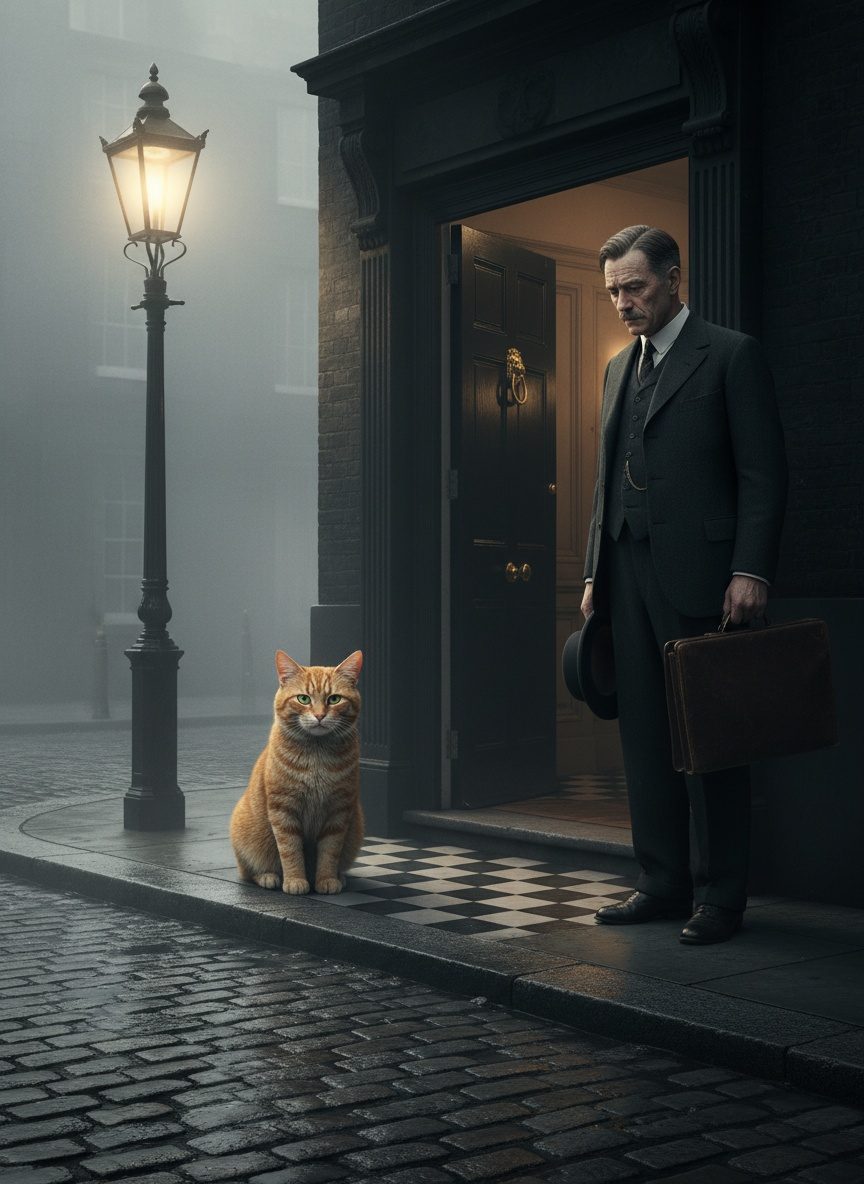
10 Downing Street is known for housing the Prime Minister. But in 1929, it housed an unlikely resident — a scrappy tabby named Treasury Bill.
The Arrival of an Unlikely Lodger
In the wake of the economic turmoil that defined the interwar era, 1929 was not a particularly auspicious year for new beginnings. Yet, amidst the deepening shadows of the impending Great Depression, a small, unheralded event occurred on the steps of one of the world's most famous addresses. A stray tabby, later dubbed "Treasury Bill" by the staff, trotted through the iconic black door of 10 Downing Street, seemingly indifferent to the human machinations of power swirling around him.
His arrival was as unremarkable as it was unexpected. Official records made no mention of him in policy discussions or cabinet meetings. However, this feline intruder captured the hearts of staff and the increasingly beleaguered Prime Ministers dealing with political and economic crises. His chosen abode was the heart of the British Empire’s political power, a beehive where decisions affecting millions were made daily. But for Treasury Bill, it was merely a place to nap, eat, and survey his territory with a regal detachment.
Treasury Bill's unfazed attitude provided a unique contrast to the turmoil of his surroundings. Ramsay MacDonald, the Prime Minister at the time of his arrival, was struggling with the economic challenges that would soon culminate in the Great Depression. While MacDonald managed a coalition government aimed at assuaging national malaise, Treasury Bill moved seamlessly through the halls, his existence unfettered by the mounting crises. Where politicians plotted strategies and planned countermeasures, he prowled with the nonchalance of a creature that had no regard for party politics.
An Unofficial Permanent Resident
As Ramsay MacDonald departed and Stanley Baldwin entered the fray, Treasury Bill remained, a steadfast witness to political change. Silva Wiley, a long-time secretary, humorously recounted how the Downing Street cat could always be found underfoot during the busiest of times, often present during tense debates about budget proposals—a living nod to his moniker.
Baldwin's government faced its own set of challenges, not least among them the sharp rise of political extremism across Europe. Yet through meetings with foreign dignitaries and the implementation of domestic policies, the tabby's silent endorsement or disdain was often read humorously by staff as a sign of impending fortunes, or lack thereof.
Over the years, as Neville Chamberlain entered with aspirations of appeasement, Treasury Bill's curious, uninvited presence became near legendary. Chamberlain, embroiled in the fraught politics of international diplomacy, reportedly developed a fondness for the cat, whose napping habits often precluded important meetings—an endearing anecdote for those navigating the high-stakes environment.
When Winston Churchill later strode through the doors in the midst of war, Treasury Bill remained an unperturbed constant. His domain expanded even further with new war rooms and security arrangements. While Churchill practiced oratorical brilliance in public speeches and rallied the nation against Nazi tyranny, Treasury Bill maintained a stoic presence, perhaps reminding all within earshot that some matters were eternal, utterly mundane, yet profoundly soothing.
The Cat Who Stayed On
Post-war, as Clement Attlee took the reins amidst rebuilding efforts, Treasury Bill continued his tenure at Downing Street, much to the delight of all who had grown accustomed to his solemn company. Attlee, whose government initiated significant social reforms, found the cat a source of silent, contemplative calm during exhaustive deliberations over Britain's future.
In a period where political tensions and rapid social change dictated the order of the day, Treasury Bill became something of a talisman, an agent of enduring stability in a country grappling with the remnants of empire. Through the less tumultuous leadership of Winston Churchill's second tenure and Anthony Eden’s short-lived premiership, the enigmatic feline persisted, watching as each Prime Minister dealt with the unique challenges handed to them by history.
As the years turned, the increasingly elderly cat, who patrolled less vigorously, became a legend of sorts among Downing Street staff, creating a legacy intertwined with the very essence of British political life. Though officialdom never acknowledged him, this nonchalant creature exemplified an unspoken truth: in the grand tapestry of history, the most unassuming entities can weave an enduring narrative.
The stately halls of 10 Downing Street have seen many faces, each marked by the pressures and triumphs of leadership. Between 1929 and 1946, amidst the reverberations of economic collapse, political upheaval, and global war, Treasury Bill endured. Through seven Prime Ministers and untold challenges, he remained a reminder that amidst the chaos of human endeavor, there lies a silent persistence that shapes the world in ways small yet profound. This feline lodger, with no elected office or word spoken, became an indelible part of history's quiet witness to transformative change.