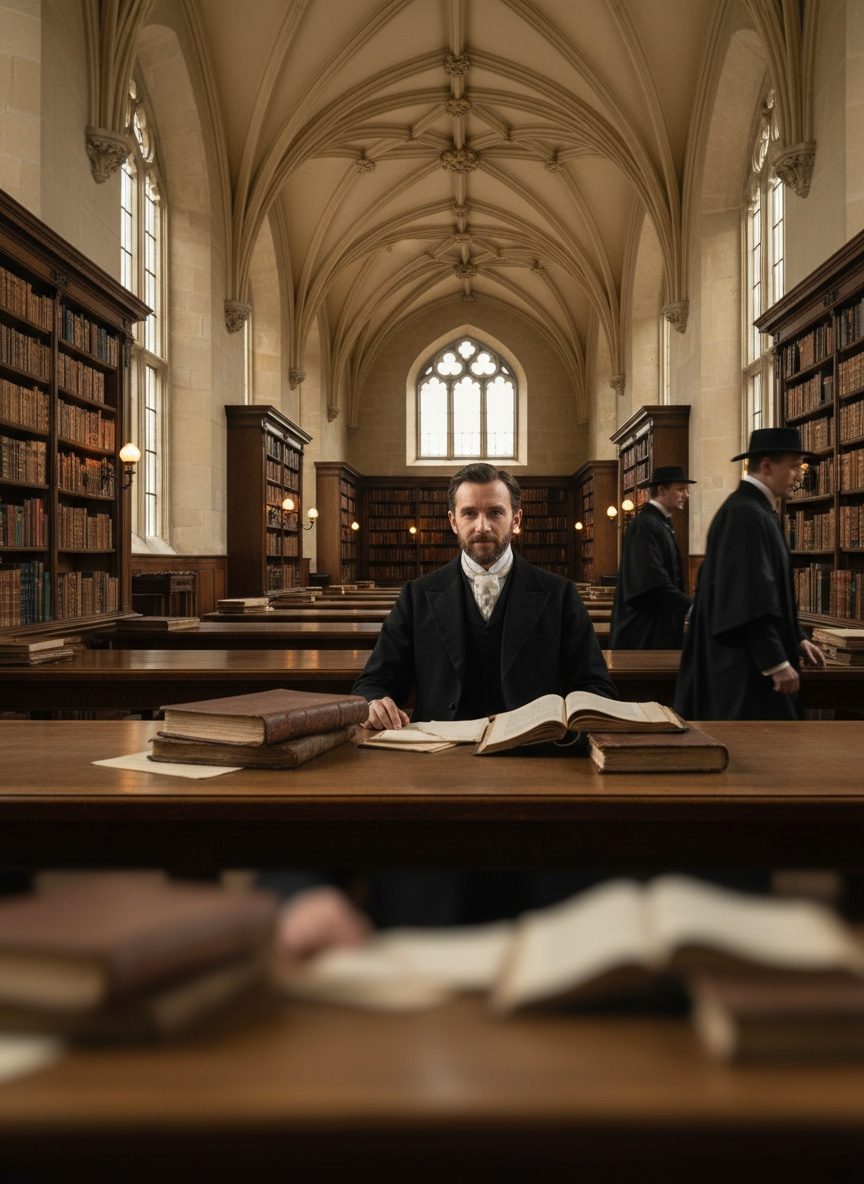
Antony Fabroni's hands steadily placed the vellum folio back onto its shelf, the musty scent of parchment mingling with the dust motes dancing in the afternoon sun. The clank of footsteps echoed down the ancient stone hallway of the Bodleian Library, occasionally punctuated by the low murmur of scholarly debate. The hallowed halls of Oxford were abuzz with intellectual rigor, yet behind the curtain of academic serenity, an unprecedented deception unfolded.
Fabroni had arrived at Oxford with a carefully curated air of intellectual supremacy, effortlessly woven into the fabric of his immaculate three-piece suit and authoritative gaze. He bore no degree, no published works to his name, nor any verified history tracing back to scholarly pursuits. Yet, there was something in his carriage and manner of speech that resonated with the scholars who prided themselves on sniffing out duplicity. Here was a man who could quote Virgil and Cicero with ease, who spoke of Greek tragedies with the fervor of a man resurrecting ancient dialogues.
His grand tales of academic exploits were as ornate as the historic spires of Oxford themselves. Fabroni was supposedly an erudite from a prestigious Italian institution, a traveler of climes beyond imagination, yet for all his narratives, there seemed to be no official verification, no letters of introduction, no tangible lineage of his academic genealogy. Still, Oxford's respected assembly of scholars chose to overlook these inconsistencies, convinced perhaps by Fabroni’s mastery in feigning erudition over the most discerning of their number.
The decision to grant Fabroni full access to the prodigious collections within the Bodleian Library was the tip of the iceberg of this mesmerizing gambit. It was said that he would scrutinize folios for hours on end, leaving pages scattered and some say, re-arranging them in his impudent revisionism. Few doubted his prodigious intellect, but as the years passed, a sense of unease settled like a dense fog over the university grounds. Whispers swirled through the quadrangles about inconsistencies in Fabroni’s bibliographic citations, strangely distorted interpretations of classical texts that seemed deliberately exclusionary to the initiated.
Yet in an era where polymaths were as rare as the ebbing Empire's untouched frontiers, Fabroni was seen as a prodigious comet, albeit one that had not left a return address. He was involved in discussions that spanned the scope of the known intellectual world, from advancements in astronomical observations to the nuanced alleys of historical philosophy. Those who worshipped at the altar of Oxford's intellectual rigor remained entranced, if somewhat cautiously, by the unusual luminescence this foreign sage cast upon their dim academic conclaves.
Eventually, suspicions turned to inquiries, half-hearted at first, into Fabroni's supposed past. The archives revealed an uncomfortable truth—there was no trace of an Italian progeny named Fabroni in any university registry. Not even a distant echo could be heard from the annals of the learned societies of his claimed homeland. It was as if he had sprung fully formed from the ether, ready to enlighten the British Empire’s brightest thinkers.
When the house of deceit came crashing down with the weight of unexamined trust, the reaction was not one of scandal or reform but a hushed sweep under the ornate rug of institutional preservation. Amidst the backdrop of the Edwardian serenity, there was a stoic refusal to address the embarrassing oversight. A mere footnote in the unwritten tome of Oxford’s affairs, the Fabroni incident was quietly archived, his access surreptitiously revoked and mentions of his name politely omitted from dinner conversations in oak-paneled dining halls.
The intrigue of Fabroni’s story lies not merely in the audacity of his social engineering but in the question it posits to the world of academia and beyond—how often has eloquence duped scrutiny, and confidence masqueraded as competency? In an era defined as much by the rigid hierarchies of class as by the intellectual pursuits it championed, the tale of Antony Fabroni echoes beyond Oxford, exhorting a lesson in the perils of unchecked credulity.
As the echo of footfalls faded from the stone corridors of the Bodleian, so too did Fabroni’s scandal dissolve into the mist of forgotten controversies. Yet, the story remains a potent reminder of the fragility of our bastions of learning, where the allure of intellectual novelty can sometimes cloud judgment. It cautions us to remain vigilant, lest the mythologies we craft become the legends left untold by history.