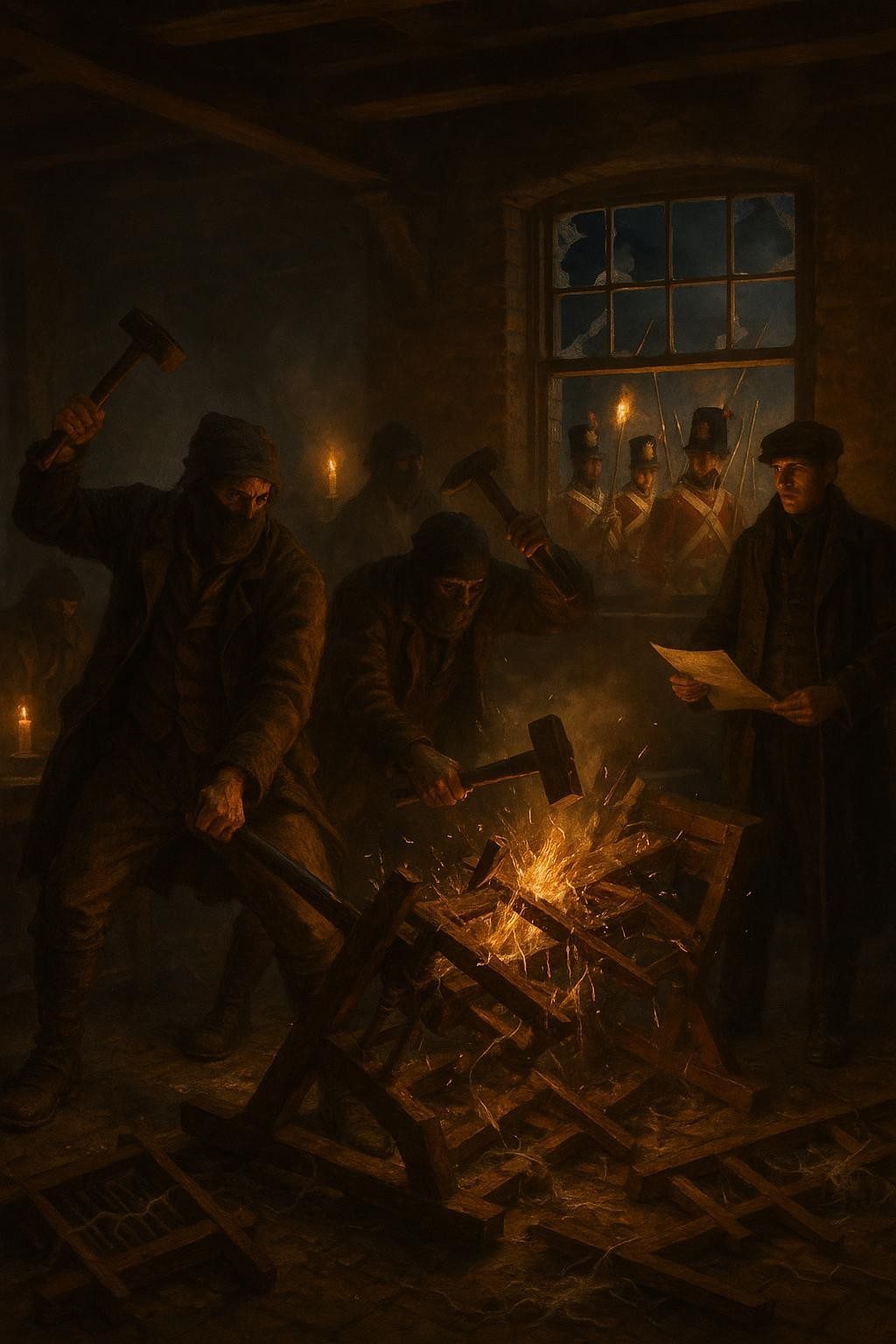
February, 1812. The cold bit sharply through the rolling hills of Nottinghamshire.
A Midnight Rebellion
The winter of 1811 had barely loosened its icy grip when discontent simmered through the English countryside. In the densely packed cottages of Nottinghamshire, Derbyshire, and Yorkshire, shadows morphed into forms, masked figures moving with a silent determination. Under the spectral moonlight, these men took on the moniker of "General Ludd's Army," evoking the mythical figure, Ned Ludd. It was said that years prior, Ludd had smashed a couple of stocking frames in a fit of rage, sparking an almost legendary reputation as a defender of the downtrodden. Despite his likely fictional origins, Ludd became a symbol of resistance against stark industrial progress that threatened livelihoods.
The rhythmic clacking of frames in factories had for years competed with the gentle hum of cottage industries. Yet, as the clatter grew louder, so did the frustration of traditional craftsmen. They watched helplessly as mechanized looms churned out textiles at unprecedented rates, reducing the demand for their painstaking manual labor. As night cloaked the landscape, these masked men invaded factories armed with hammers and axes, reducing the hated machines to heaps of splintered wood and twisted metal. Despite the veil of secrecy, a curious admiration enveloped them among many suffering the same plight, even as their nocturnal raids invited the ire of the establishment.
What they couldn’t foresee was the scale of response they would provoke. The Crown, realizing the rumblings of rebellion, called upon more than 14,000 soldiers to barricade their progress. Troops poured into the Midlands—a number that eclipsed even the forces under Arthur Wellesley, the future Duke of Wellington, who was embroiled in the bitter struggles across the Spanish Peninsula. Such a force, assembled to quell an insurrection rooted not in territorial conquest, but in the fight for fair work, was almost unheard of.
The Flame of Resistance
This military incursion only seemed to fan the flames of defiance. By the flickering light of torches, in gatherings shielded beneath trees where the cold wind couldn’t reach, speeches roused the spirits of those disenchanted by an inexorable industrial tide. While many remained supportive, some locals grew wary as the army began patrolling, certain that the scaffold awaited those bound by principle.
Meanwhile, in the heart of London, an enraged Parliament plotted its counter. The Frame Breaking Act crystallized their resolve, setting forth a chilling reality: the destruction of industrial machines was now a hanging offense. The law, draped in a veil of justice, cast a long shadow, painting defiant craftsmen as common criminals. To merely stand among those who dared challenge industrial practices risked the gallows, an edict that echoed sinister portents from the days of public hangings.
But laws and troops could not dismantle desperation, nor quench the thirst for back a perceived injustice. The framework of revolt was not hewn from the destruction of mere machines but more deeply rooted in the human condition, craving dignity above compliance. As such tensions flared, both workers and their supporters did whatever necessary to entrench their visible presence within the convoluted socio-economic landscape.
A Lingering Impact
As the calendar pages flipped into the year 1812, the government action had gained a firm foothold, effectively suppressing much of Ludd's visible impetus. Yet, beneath the stillness lay smoldering ambers of a silent war against dispossession and disenfranchisement. Moments of clandestine resistance continued to taunt the onset of industrial modernity even as those behind the masks faded back into obscurity.
The story of the Luddites is more than an anecdote of antiquated views clashing with relentless progress. It serves as a heartfelt query into how societies chose to manage the poignant balance between technological advancement and humane labor practices. The confrontation left deep impressions on the subsequent labor movements that questioned the fairness and ethics of industrial transformations, decades after the last defiant frame-breaker walked the path to scaffold.
While history books may distant themselves from this chapter's full irony, the spirit of General Ludd’s Army remains etched into societal consciousness as a reminder of humanity's relentless pursuit of equity amid progress’s march. Their cries echo through time, whispering questions on the delicate dance between human costs and industrial gains, urging each successive generation to ponder these unresolved tensions anew. As the clamors of old machines recede into memory, the lessons they leave echo with the rhythm of the past and the cadence of stories yet to be told.