His pulse quickened with each careful step. The vast expanse of the Tibetan plateau stretched out before him, bathed in the haunting glow of dusk. For Nain Singh Rawat, a Kumaoni schoolteacher turned secret agent, this wasn't just a journey across an uncharted territory; it was a dance with shadows, a test of human endurance and skill against nature's grandest and most forbidding theater. His once-humble life in the Bhotia village of Milam seemed a world away, as distant as the snow-clad peaks he traversed. Yet every bead of sweat was a note of courage, and each whispering gust an invincible witness to his mission: to map a mysterious land that the British Empire could barely dream of, and no European dared to probe.
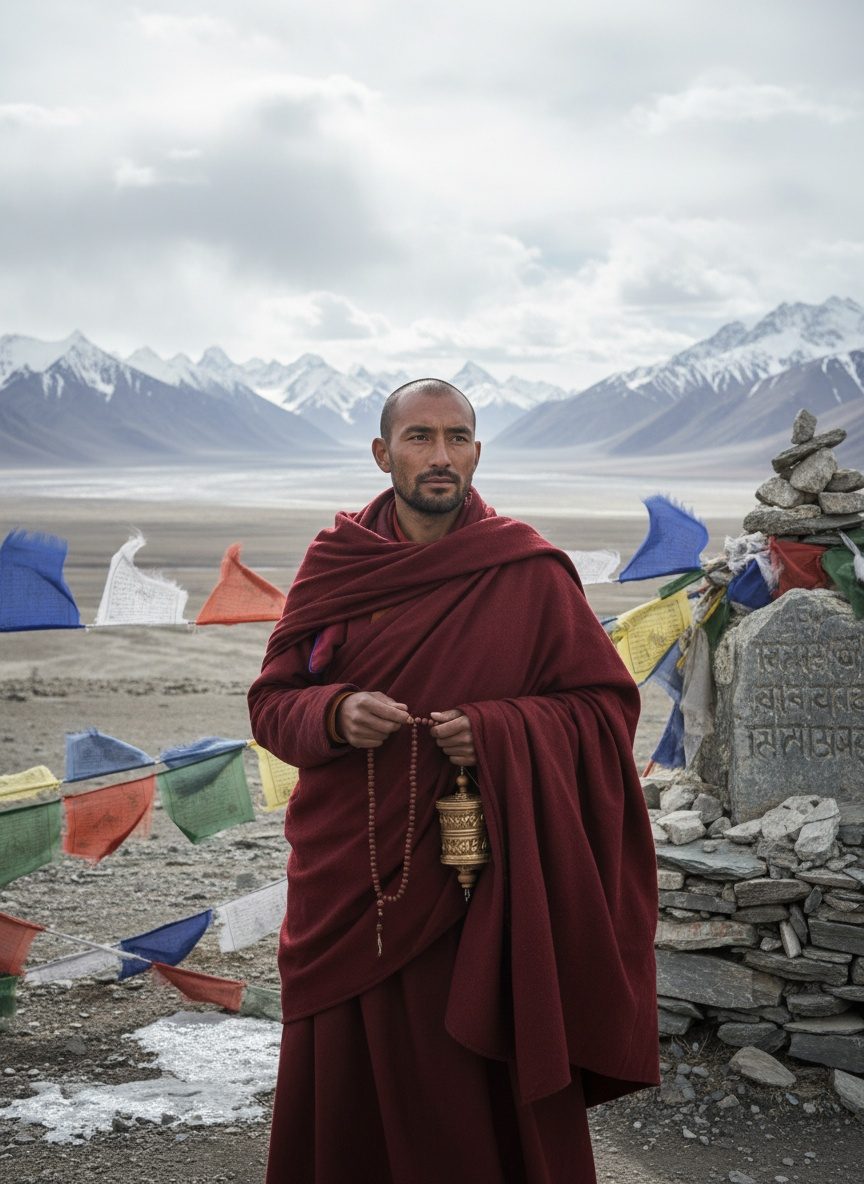
The covert mission had begun months earlier, beneath the dignified facade of the British Survey of India. The enigmatic "Great Game" — a diplomatic chess match between the British and Russian empires — was at its fever pitch. The stakes involved the secrets tucked away in the geographic heart of Asia, in places no foreigner could tread unmasked. Enter Nain Singh, an ingenious solution to an imperial headache. Trained under the watchful eye of the Survey's masterminds, Singh became a master of disguise, adept at moving through the stratospheric realms of Tibet in the guise of a humble lama or merchant. He had learned to walk like a monk. To pray like a monk. He even concealed a sextant in his robes, while his rosary became a rudimentary but precise distance-measurer, each prayer bead marking his tireless stride.
The air was thin and each breath seemed lighter, almost ephemeral. He would happily recount tales from his rich homeland to stave off suspicion. The remote villages and incantatory landscapes he walked captivated his mind; each temple bell's peal was a signal to remain steadfast. Nain meticulously counted his footsteps — 1,580 miles became an unfathomable 3,160,000 paces. This human odometer was his most potent tool, transforming personal endurance into geographical revelation.
The magnitude of Nain Singh's mission demands more than a glance. It requires a full unfolding of his intrinsic motivation and training, nurtured by a lineage of explorers from the Johar Valley. The land of his birth, peppered with snow-fed streams and shadowed by the mighty Himalayas, had long been a cultural crossroads, a place where commerce melded with the spiritual. This cultural heritage became the foundation upon which the British built their empire of exploration — where indigenous knowledge met the steely precision of Victorian surveying instruments.
Neatly tucked away in Code Name Number 9, Nain Singh would defy odds, cross into the forbidden city of Lhasa in 1865, and change the known world map forever. His undercover achievements included calculating the exact position and altitude of the once-illusive capital. The heart of Tibet, which swam in the foggy annals of British cartography, now beat with measured precision, drawn out punch by treaded punch in Nain Singh’s painstaking reports. He uncovered truths about the Brahmaputra's voyage that had intrigued geographical espionage circles for years.
The stark beauty of the Himalayas belied its challenges. Nain Singh knew how to endure travails that would break most humans. Blinding snowstorms that stole vision, frostbite that nibbled at skin, endless plateaus of barren cold — his survival and triumph were testimony to his indomitable spirit. Just like the peaks that kissed the heavens, Singh stood taller than a mere explorer. He was a silent harbinger of knowledge, an unsung hero walking amongst giants and gods. His every breath harmonized with the whispers of the wind, and his every step echoed in the silence just beyond the mountains’ shadow.
Though the empire commissioned other skilled "pundits," none paralleled the bravery and brilliance synonymous with the name Nain Singh. Over subsequent assignments, he would cover more treacherous terrains, from the Yaksa mountains to the green stretches along the yang of Central Asia, his compass hidden in the guise of a prayer wheel, his loghidden within the silent reveries of a wanderer. Returning with tales sculpted from ice and stone, his narratives drew maps not only of lands but of cultural fascinations: forbidden cityscapes hidden under skies that only a few dared to challenge.
In his wake, Nain Singh left an indelible legacy that transcended immediate military gains. He brought enlightenment as both a guide and a bridge to a broader understanding beyond imperial divides. While he breathed his last in 1882, in the solitude of his mountainside origins, his pioneering guides did not die with him. Instead, they flowered, whispered through the silent cries of battling Himalayan winds, echoed in navigational tomes etched with his journey, continuously looped across the tapestry of legend and history. Though described as a spirit who walked across height and expanse beyond mere human endurance to draw the very lilt of the earth's tapestry, he remains locked outside the day-lit pages of many textbooks.
So why does this tale, sprawling across maps and time, reverberate into present concerns, echoing across borders yet? Because in each footfall of Singh's silent march lies a meditation upon the sheer power of individual odyssey — a quest far beyond territorial conquest, restrained not by language or political frontiers, but cast in the language of humanity itself. He is not just a figure etched into the ink lines of maps created, but an embodiment of the human spirit's longing to discover and connect. His story whispers to us: in maps overlooked or in trails revisited, all roads, perhaps, beckon onwards into a semblance of home.