Most people recall the Victorian era as a time when the British Empire carved its domain across the world. Few realize the extent of the individual sacrifices it demanded. One such sacrifice came in the form of Nain Singh, an Indian schoolteacher whose extraordinary courage changed the course of cartographic history.
The Forbidden Land
In 1865, crossing into Tibet was a journey into a realm shrouded in secrecy and danger. For a foreign intruder, the penalty was not imprisonment or expulsion; it was death. Yet, for Britain during the Great Game—the strategic rivalry with Russia over Central Asia—a map of Tibet's uncharted territories was invaluable. Tibet’s isolation was both its allure and its mystery, a blank spot in the imperial playbook that Britain was determined to fill. To navigate this treacherous land, the British would need someone who could blend seamlessly into the crowds, someone unnoticed until it was too late.
Enter Nain Singh. From the bustling bazaars of Kumaon, Singh emerged with a reputation not as a spy but as a teacher. Yet, under his scholarly demeanor lurked a fearless wanderer, eager to tread where others dared not. His mission: to navigate 1,200 miles of Tibet's perilous landscapes and return with a map that the world had never seen.
The Pilgrim’s Disguise
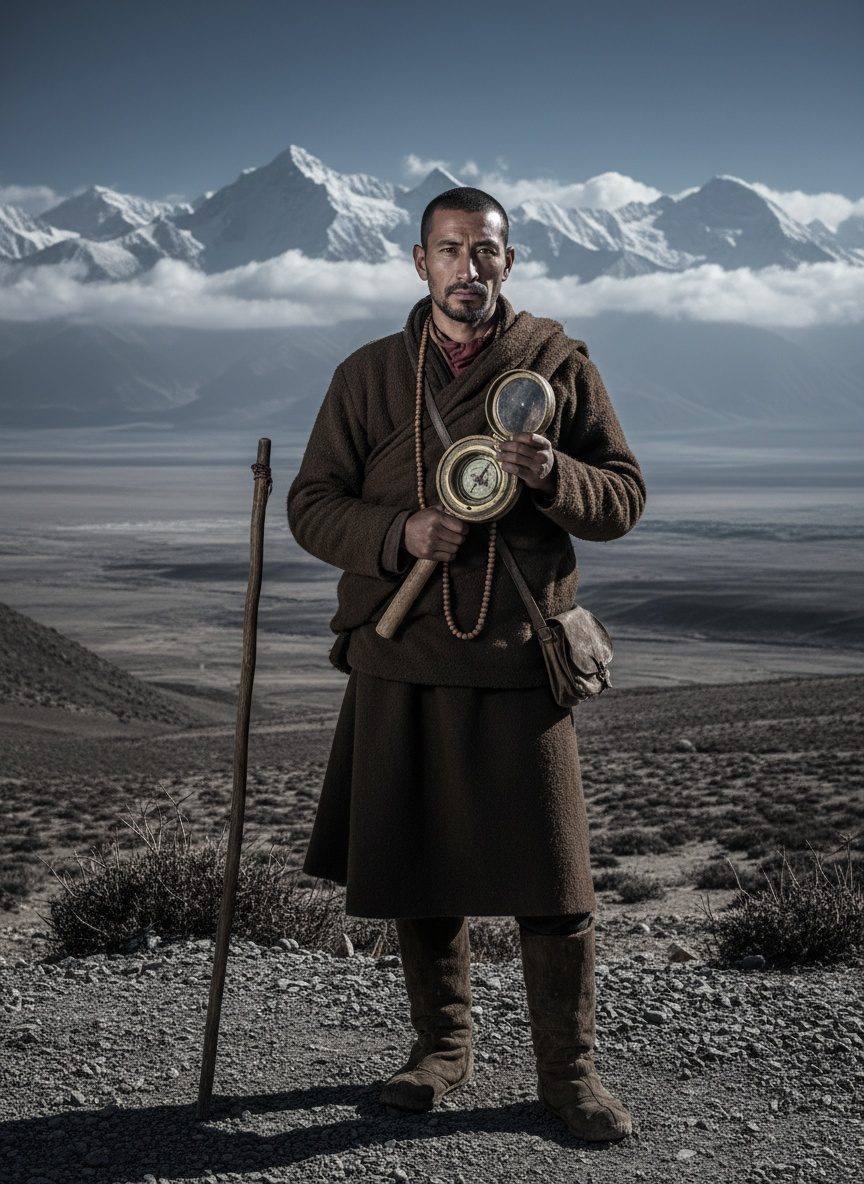
To conquer the unfathomable challenges ahead, Nain Singh donned the guise of a Buddhist pilgrim. Clad in traditional robes, he gently spun his prayer wheel with each step. But his wheel was no ordinary artifact of faith; hidden within was a compass, his clandestine tool to chart the unknown. With every whispering turn of the wheel, Singh logged navigational data invisible to any prying eyes.
But this ruse was only part of his meticulous preparation. Singh mastered the intricate customs and languages of Tibet, allowing him to pass undetected beneath the very noses of potential adversaries. In a land where each step could spell discovery and doom, Singh’s unassuming demeanor was his strongest ally.
A Journey of a Million Steps
Counting each step in leagues beyond the scale of ordinary travelers, Singh meticulously documented each one to cover the distance—an astonishing 1,200 miles. To maintain accuracy over this immense journey, he relied on a compass and the daring precision of his own pace. Each step was a data point logged in his memory, later transcribed in the form of meticulous notes woven into the fabric of religious texts.
Traversing formidable terrain—from daunting Himalayan passes to the expansive Tibetan plateau—Singh faced not just geographical challenges but the unrelenting threat of the elements. A slip could mean icy oblivion, a wrong turn could lead straight into the arms of a hostile patrol. Yet, Singh’s resolve remained unwavering, steeled by the knowledge of what his observations might yield. This was more than mere espionage; it was an epic quest to illuminate hidden realms.
Changing the Map
When Nain Singh returned from his odyssey, he did so with an unparalleled treasure trove of information. His work was not merely a map but a revelation. For the first time, Britain possessed a detailed layout of the intractable Tibet, sketched by the footsteps of an extraordinary individual who, against all odds, explored the forbidden expanse with nothing more than wits and will.
The maps Singh produced became pivotal to the British strategic position in Asia. They revealed the topography, the settlements, and the geography of Tibet with a precision that was previously unimaginable. Singh's contributions extended beyond his final report; they marked a turning point in the relationship between imperial powers and the lands they sought to map and understand.
Nain Singh remains an emblem of human resilience, his story a testament to the power of an individual’s courage against insurmountable odds. His adventure in Tibet underscores the unseen chapters of imperial history—of those who journeyed into the unknown and changed the world one step at a time. As we reflect on his odyssey, we are reminded that history is not just written by those in power but also by those who defy fear to reveal the world’s hidden corners.