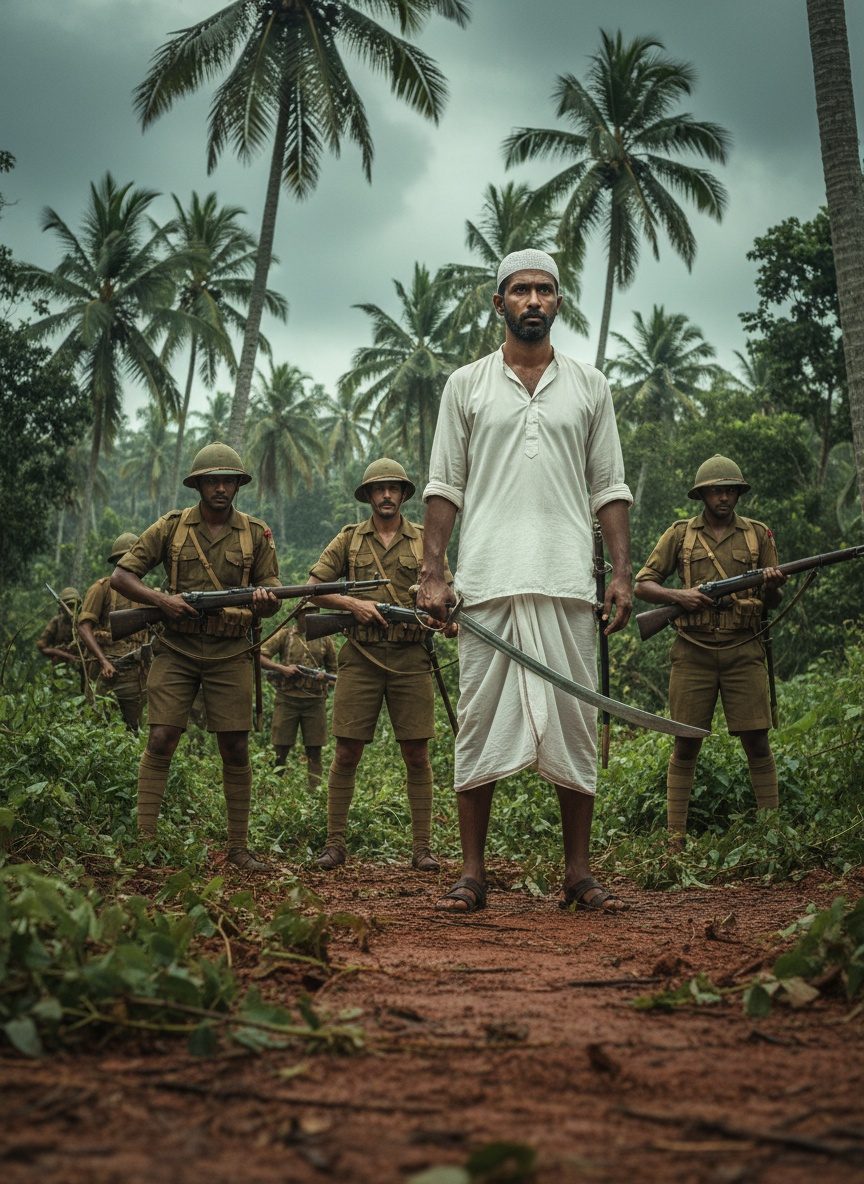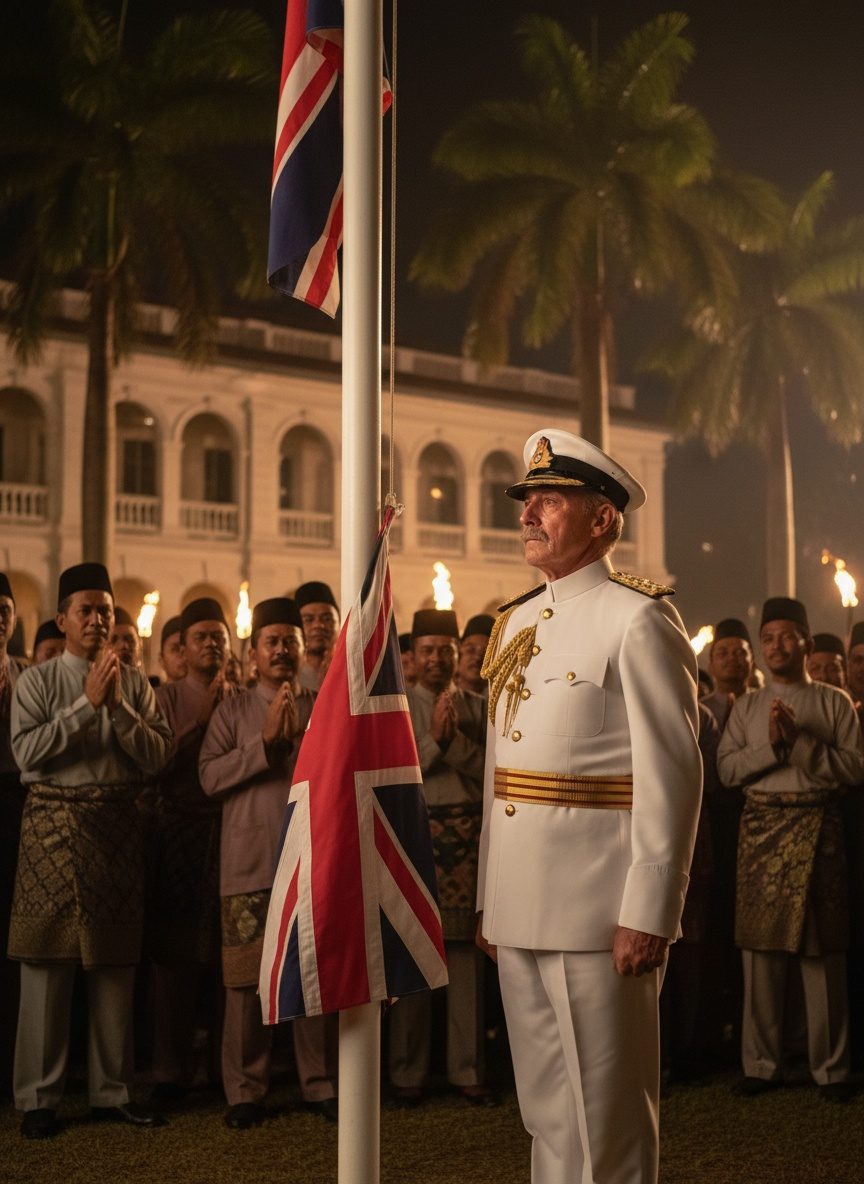
The morning light crept softly over the parade ground in Kuala Lumpur, casting long shadows that mirrored the historic weight of the moment. The air was thick with expectation, buzzing like a low hum that resonated in the hearts of those gathered. Against the pale sky, the Union Jack fluttered proudly for the last time, an emblem of an era that was drawing to a poignant close. It was August 1957, and the atmospheric tension was as palpable as the heavy humidity that cloaked the city. Every eye was on Sir Donald MacGillivray, the last British Governor of Malaya, as the ceremony began.
A Legacy of Transformation and Transition
Malaya, a tapestry of emerald landscapes and cultural convergence, had for centuries been the gleaming jewel of strategic colonial ambition. Yet, standing at the crossroads of historical pivot, it was about to redefine its destiny. Sir Donald MacGillivray had spent years meticulously preparing for this day. His tenure as governor was marked not by the customary iron fist of colonial rule, but by a genuine endeavor to understand and respect the intricate fabric of Malayan society.
His focus was sharply tuned to ensuring a peaceful transfer of power. MacGillivray worked tirelessly with local leaders, bridging divides with diplomacy rather than demand. His efforts ensured that the transition was not only peaceful but was imbued with an authenticity that promised prosperity and continuity for a burgeoning nation. The ceremony was a realization of that vision, a testament to the years spent fostering trust and mutual respect.
The Emotional Gravity of a New Dawn
As the band struck up the formal strains of "God Save the Queen," a hush fell over the crowd. It was a scene that could have frosted hearts with solemnity. Instead, an unexpected warmth embraced the assembly. When the Union Jack descended for the last time, Sir Donald MacGillivray stood at attention, his expression as solemn as the occasion demanded — until the tears came, unbidden and raw in their honest sentiment.
He was not alone in his emotional vulnerability. The crowd, a mosaic of ethnicities and backgrounds, stood alongside him, united not only by shared history but the shared possibilities of the future. The solemnity of the anthem gave way to an emotional release, an act of catharsis that transcended loss and celebrated new beginnings.
Flags as Symbols, Flags as Stories
The British presence in Malaya, like so many parts of the empire, was inexorably linked to the symbolism of the Union Jack. More than just a banner of imperialism, it represented a complex relationship with its colonies—one that entailed not just subjugation but also cultural exchanges and shared development. As it was lowered, the stark realization settled in that what was at hand transcended mere political protocol; it was the closing chapter of a storied relationship between people.
Rising resolutely to take its place was the flag of an independent Malaya, embodying the aspirations and dreams of millions. This was more than a ceremony of flag change, but an emblematic transition reflecting a cultural and political awakening. The hoisting of the Malayan flag did not just signify independence; it was a visual punctuation to the narrative Sir Donald MacGillivray had helped craft, an acknowledgement of Malaya’s voice as it stepped into the pages of a new story.
Unexpected Joy in the Heart of Change
What followed the formal aspects of the occasion was not the anticipated heavy burden of an ending, but rather a surge of unexpected joy. As the crowds dispersed into celebrations across Kuala Lumpur, an electric excitement filled the air, turning what could have been a somber occasion into a lively festival of national identity. Sir Donald MacGillivray, much to the surprise of those who had expected the day to be marked with gloom, was seen smiling amid new friends, caught up in an outpouring of hope and optimism as Malaya took its first steps as a nation.
The celebrations rolled through the streets in a vivid splash of colors and sounds, embodying the resilient spirit of a people ready to navigate their own course. Dancers moved freely, children laughed with the unbridled exhilaration of freedom, and families gathered to share stories of what had been and what was to come. In those moments, unity became more tangible than politics, and hope more palpable than history.
The Irony of Tears, a Testament to Hope
Reflecting on that pivotal day in August 1957, one grasps the puzzle of emotions bound to pivotal historic transitions. The tears of Sir Donald MacGillivray captured this irony perfectly—his sorrow was not for the loss of empire but for the bright birth of a new era. He wept for the shared journey, for the bridges built and the legacy left behind. Most crucially, his tears were ones of hope, a silent prayer that the seeds of respect and cooperation he helped sow would blossom into a future shaped by the hands of the Malayan people.
Such stories remind us that history is not just an accumulation of dates and events but a living narrative that echoes through generations. It is the stories left untold, of individual hearts beating in time with epochal change, that leave an indelible mark on our understanding of the past. The tale of Malaya's final days under British rule is not just about the decline of an empire but also an eloquent prelude to sovereignty, illustrating the nuanced evolution from colonial rule to national identity.