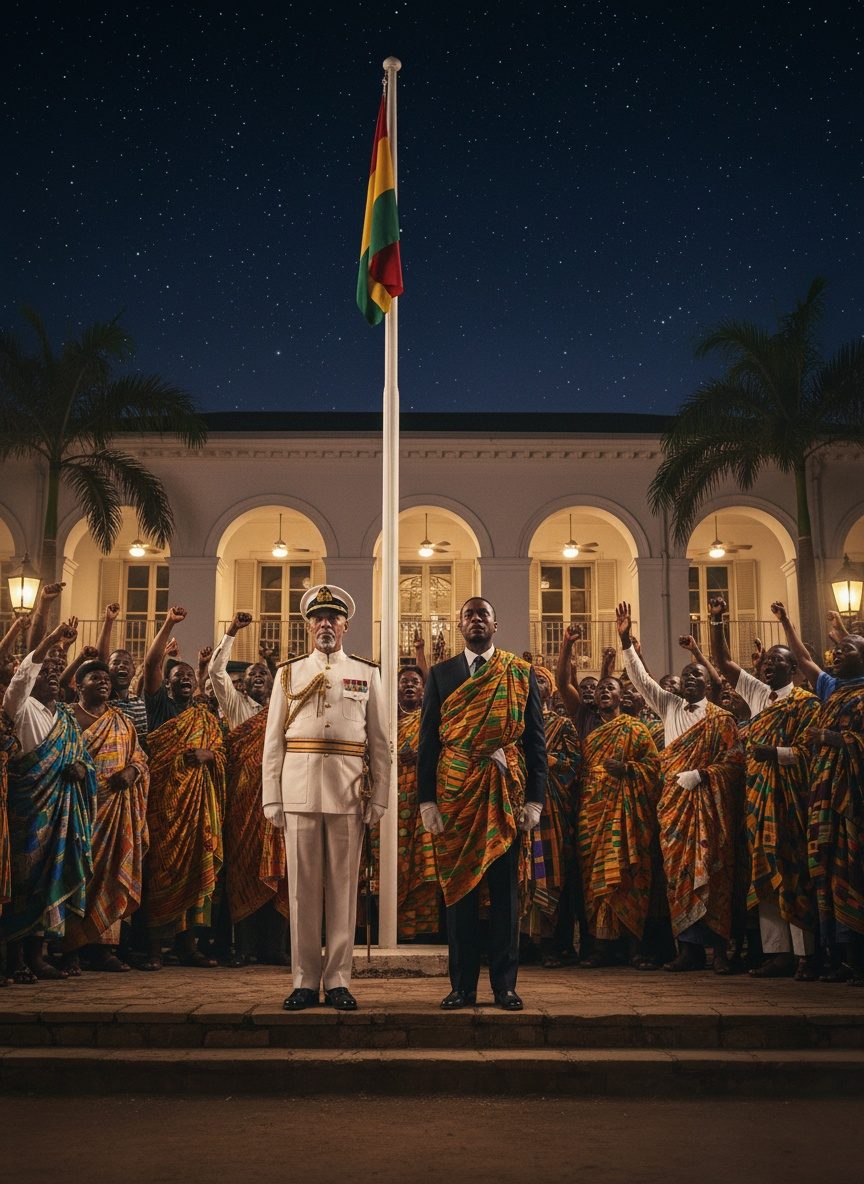
The fabric ascended the pole, gathering its folds methodically against the crisp morning air. In the crowd, eyes strained against the light of the rising sun, intent on the bright new flag unfurling high above them. Voices barely breathed, shoulders pressed against each other, hearts thumped in unison, building a pulse that matched the wait for the historical pivot. And then came the rush—the Union Jack lowered, its absence immediately filled by the vibrant colors of red, gold, and green, accompanied by a rampant black star that beamed promise and independence across the gathered sea of humanity. The silence broke. The crowd erupted in a shared roar that seemed to travel beyond Accra's borders, reverberating across the whole continent. Ghana was born.
This was not merely the birth of a country but a powerful symbolic act that signified the beginning of a new era for Africa. For more than a century, the Gold Coast had been a crown jewel in the British Empire's colonial treasury. A land rich in gold and abundant in cocoa, it was a place that powered industries far beyond its shores, yet its own people saw little of the fruits harvested under alien rule. The transition of power on that symbolic midnight in March 1957 was the climax of a journey of ambition, resilience, and unyielding tenacity.
Kwame Nkrumah—whose very name seemed to echo determination—stood proudly, embodying that moment of transformation. Born into the world with little to his name, Nkrumah had risen through the crucible of education and international exposure, his journey taking him from the silent corridors of Achimota School to fevered discussion halls at Lincoln University in Pennsylvania. Here was a man who balanced between the worlds of pan-Africanism and pragmatism, a leader whose charisma galvanised the masses into a collective national rise. He did not have to lift a weapon to lead a revolution; instead, his formidable weapon was his vision, fostered by ideas of freedom that spread like wildfire through radio broadcasts and passionate rally speeches.
Nkrumah's message was clear: total independence. It was a frictional proposition in the 1950s, a time when the map of Africa was marked by colonies like some modern-day chessboard. Despite resistance from colonial power-seekers, his words found fertile ground in the hope and anger that simmered under the colonial landscape. Each strike, each protest, added another stitch to the dream of a self-determined future. These efforts were far from disorganized rabble; they required strategy carefully orchestrated through political platforms, such as Nkrumah's Convention People's Party, which artfully balanced grassroots support and legislative action.
The march toward independence in the Gold Coast was a delicate dance. Nkrumah's imprisonment in 1950, a consequence of advocating the Positive Action campaign, could have easily turned him into a footnote in the struggle’s history. Instead, it catapulted him to a martyr-like status, embodying the heavy chains that bound his nation. Vote-wielding supporters sent a resounding message of defiance in the elections of 1951, securing Nkrumah's release and entry into government in a position weary with newfound responsibility. These calculated steps converged with steady diplomacy, laying bare the inevitability of a free Ghana in the shimmering horizon.
As March of 1957 approached, the narrative of decolonization was becoming clearer across the continent. Ghana was unprecedentedly about to set a blueprint for liberation, a clarion call that echoed even to distant rumbling uprisings like Mau Mau in Kenya. Beyond Ghana's borders, the eyes of colonized peoples watched eagerly. They saw not only a shift in power but a reawakening of dignity. The implications of the event reached beyond politics and economy, impacting cultural consciousness. It was a heavy torch Ghana carried, lighting the path for others who would soon follow.
Even the British, despite their official stance, were not immune to the moment’s gravity. The ceremony that took place, choreographed with the brisk efficiency and muted grandeur of British tradition, carried the bitter-sweetness of any ending. The last British Governor, Charles Arden-Clarke, took his step back with decorum, understanding that history would now chart its course independently of colonial edicts. This was not just the end of Britain’s oversight over the Gold Coast or the end of an empire. It was the beginning of a self-authored saga for Ghana and, by aspiration, a wider Africa.
The crowd's roar on that dawn in 1957 was not mere jubilation; it was catharsis from years of subjugation. Yet, with liberty came complex challenges—a future demanding answers to questions of governance, development, and unity. How would Ghana's newfound freedom translate into tangible progress? Would the dream suffer dilution faced with the stark reality of poverty and inequality? These were the nuanced struggles grafted to the hopeful yearnings of independence. Nkrumah knew of these challenges and had his eyes fixed far beyond immediate celebrations; he envisioned not just a free Ghana but a united Africa, anticipating a day when colonial borders would be mere artifacts in history's museum.
The morning sun finally bathed the courtyard where thousands had gathered to witness history. Jubilations eventually gave way to the chores of daily life. Yet, under every Ghanaian roof that day, a new story was taking form—the tale of a people responsible for their destiny, written in their tongue. This story of Ghana's independence remains vital not just to Ghanaians but to humankind in understanding the tides of change and the indomitable spirit that fuels resilience and hope. It serves as an enduring reminder that flags, though mere fabric, can soak up the aspirations of millions and that freedom is as tangible as the hands that raise them and the hearts that uphold them.