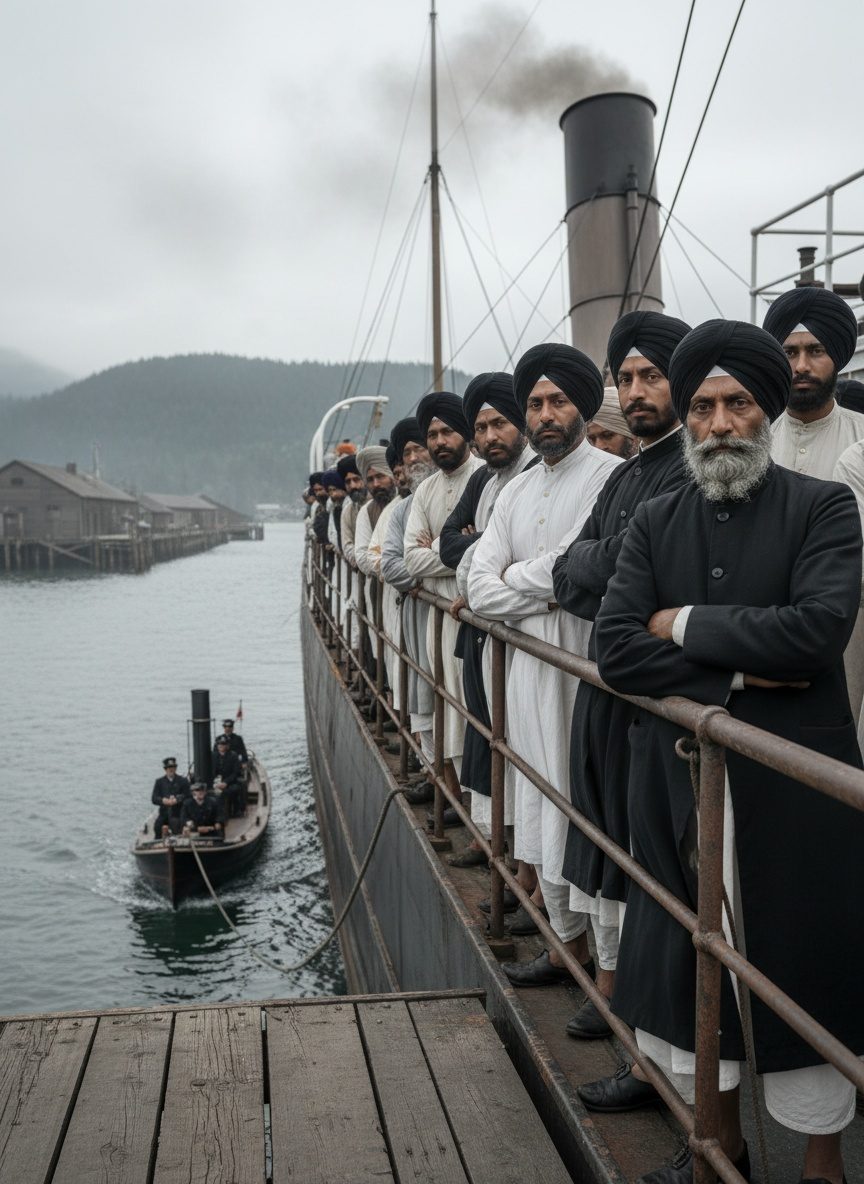
The late spring of 1914 cloaked the waters of Burrard Inlet in the soft luminosity of the Pacific sun, casting long shadows against the shoreline as gentle waves whispered against the hulls of ships anchored in the harbor. It was here, amid the bustling port of Vancouver, that a singular vessel, the Komagata Maru, became a symbol of defiance—a floating microcosm of tension between subjects and empire, tradition and modernity. Within view of the verdant coastlines stood this steel-hulled steamship, stagnating where ocean meets land, a mute yet challenging figure calling into question the very nature of what it meant to be part of the British Empire.
Aboard the Komagata Maru were 376 passengers—Sikhs, Muslims, and Hindus, all subjects of the British crown. They hailed largely from the Punjab region, a land deeply woven into the imperial tapestry, its sons populating the British Indian Army, fighting battles for an empire that now turned an indifferent eye to their plight. The travelers had embarked on this arduous odyssey across the Pacific carrying more than mere luggage; they bore with them a law book, a piece of legislation they hoped would guarantee their entry into Canada, a dominion of the British Empire.
As their vessel anchored near the shore, the passengers found themselves within sight of their intended land—a landscape promising opportunity and justice. Yet, they were denied entry, their dreams temporarily dashed against the unforgiving judicial tides of the Canadian Immigration Act. This act, veiled in the legality of imperial authority, demanded a continuous journey from India, a near impossibility given the maritime routes of the time. Although British subjects on paper, the passengers were met with suspicion fueled by a growing unease about the influx of Asian immigrants.
The decision to challenge the denial was not taken lightly. Standing shoulder to shoulder on the ship's decks, the passengers were acutely aware of the significance of their stand. To many aboard, the trip was a matter of dignity and rights, a venture that transcended personal ambition to touch the larger geopolitical hierarchy, questioning a system that imposed imperial responsibilities but withheld equitable privileges.
In the cat-and-mouse game that ensued, a battle not of arms but of wills and words, the Komagata Maru became a floating courtroom. Legal representatives and advocates fought for their cause, wielding arguments as their weapons, pitting the language of empire against itself. Public opinion on shore simmered, divided between those echoing the words of policymakers, wary of what they saw as an influx of undesirable elements, and others sympathizing with the plight of these travelers, recognizing the injustice of denying entry to those upon whose labor and sacrifice the empire had in part been built.
While the ship languished in the harbor for what would become sixty-seven days, an increasingly tense atmosphere hovered over the communities connected to this maritime stalemate—neighbors, connected yet divided by the sea. Behind closed doors, politicians, immigrants, advocacy groups, and British officials engaged in a diplomatic tug-of-war, their decisions echoing beyond the port, challenging social norms, and stirring racial tensions. In a peculiar way, the ship became an island of resistance, steadfast upon the tides, unyielding.
Inside the hull, living conditions grew increasingly desperate. Supplies dwindled, tempers flared, and hope began to waver against the rhythmic patience of the waves. The passengers' struggle for dignity in the face of exclusion resonated far beyond this inlet. The situation aboard the ship served as a stark reminder to the empire—a reflection of its failure to reconcile its expansive reach with the equitable treatment of its subjects.
In late July, the stalemate reached its zenith. As pressure mounted and the realities of fading provisions pressed on them, the passengers resolved to maintain their defiance until the end, managing to sustain a fragile unity in the face of adversity. Yet, the decision was ultimately made for them. Under the watchful eyes of law enforcement and upon orders issued by bureaucratic decree, the Komagata Maru was compelled to depart Canadian waters, a forced retreat marking the conclusion of this chapter of resistance.
The return journey would not be a quiet passage. Upon arrival back in India, the political climate had shifted. The shadow of the incident loomed large, feeding into growing discontent and escalating calls for independence from British rule. This maritime stand, set adrift in the waters of Vancouver, had sent ripples through the empire, shaking the system at its colonial roots.
More than just a grim recollection of imperial limits, the story of the Komagata Maru challenges future generations to contemplate the intricacies and ironies of sovereignty, nationality, and human rights. As we reflect on this watershed moment in history, we are reminded that the boundaries we draw in policies and regulations often fail to contain the spirit and rights of the people. The Komagata Maru remains an emblem of resilience—a stark testament to the human spirit's indefatigable pursuit of justice and equality against the tides of systemic exclusion. It reminds us that while borders may determine the limits of nations, they can never circumscribe the deepest currents of the human quest for dignity.