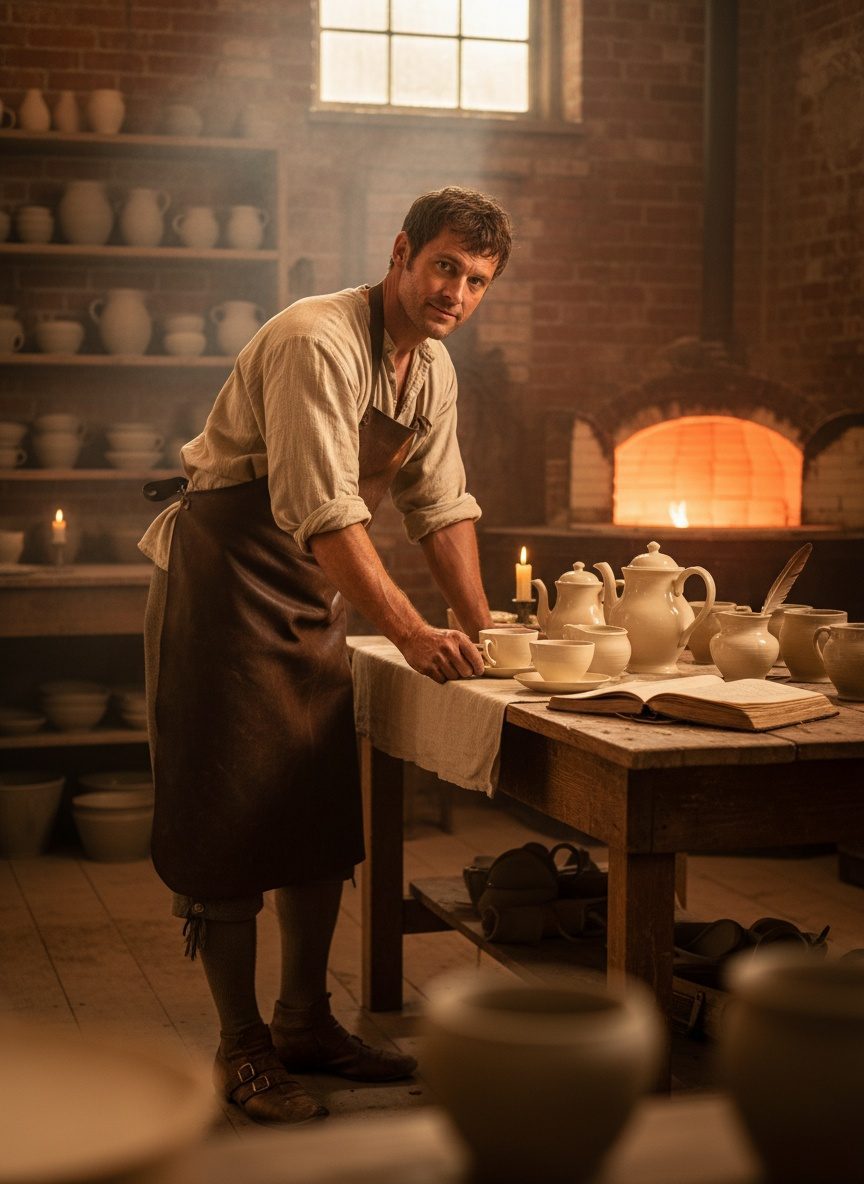
Josiah Wedgwood's fingers pressed deftly into the spinning clay, the wheel a whirl of motion beneath his hands. The subtle hum of the potter's wheel harmonized with the gentle crackle of the kiln, a symphony in earthen tones that filled the workshop with the quiet bustle of creation. A single candle flickered near his workbench, casting a warm glow over the cream-colored clay as his heart thudded with anticipation. He could almost see it now—her majesty's table set with his handiwork, the fine cream-coloured tea service gleaming under the regal light of a chandelier.
The Royal Commission
The scene that unfolded in Josiah Wedgwood’s workshop in 1765 was the turning point in the life of a man on the cusp of transforming the pottery industry. Hailing from Staffordshire, a region renowned for its potters, Wedgwood was no ordinary clay worker. A self-taught artisan, his genius lay not just in molding clay but in crafting opportunity. When Queen Charlotte, wife of King George III, placed her royal order with him for a cream-colored tea service, it was no simple commission. In receiving this royal endorsement, Wedgwood not only earned prestigious patronage but also, crucially, the right to associate his ware with the crown.
To most, it might have seemed like a moment of fleeting prestige, the kind that flickers bright and fast, whispered in salons and drawing rooms before fading into the past. But Wedgwood saw potential well beyond the immediate honor. Seamlessly, he coined the term “Queensware” for the now-praised service and turned what had been a bespoke commission into a standardized product line. This was a radical notion—a single design, emblematic of a single royal moment, sold en masse. The strategy was simple yet revolutionary: what graced the royal table could now adorn any table in England, provided the buyer possessed both the means and the taste.
Within a few years, Wedgwood had shipped his Queensware across England, marketing it as a must-have expression of refined taste and modern luxury. He had democratized his design, a master stroke of branding that went beyond the clay wheels and kiln fires—a true orchestration of commerce and craftsmanship. The once humble potter became a pioneer, with each successful sale not just expanding his reach but laying the foundational bedrock of a burgeoning British industry.
Crafting an Empire
While the world turned towards industrialization, Josiah Wedgwood turned towards imagination. He leveraged the connection with royalty and deftly transformed it into a commercial weapon. By branding his teaware "Queensware," he tapped into a powerful allure: the lure of emulating royalty. This was not just pottery; it was a slice of English sophistication, a piece of the regal presence made tangible and attainable for the emerging middle class.
Wedgwood's approach was distinctly modern, marked by a network of showrooms and catalogs—novelties in the 18th-century commercial landscape. His savvy extended beyond design and distribution; he instituted quality control processes and backed his creations with an unwavering standard of excellence that turned Wedgwood ware into synonymous with quality. Every piece was meticulously inspected, and only those meeting the high standards bore the company’s mark—a strategy that both kept the competition at bay and firmly established his reputation.
He transformed his factory into a place of invention, a microcosm of progress where efficiency met elegance. His Etruria Works in Staffordshire was not merely where he shaped clay; it was where he shaped the future. With divisions of labor reminiscent of the assembly lines yet to define the industrial age, Wedgwood ushered in systemic methods that made pottery both a science and an art. His use of innovative techniques not only increased output but also set a precedent. Each pot crafted in his Etruria Works was a testament to the fusion of art and technique—a harmonious union that resonated across borders and beyond time.
The Legacy of One Potter’s Vision
Wedgwood’s revolution was not in the realm of production alone but in the realm of perception. He changed the narrative around pottery, elevating it from utilitarian necessity to a desirable luxury. But perhaps the greatest testament to his profound impact lies in how far his reach extended—from the lush courts of Europe to the burgeoning societies of America, his designs were sought after, his techniques emulated. His success was a precursor to the boom of British industry, a prelude to the empire of trade that would globalize British influence, not by conquest but by invitation.
Under Wedgwood’s careful shaping, the humble clay turned into vessels of cultural exchange. His wares were more than mere objects; they were ambassadors of a new world order, where commerce and culture intertwined in the kiln’s glaze. In the homes of Boston, the courts of Europe, and the noble tables of St Petersburg, Wedgwood’s pottery became symbols of the interconnected age that was dawning—a beacon of British craftsmanship lighting the way into the modern era.
Josiah Wedgwood's empire was not merely one of industry; it was an empire of influence. Through astute marketing and innovation, he not only defined the standards of quality and beauty in pottery but also redefined what was possible in the realm of commercial enterprise. His story reminds us that empires need not always be built on conquest and might; sometimes, the simple turn of a potter's wheel is enough to spin history into a new direction. The legacy of Josiah Wedgwood, the potter who dared to dream beyond clay, remains in the annals of industry as both a reminder and an inspiration for the craftsmen and marketeers of tomorrow.