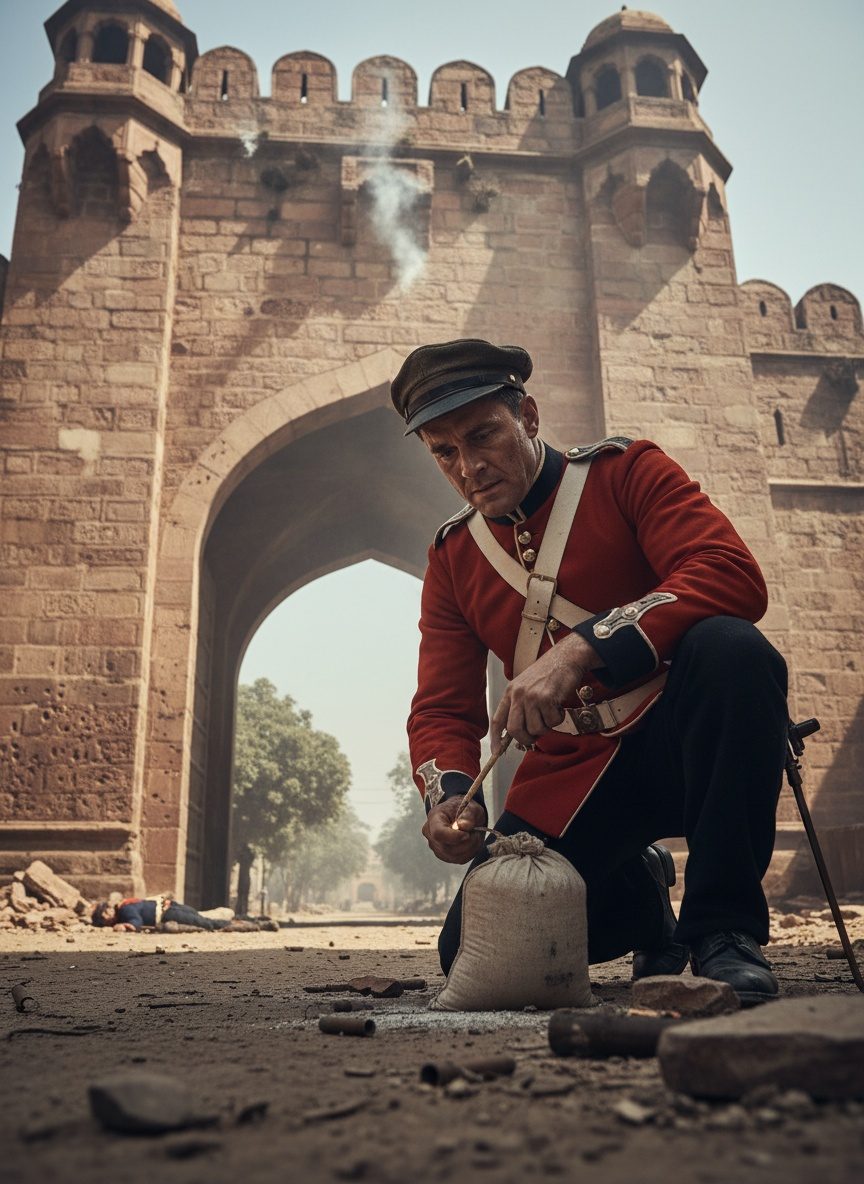
John Nicholson's Engineer blew the Kashmir Gate. Many bloodied heroes never saw their victory.
The Stony Defender
Delhi, September 1857—a city swollen with defiance and coursing with the chaotic currents of rebellion. For three relentless months, it had been a bulwark of insurrection, holding tenaciously against British attempts to suppress the Indian Mutiny, a rebellion that threatened the core of British rule in India. The Kashmir Gate, a seemingly impregnable barrier, was a symbol of the rebels' might, sheltering tens of thousands within the formidable walls of the city.
It was September 14, the day when dust and destiny intertwined. British forces, led by the stern and charismatic Major General John Nicholson, faced the daunting task of storming Delhi. But their path was barred by the Kashmir Gate, an edifice of thick wood and iron that laughed in the face of artillery. Capturing this gate was not merely a matter of breaching a city; it was tearing open the heart of an uprising. Yet, to accomplish this Herculean feat, someone would need to expose themselves to certain death, crossing open ground beneath a barrage of fire to plant the charges.
Four men, driven by fierce loyalty and perhaps an acknowledgment of their expendability, volunteered for one of the war's most infamous acts of self-sacrifice. The mission was not tactically sound; it was a desperation play—a gamble with lives as the stakes. These men, known as sappers, were to lay the explosive charges against the gate, aware that even reaching the door would almost certainly mean annihilation. This was a mission for heroes, and a mission for martyrs.
The Mortal Hand of Destruction
The air sang with the deadly hum of bullets. The moments began to stretch into an eternity as the four-man sapper team approached their seemingly impossible task. Each step closer to the Kashmir Gate meant wading deeper into a hail of gunfire. It wasn’t just the odds they faced, for the ground beneath them was soaked with the echoes of bravery from those who had tried and failed before them.
The sappers were guided by nothing but courage and a grim resolve. In those fleeting seconds, these men became a model of what history would later remember as "doomed bravery." Three of them fell, one by one, consumed by the violence that swirled around them, each lifeless body marking the road to explosion. Only one remained to defy fate boldly. That lone survivor, bloodied but unbroken, reached the wooden surface and set about lighting the fuse. The task required steadiness and speed—no margin for error, no second chances.
As the fuse ignited, the sapper turned and ran, knowing full well he might never escape the impending blast. The world froze, just for a heartbeat, before erupting in a blinding crescendo of noise, splinters, and flame. The Kashmir Gate, which had stood resolute as a sentinel, succumbed to the artifices of mortal hands, blown open in a fantastic burst that scattered defenses and tore a path for vengeance.
In the depths of the inferno, the essence of sacrifice was rendered with brutal clarity. The gate had been unsealed, and with it, the veil of resistance within Delhi began to shred. Through the thick curtain of smoke, British troops surged forward, the roar of the explosion still reverberating in their bones. Yet, for many who remember that chaotic day, the real honor was not in the storming itself but in the silent steps of those four who dared the impossible.
The Echo of Forgotten Valor
The capture of Delhi was a strategic keystone in the reassertion of British dominance over the subcontinent. But while history can recount military movements and tally casualties, it often leaves the human stories untold—those moments when individuals became legends in the narrative of empire. What then survived the assault on Kashmir Gate was not only a token of warfare's violent resolve but a testament to human bravery in the face of doomed ventures.
The act of blowing the gate was not a product of military genius but rather the crucible of human will. It speaks to a historical truth rarely explored in textbooks: that victory often comes at a price calculated in lives willingly offered for a cause few could rationally uphold. These soldiers didn't act for glory or gain but embodied the raw edge of duty that draws the thin line between heroes and stone-carved names.
As the dust settled on the chaos and the city's capture became a story etched in military annals, the name of the surviving sapper faded into obscurity, overshadowed by the broader narratives of empire and rebellion. Yet, in looking back, their story provides a compelling lens through which to deliberate the cost of the ambitions that fueled such grand conflicts. This forgotten act of valor reminds us of the unseen threads of heroism—those quiet moments that shape history as much as the loud thunder of battle. Through this lens, the sacrifice at Kashmir Gate becomes a haunting reflection on human courage when liberty hangs precariously on the edge of oblivion.