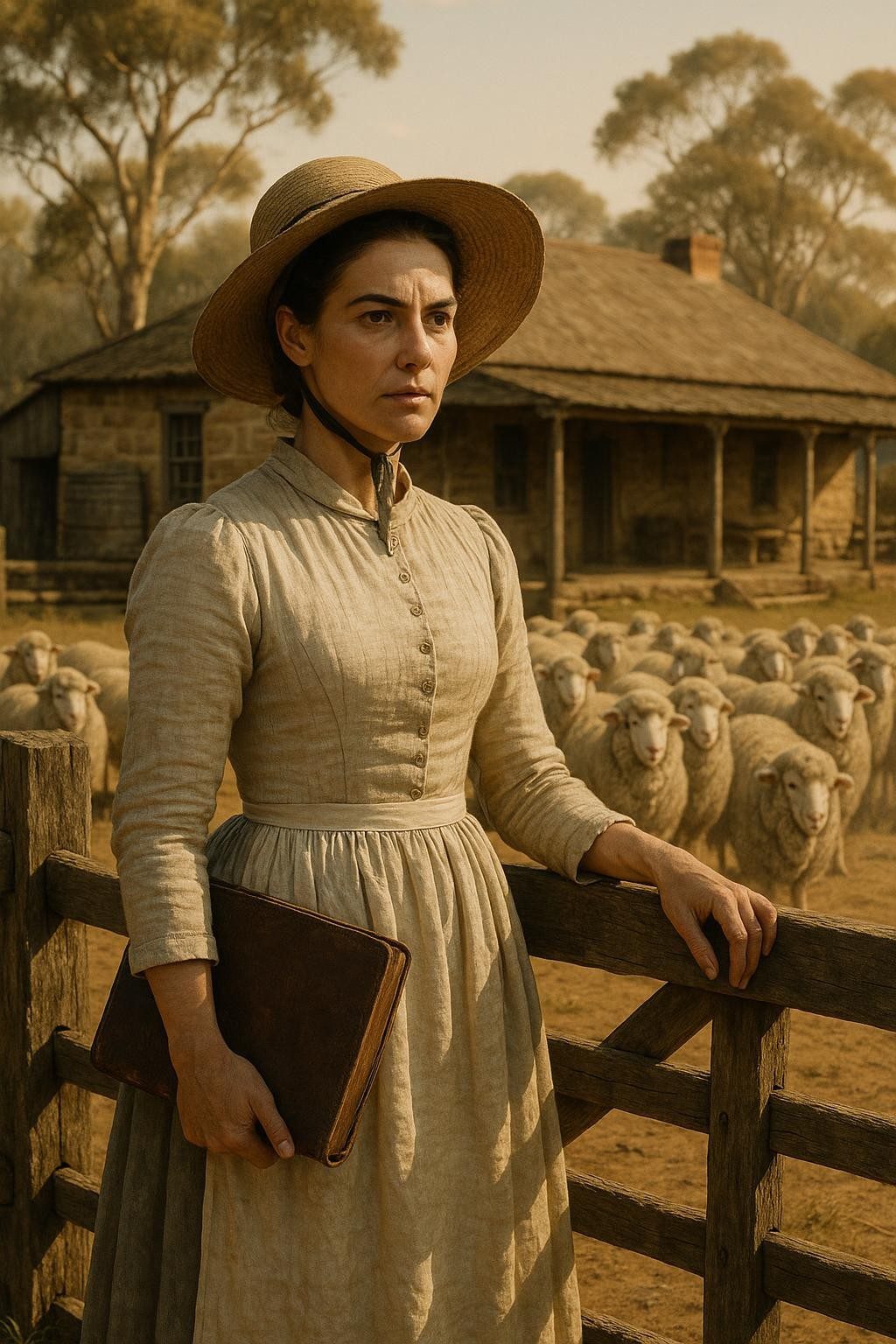
June 15, 1804. The damp chill of an Australian winter hung in the air.
Elizabeth Macarthur watched the ship inch away from the shore, her husband John among its chained passengers. The vessel creaked and groaned under the weight of its new cargo, destined for England where John would face a military court martial. While most eyes were on the departing ship, Elizabeth's attention turned inward, towards her children and their precarious homestead. With John gone, the burden of their future rested squarely on her shoulders.
The Macarthurs had established their foothold in the nascent colony of New South Wales with a vision far from the imagination of most settlers. Australia was primarily known as a penal colony, and the rugged land was both a challenge and an opportunity. John Macarthur dreamed of transforming the harsh bushland into a burgeoning wool industry, a dream symbolized by their small, delicate flock of merino sheep. These sheep were unlike the common English breeds, prized for their fine, soft wool. Acquired from Spanish stock by John Macarthur, their value was immense — at least in his eyes. To many others, they were just another risky venture in a land of uncertainty.
Left alone with seven children, Elizabeth stood at a crossroads. Managing Elizabeth Farm was no small task; it was still in its infancy with half-built enclosures, scant resources, and those invaluable sheep grazing among the eucalypts. She knew that the survival of the flock was crucial not just for her family's livelihood, but for the economic potential inculcated in those bleating creatures. The sheep held a promise that she was resolved to nurture, despite the odds stacked against her.
Elizabeth was no stranger to tenacity. Born into a world where women were often sidelined, her role was often relegated to that of wife and mother. Yet, in the absence of her husband's steady hand, she became her own overseer. Her daily life transformed into a whirlwind of duties which included herding sheep, managing farm laborers, tending to the children, and maintaining correspondence with John, who was fervently advocating for the wool industry from his distant confinement.
While the elements in Australia could be unforgiving, so too could the settlers. Many considered the Macarthurs' scheme folly, doubting the climate's ability to sustain such specific livestock. Elizabeth had little time for their skepticism. Her days stretched long into the fading light, filled with practical tasks she learned to master. She personally oversaw the help, scrutinizing their every move, ensuring the sheep were given the utmost care. Elizabeth became fluent in the language of wool – its grades, its marketability, and its potential. Through meticulous record-keeping, she monitored the flock’s growth and health, identifying which schemes worked and which faltered.
Over the course of the four years John spent in England, carried away by winds and politics beyond their control, Elizabeth’s efforts bore fruit. The merino sheep multiplied under her care, thriving more than the doubters had predicted. She expanded the flock's size, improving their conditions and paying heed to their nature rather than attempting to mold them by European standards. This was no small feat – it was a testament to Elizabeth's acuity and relentless diligence.
The colony faced its woes, economic strains, and sparse resources. Yet Elizabeth's station, standing as a beacon of agricultural promise, signaled that sheep could indeed flourish here. She resisted calls to sell their sheep, understanding that the true value lay in their progeny. Her foresight ensured that when John finally returned, he was greeted not by desolation but a thriving enterprise he could scarcely have imagined.
For the returnees of 1808, Elizabeth's success was unmistakable. The flock had not only survived but had robustly grown, its wool attracting the keen interest of British traders. This success would go on to lay the groundwork for an entire industry, as Australia began to weave itself into the fabric of the global wool trade. The country became a cornerstone of the British wool market, setting the stage for the fervent pastoral expansion that would define much of its economic life.
Elizabeth Macarthur's quiet stewardship during those years left an indelible mark on the Australian landscape. Her ability to adapt, learn, and overcome the profound challenges she faced is not widely celebrated in mainstream accounts, yet her work was foundational.
It's tempting to summarize this chapter in the tale of colonial Australia as a footnote to John Macarthur's contributions. However, to do so would be to miss the essence of Elizabeth's story, rich with lessons about perseverance, vision, and the silent power of fortitude. Without her, the sheep might have dwindled, the opportunity lost, and the pages of history quite different. Her legacy whispers through the millions of sheep that roam the fields today — a testament not only to a flourishing industry but to the determination of one extraordinary woman who defied societal norms, braving solitude and adversity to change the course of her colony's future.