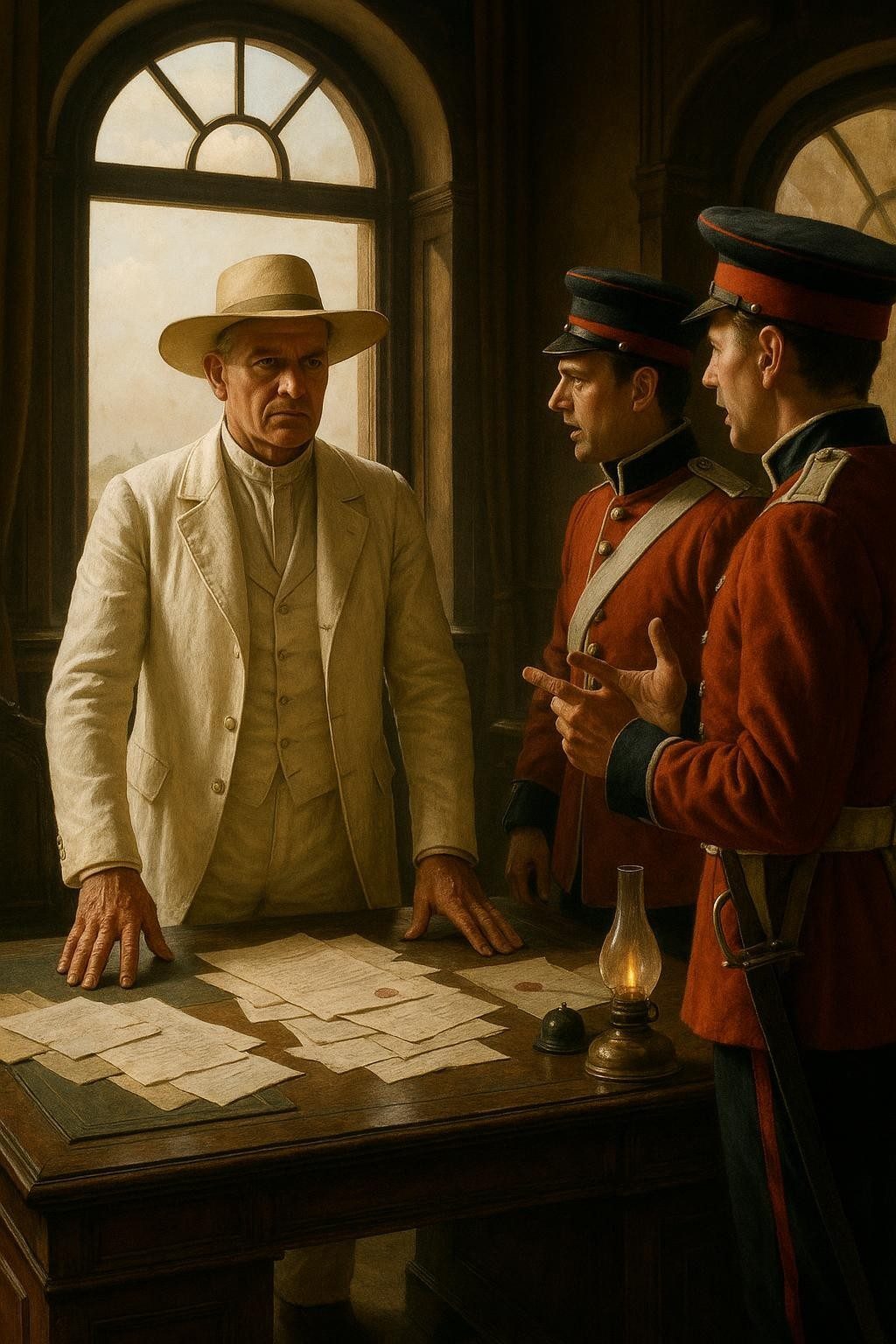
The air was electric with tension as John Laird Mair Lawrence stood before the assembled officers. The murmurs of discontent reverberated through the room, mingling with the oppressive summer heat. He could feel their eyes on him, a palpable mix of skepticism and fear as they considered the enormity of the decision at hand. Outside, the distant sounds of the bustling bazaar in Lahore seemed like echoes from another world, one undisturbed by the dark specter of mutiny looming on the horizon.
In the flickering candlelight, the faces of the officers mirrored the landscape of India itself — vast diversity bound by a single tenuous thread of authority. With the Mutiny of 1857 spreading like wildfire, many garrisons had already succumbed to chaos. Delhi was ablaze with insurrection, the symbol of British power teetering on the brink of annihilation. Yet here in the Punjab, nestled at the heart of a volatile empire, fifty thousand sepoys stood armed and potentially dangerous. Lawrence knew that inaction was a luxury they could not afford.
Drawing a deep breath, he addressed the assembly. "Gentlemen," Lawrence began, his voice steady yet urgent, "the choice we make today will decide whether the Punjab stands or falls." The room fell into a heavy silence, each man weighing the risks of what lay ahead. To disarm these sepoys was to strip away any chance of immediate reprisal against mutiny, a perilous gamble in the eyes of many. Yet Lawrence had seen what unchecked rebellion had wrought elsewhere and was convinced that vigilance now would prevent catastrophe later.
What many didn't know was that Lawrence, the Chief Commissioner of the Punjab, had already been quietly laying the groundwork for such an audacious move. His network of spies, an intricate web spun across the province, fed him vital intelligence that others could only grasp at. He cultivated loyalty among the local chieftains and leveraged alliances with influential Sikhs and Punjabis, understanding deeply that unity was his strongest shield. If the spark of rebellion were to catch, Lawrence intended to ensure the fire would have no kindling in Punjab.
As he outlined his strategy, Lawrence emphasized acting before the flames reached them. The officers' faces revealed shadows of doubt, yet they began to nod, a sign of trust in his leadership. History would remember Lawrence's resolve as the backbone of his success — his ability to foresee disaster where others saw mere possibility. Many in his position might have succumbed to the pressure of conventional military wisdom, yet Lawrence had always danced to the beat of prudent defiance, engaging in calculated risks when the stakes demanded it.
The days that followed his decision became a race against time and fear. Across the Punjab, orders were swiftly disseminated, regiment by regiment. Local chiefs were summoned, their support enlisted under the veil of both respect and necessity. The disarming, begun quietly, quickly turned into scenes of tense confrontation. Sepoys, torn between loyalty and simmering resentment, were ushered into cantonments where their weapons were surrendered. In the glow of rifle racks being emptied, Lawrence's gamble began to reveal its worth.
The immediate impact was palpable. Having uprooted the potential for mutiny from within his own ranks, Lawrence not only fortified the military stability of Punjab but also sent a message rippling through the ranks of any would-be rebels: the British would not be caught unprepared again. The sepoys, disarmed yet respected, saw no immediate benefit in rebellion without the element of surprise. In this single, decisive act, Lawrence reshaped the tide that threatened to drown them all.
Yet, while the soldiers of Punjab laid down their arms, the ghost of unease still haunted the province. Lawrence knew his victory was not without cost. As whispers of his arguably unorthodox methods reached British ears in distant corridors of power back in England, his reputation became a subject of intense debate. Critics murmured of tyranny veiled under the guise of necessary action, while staunch proponents praised the stability he had forged out of chaos.
As the rise and fall of this storm settled into history, Lawrence's choice stood distinct, casting a long shadow over subsequent chapters of British colonial strategy. The Mutiny of 1857, one of the most formidable uprisings faced by the British Empire, found itself blunted in Punjab—a testament to what one resolved individual could achieve against overwhelming odds. While Delhi faced the brutal onset of mutiny, Lahore remained secure, a bastion amid the turbulence precisely because one man refused to stand idle in the face of impending disaster.
Reflecting on the iron resolve and tenacity John Lawrence demonstrated illuminates the complexity of leadership under duress. In choosing to disarm the sepoys, he not only forestalled a potential disaster but redefined a province's narrative amidst an empire's upheaval. The Punjab held indeed, an enduring testament to a leader's audacious defiance in the face of calamity. As we sift through the chapters history chose to leave out of the textbooks, stories like Lawrence's reveal the intricate dance of courage and calculation that often goes unseen, urging us to examine beyond the legends and recognize the overlooked architects of an empire's fate.