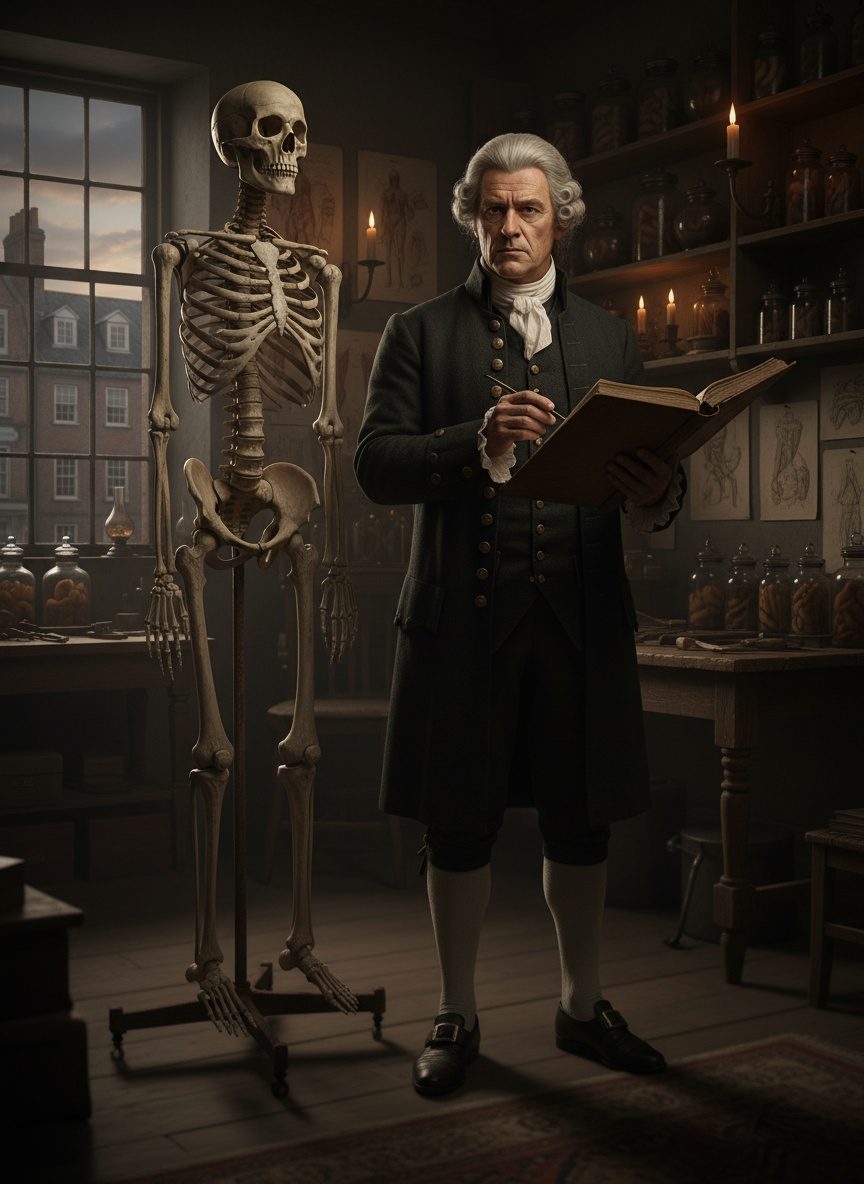
John Hunter is widely celebrated as a pioneering surgeon. Yet one of his boldest acts was stealing the body of Charles Byrne, a man who lived in constant fear of precisely such an aftermath.
The Irish Giant in Georgian London
In the cacophonous heart of Georgian London, a city vibrating from the fervor of the Enlightenment, strolled a figure who captured imaginations like no other. Charles Byrne, born in 1761 on the verdant isle of Ireland, was unlike his peers in ways both profound and visible. Standing a staggering 7 feet 7 inches tall, Byrne towered over the hustle and bustle of the age, becoming a living legend during his lifetime.
Byrne's extraordinary height brought him both fame and misfortune. He traveled to London in the early 1780s, where he was exhibited as the "Irish Giant," drawing crowds from all over to marvel at his stature. Thousands flocked to witness this marvel of nature in person. Yet beneath the public fascination lay a life marked by vulnerability. Byrne struggled with the health complications customary to gigantism, and as he wandered the streets of London, he cast an anxious look towards the city's medical men.
In an era where medical science was beginning to embrace the ambitious, albeit frequently unethical, pursuit of understanding the human body, Byrne’s rare condition made him a coveted subject for surgeons eager to unlock his mysteries. Foremost among these ambitious men was John Hunter, a surgeon whose drive for knowledge sometimes eclipsed ethical considerations.
A Surgeon's Obsession
John Hunter was a renowned figure in London's medical circles, a man of remarkable intellect and insatiable curiosity. Born in 1728, Hunter's contributions to the field of surgery were revolutionary, spanning from new surgical techniques to the classification of thousands of anatomical specimens. His home in Leicester Square was both an abode and a museum, filled with countless curiosities collected over decades.
After hearing of Byrne’s condition, Hunter’s interest was piqued not by the Irishman's living presence but by the possibilities his death presented. Byrne, however, was acutely aware of the attention his body might garner. He was tormented by the thought of ending up as yet another exhibit in the burgeoning collections of English surgeons. Determined to avoid this fate, Byrne orchestrated a plan for his body's disposal: he purchased a coffin and enlisted trustworthy sailors to ensure his remains would be cast into the depths of the sea, far from the reach of prying hands.
Despite Byrne's efforts, Hunter’s determination knew few bounds. As Byrne lay dying in 1783, Hunter plotted his own scheme. With the tantalizing promise of money, Hunter bribed Byrne’s acquaintances, securing cooperation that would deliver the body to the surgeon instead of the sea.
The Night of the Body Snatch
With Byrne’s death in 1783, Hunter's machinations came to fruition. In the shadowed corners of London, the nocturnal exchange took place. With the silent complicity of Byrne's supposed friends, Hunter claimed his prize. The sheer audacity of the act cannot be overstated. Unlike traditional grave robbing, this was an act completed under the bright lights of British society, a brazen acquisition that highlighted both the allure and moral complexities of medical study in the Georgian era.
Byrne's body was soon transported to Hunter's residence, where it was macerated, and its skeleton prepared for display. The skeleton was eventually mounted and included in Hunter's personal collection. When the collection was sold to the Royal College of Surgeons in London, Byrne's remains took their place among Hunter’s other collected oddities.
For more than two centuries, the skeleton of the Irish Giant could be found in the medical museum, a somber testament to Hunter's obsession and the ethical quandaries that rode the coattails of scientific progress.
A Legacy of Controversy
Byrne's story might have settled into the obscurity of history, were it not for the persistent discussions it kindled about consent, ethics, and respect for the dead—topics that reverberate through the corridors of medical history. For many, Byrne's saga embodies a cautionary tale about the lengths to which science might go and the personal agency that should endure beyond death.
As bones that were never meant to be seen stood on display, Byrne's story highlighted the often troubling intersection of human ambition and morality. In life and in death, he became a silent pedagogue on the ethical responsibilities intrinsic to scientific inquiry. Despite his wishes being blatantly ignored, Byrne's legacy endured as a call for compassion and respect, long past Hunter’s bold act of body-snatching.
The repercussions of Hunter's actions extend into modern times. Conversations about the display of human remains in museums continue to stir animated debates. In 2018, the Charles Byrne outrage culminated in calls for his skeleton to be removed from display with suggestions of belatedly fulfilling his desire for a sea burial. In grappling with these questions, we are reminded of the intangible yet vital forces of dignity and humanity, those that should govern our conduct, whether in life or in pursuit of knowledge.