May 1783. The dense fog suffocated the crowded streets of London, where the city's echoes of carriage wheels on cobblestones told tales of lives crossing paths in silent exchanges. It was here, amidst the hustle of Georgian life, that the fate of an extraordinary man’s remains was being written.
Charles Byrne, known in life for his formidable height of 7 feet 7 inches, had drawn the curious and the credulous from across the Empire. The "Irish Giant," they called him, a moniker that both celebrated and reduced the complexities of the life he led. Born in County Londonderry, Byrne had been brought to England for exhibition, a human oddity paraded for wonderment and profit. But in the shadows of this spectacle lay Byrne’s constant dread—his dread of what might come after death. He knew well that surgeons of the day saw his body not as a man’s resting place, but as a rare specimen too tempting to resist.
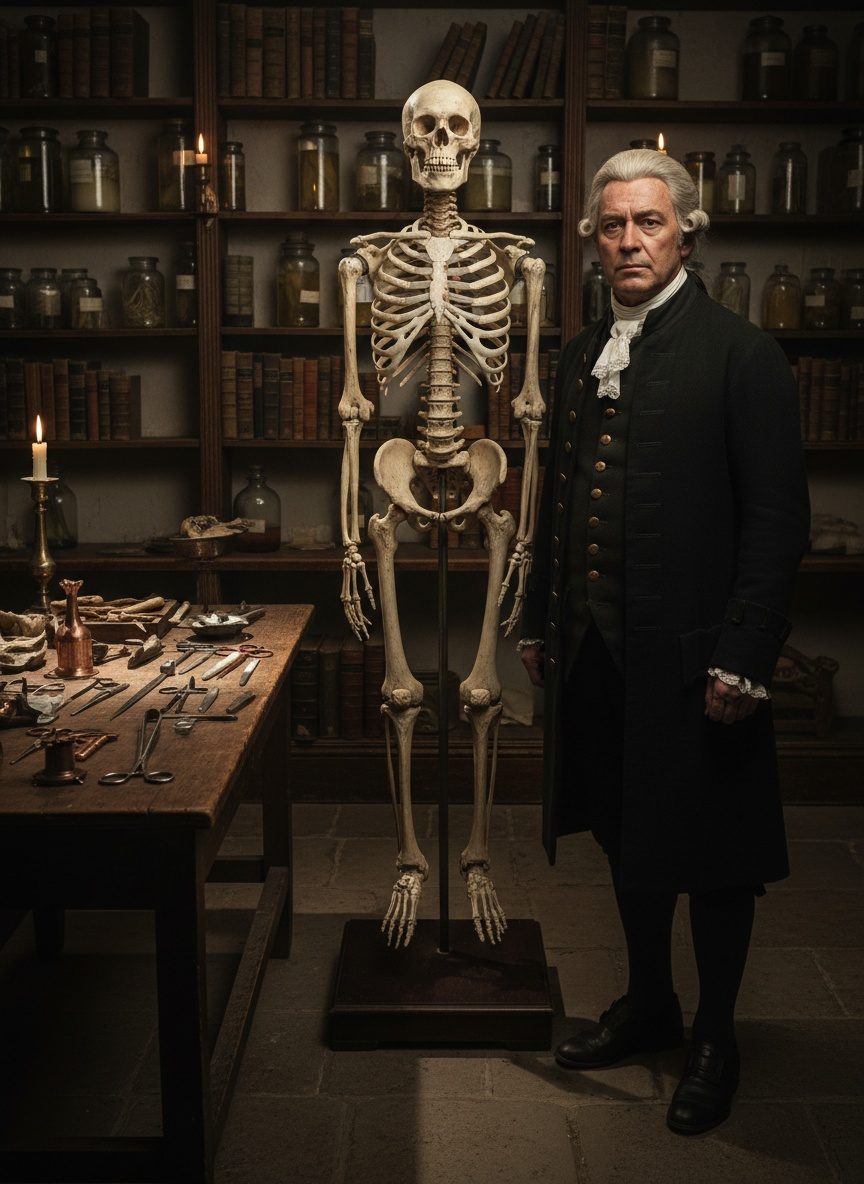
The medical and scientific communities of the Georgian era were defined by their insatiable thirst for knowledge, often at the expense of ethical considerations. In this dogged pursuit, no figure loomed larger than John Hunter, a man whose name was known far beyond the crowded alleys of London. A skilled surgeon and obsessive collector, Hunter transformed his home into a museum with a vast array of anatomical wonders. Yet, amidst his erudition lay an unyielding ambition that often blurred the boundaries of morality.
Secretly fearing the dissector’s scalpel more than death itself, Byrne went to great lengths to ensure his body would not become a public display. He arranged for a sea burial, believing that only the depths of the ocean could free him from the prying eyes of men like Hunter. However, in the looming shadows of Georgian society, money wielded the power to overturn promises and betray wishes.
At the hands of unscrupulous opportunism, the promise of Byrne's watery grave dissolved. His pallbearers, driven by greed, conspired to betray Byrne’s trust. It was to Hunter that they turned, offering the giant’s remains for a sum they could not refuse. Thus began the grisly task of transporting Byrne’s body discreetly away from its destined path, into the reaches of Hunter’s unyielding pursuit.
One can only imagine the dismal scene as Byrne’s body was boiled down to bone in the dark recesses of Hunter’s lab—a macabre transformation from flesh to skeletal artifact. This was no mere act of scientific inquiry; it was a manifestation of the power imbalance that defined the period. In a time when social class dictated one’s very rights to rest in peace, Byrne’s giant frame became a symbol of how personal dignity could be so easily stripped away.
What followed was the installation of Byrne’s skeleton in Hunter's extensive collection, where it hung for over two centuries, stark white against the dimly lit walls. Visitors to the museum marveled at the giant’s stature, often ignorant or indifferent to the story of how he came to reside there. To John Hunter and his successors, Bryne was instrumental in advancing understanding of human growth abnormalities. However, beneath the layers of scientific enlightenment lay questions of consent and respect for the dead that foreshadowed deeper ethical debates to come.
The story of Charles Byrne and John Hunter transcends the annals of Georgian medical history, highlighting a perpetual struggle between curiosity and dignity. It raises poignant questions about agency over one's body, intricately weaving the themes of power and inequality into its tragic narrative. Byrne’s posthumous odyssey serves as a reminder of an era where human remains were commodities within the halls of scientific exploration—a haunting juncture where personal autonomy was all but disregarded in the relentless march of progress.
In today’s discourse on ethics in science, the tale echoes anew as we grapple with the implications of the past on present-day boundaries. Byrne’s desire to remain untouched by the world even in death speaks volumes about the importance of honoring personal wishes and ethical practices. It forces us to reflect on how far we have come in respecting such rights, and how much further we must go to ensure that history, however unkind, is never left untold.