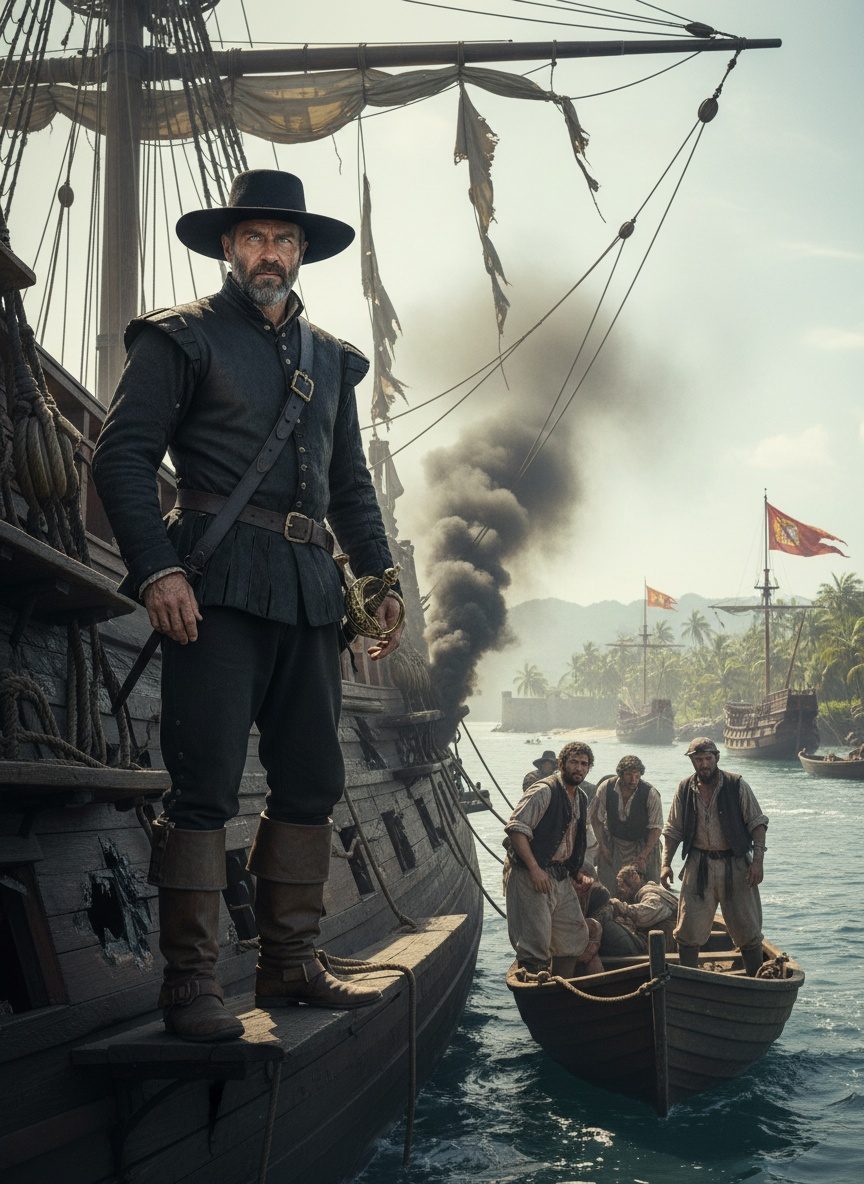
The salty breeze whipped fiercely across the harbor of San Juan de Ulúa, stinging the faces of sailors and soldiers alike, while the relentless sun bleached the sky above a fiery blue. Wooden hulls creaked under tension, and the sharp tang of gunpowder hung heavy in the air. It was in this crucible of heat and smoke that John Hawkins, an English sea captain of formidable renown, found himself cornered. His fleet lay shattered by Spanish artillery, and with it, the ruthless calculations of profit and survival weighed heavily on his mind.
The Storm of Iron and Choice
In 1568, the tropical grounds of San Juan de Ulúa were far from peaceful. John Hawkins, an English privateer and naval commander, was on what he initially envisioned as a mercantile venture combined with privateering—a venture with promises of riches in exchange for distress. The Spanish, however, saw Hawkins and his fleet as interlopers meddling in the transatlantic trade monopolized by the Spanish crown. Thus, when the Spanish guns roared to life, the ensuing havoc was not merely a skirmish but a betrayal, a sudden rupture of trust amidst the supposed neutrality of trade.
The violence of the ambush was cataclysmic. Spanish cannons pounded Hawkins’ ships, splintering masts and tearing through sails. The screams of men and the acrid smoke of burning wood enveloped the harbor in a cloak of chaos and confusion. Hawkins, who had until moments before been negotiating his passage with Spanish officials, saw his hopes of peaceful trading dashed in a thunderous barrage.
Enemy forces possessing overwhelming artillery and numbers surrounded his six vessels. Alongside his cousin Francis Drake, Hawkins had to make a life-altering decision. With resources dwindling and Spanish forces pressing every advantage, Hawkins instructed his men to put the most vulnerable ashore—those who were wounded, sick, or too weak to withstand the forthcoming trials at sea. What unfolded next was a testament to the responsibility he felt towards his crew.
Trading Cargo for Lives
The air crackled not only with the discharge of cannon fire but with moral questions that few of Hawkins' contemporaries would have considered. In a time when wealth was often weighed favorably against human lives, Hawkins' decision stood as an anomaly. Slavery was an entrenched practice across European empires, including England, as human chattel could mean the difference between ruin and riches. The human cargo aboard Hawkins’ ships represented potential profit, a means to recoup losses—or so thought any contemporary businessman might assume.
Yet, as the Spanish commanders tightened their stranglehold on the English fleet, Hawkins faced an unenviable moral dilemma. With the prospect of saving only a handful of his crew by drastically lightening ship, Hawkins chose his men over the ill-gotten gains. The human cargo was abandoned, a decision that flew in the face of conventional wisdom and economic necessity. This, by all accounts, was a rare act of defiance against the burgeoning practices of the transatlantic slave trade.
As the sun dipped lower, casting long shadows over the calamity, Hawkins orchestrated an escape. His men hastily sawed masts to free the ships entangled in the harbor’s web. Loaded onto the few remaining seafarers, Hawkins' loyal crew slipped the Spanish net, although many were left behind, marking a bittersweet retreat filled with the burden of guilt and lives sacrificed to an unforgiving sea.
Echoes of Decisions at Sea
The aftermath of San Juan de Ulúa had reverberations that would be felt far beyond the confines of Hawkins' immediate world. The choice to prioritize human lives over financial gain set a precedent, albeit one largely ignored by history's textbooks. Yet, it is worth questioning whether, in relieving his ships of that human cargo, Hawkins might have inadvertently sown seeds of conscience in a relentless age of exploitation.
For John Hawkins, despite temporarily escaping the jaws of capture, the personal and professional consequences of his actions were profound. He returned to England with his reputation intact but shadowed by the dire economic impacts of the failed venture. More significantly, the events at San Juan de Ulúa etched themselves into the maritime history of Elizabethan England, as Hawkins’ tactical withdrawal and prioritization of his crew’s safety over profit diverged sharply from the burgeoning imperialist ideologies driven by commodities and colonies.
The story of Hawkins' narrow escape and the pyrhic victory gleaned from the fires of San Juan de Ulúa serves to remind us of the immense complexities faced by those who lived in an era where morality often clashed—violently—with ambition and enterprise. It illuminates a singular choice made amid the deafening turmoil of gunfire and smoke—a choice that rippled through history as a reminder of what it means, and what it costs, to choose humanity over power.