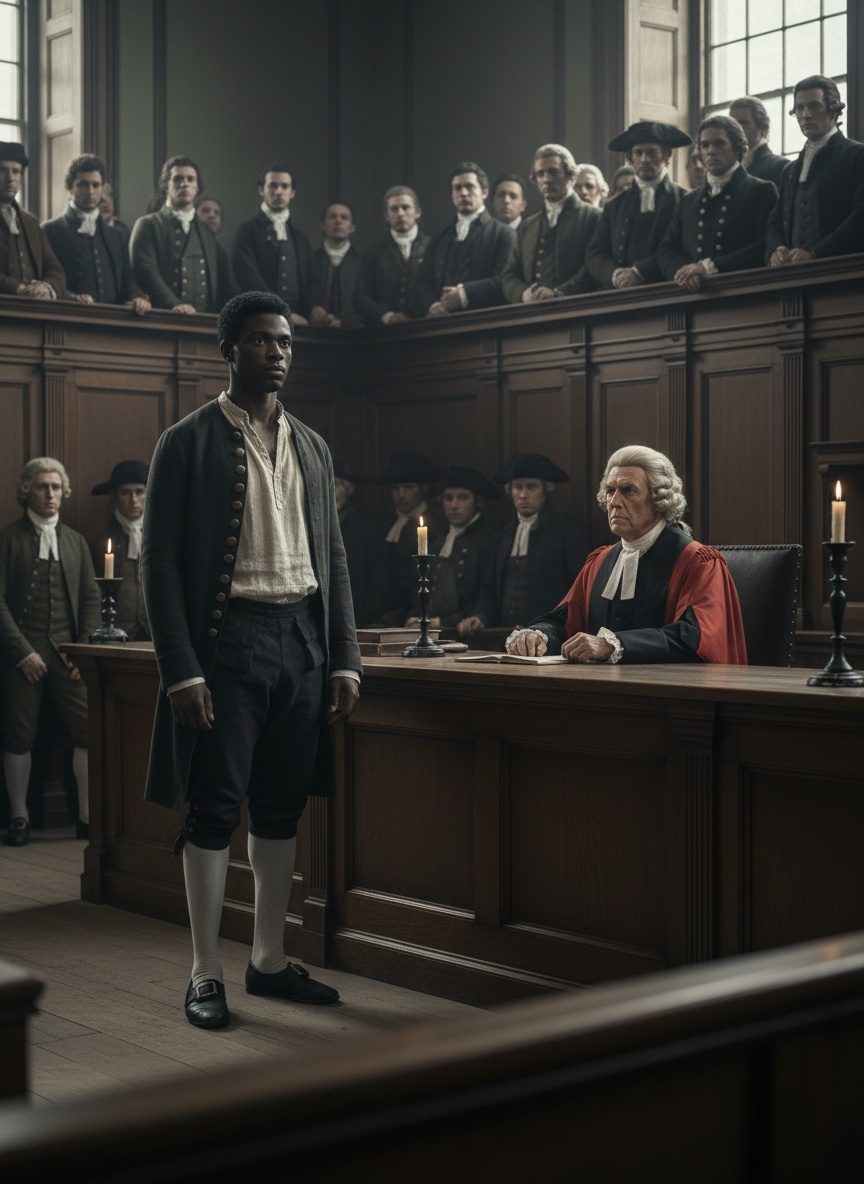
James Somerset is a name unknown to many. Yet, his decision to escape shackles rewrote the laws of the English-speaking world.
The Courthouse Drama that Shook a Nation
In the summer of 1772, the air around Westminster Hall buzzed with anticipation. Rows of curious Londoners filled the courtroom, their eyes fixed on a scene that would decide the fate of more than just the man at its center. This was no ordinary trial. James Somerset, an African man who had dared to seek his freedom, stood defiantly against a powerful adversary: his master, Charles Stewart, an affluent American customs officer. Somerset was challenging the very system of bondage that had ensnared countless souls in its merciless grip.
Under the watchful gaze of Lord Chief Justice William Murray, 1st Earl of Mansfield, arguments unfolded. Somerset's master had captured him and intended to transport him back to the plantations of Jamaica, where the crack of the whip and the toil of human suffering awaited. Yet Somerset's allies, notably the activists Granville Sharp and Thomas Walkin, marshaled another vision. They argued fervently that no harm should come to a man on the free soil of England. They argued that the air of England was too pure for slavery.
Lord Mansfield listened intently, knowing well the monumental gravity of the decision he faced. Not merely a question of law, it was a defining moment that could fracture the delicate societal norms of a nation still heavily invested in the trade of human lives. His ruling would not only affect Somerset but would ripple across the Atlantic and echo through the colonies where enslaved Africans toiled beneath an unforgiving sun. As Mansfield approached his verdict, the room sat hushed, the weight of history hanging heavy in the silence.
The Verdict that Echoed Across Oceans
On that fateful day, Lord Mansfield delivered his judgement: "The state of slavery is of such a nature that it is incapable of being introduced on any reasons, moral or political...it is so odious that nothing can be suffered to support it." In those measured words, he declared that Somerset must go free. It was an intervention so profound that it shattered the chains of presumptive subjugation for enslaved individuals on English soil.
Mansfield's decision didn’t declare slavery illegal in all its forms, but it established a precedent that shook the foundations of the transatlantic slave trade. It sparked a new hope, igniting the embers of freedom for those in bondage and providing abolitionist movements all over the world with renewed vigor. Somerset's freedom became symbolic, the first crack in the edifice of legalized human bondage in England.
What others found remarkable was the fact that Mansfield, a man of the law, chose conscience over commerce when he uttered those pivotal words. His ruling stood in stark contrast to the economic interests of the day, challenging not only financial norms but the moral fabric of an empire deeply entwined with slavery. For activists and abolitionists, Somerset's victory was a kind of clarion call—a herald for a time when freedom might be more than a word uttered in hushed tones and secret dreams.
Why Somerset's Freedom Still Resonates
The aftershocks of Lord Mansfield's verdict in the Somerset case can still be felt more than two centuries later. It didn't abolish slavery outright; that particular battle would demand years of relentless advocacy, oceans of ink, and, tragically, much spilled blood. Nonetheless, the judgement issued from that London courtroom sent tremors through the British Empire and beyond, turning whispers into demands for justice and liberty.
This case illuminated an underlying truth—one that laws, political machinations, and economic interests could not entirely suppress: the fundamental dignity of the human spirit. Even as the world around him threatened to grind him into submission, James Somerset, a man who sought nothing more than to hold the reins of his life, became the unwitting catalyst for a movement that would seek to extinguish the blight of slavery.
Today, as echoes of past struggles continue to inform our modern narratives about freedom and equality, revisiting Somerset's unprecedented victory offers a poignant reminder of the capacity for change when courage confronts injustice. The story of James Somerset and his walk to freedom sheds light on the power of resilience and the undying aspiration for a world where liberty is not confined to the fortunate few but extended to all. Somerset’s passage from the shackles of a slave ship to the embrace of English liberty remains a testament to the enduring power of human solidarity and the quest for justice.