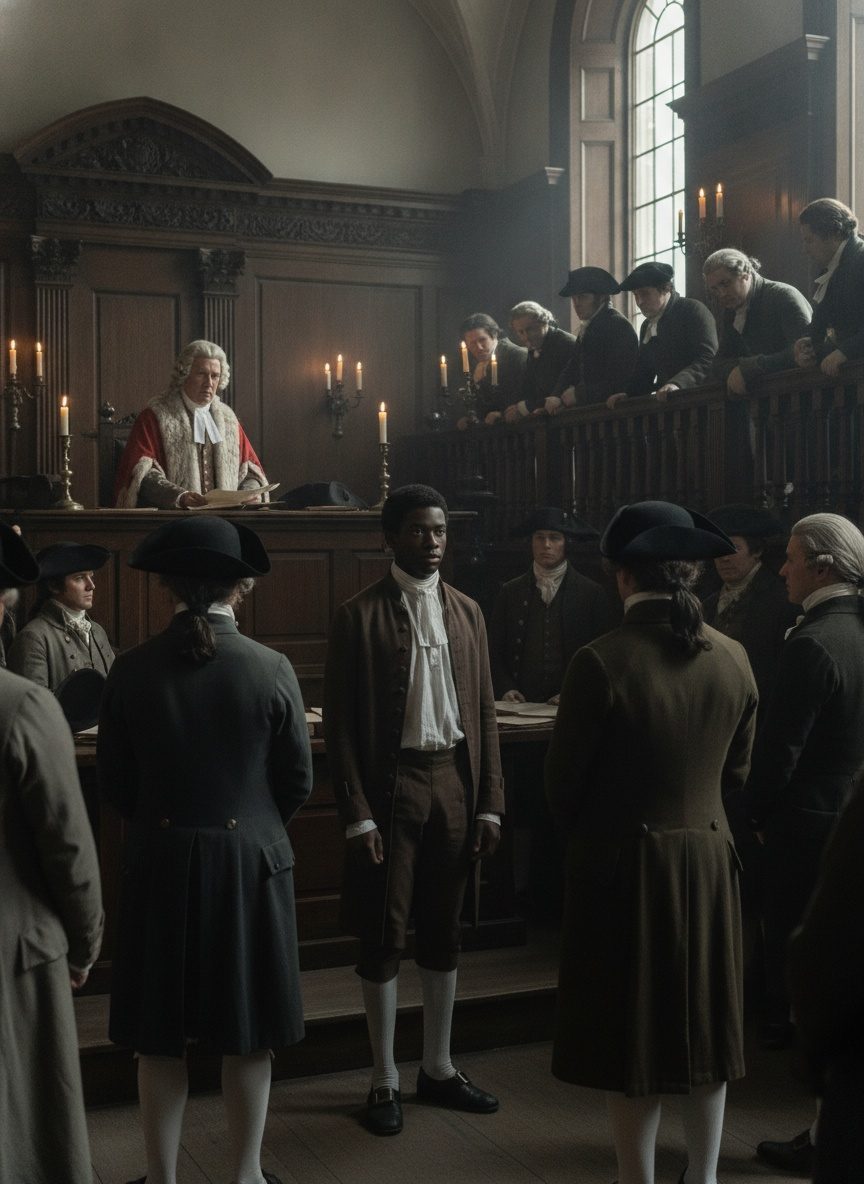
June 22, 1772. The streets of London buzzed with murmurs and eager footsteps converging toward Westminster Hall.
A Man Dares to Hope
The courtroom was swollen with anxious anticipation. All eyes turned to the figure of James Somerset, a man whose presence was a quiet but powerful declaration in itself. Somerset had been born into slavery, yet standing in Westminster Hall, he embodied the very essence of defiance against an institution long cemented into the fabric of society. Somerset had been enslaved by Charles Stewart, a customs officer, who found himself at the heart of a legal tempest when James daringly sought freedom by fleeing bondage. Captured and incarcerated on a ship bound for the hostilities of the Jamaican plantations, Somerset’s fate seemed grim until the winds of fortune carried him to the sanctuary of Britain’s judiciary.
This wasn’t just a trial; it was a vehement ideological battleground. Under Lord Chief Justice William Murray, 1st Earl of Mansfield, the court was poised to make a ruling that would reverberate throughout the empire. The air was thick with tension not only for Somerset but for the hope of hundreds like him who dared to dream of freedom. If Somerset went free, it could spell the beginning of the end for legalized slavery on English soil.
The Weight of the Gavel
Lord Mansfield sat beneath the cavernous curls of his judicial wig, a man whose judgment carried the weight of law but also the whisper of ethics and morality. His charge was to balance precedent with the principles of justice in an empire burgeoning with philosophical enlightenment yet deeply entwined with the dark legacy of its economic underbelly.
The clamor around the case had drawn fierce advocates of abolition like the abolitionist Granville Sharp, who fought tirelessly for such causes, and those defending the entrenched rights of property. As legal arguments circled the courtroom, one phrase stood out like a beacon in the mist: “The air of England is too pure for any slave to breathe.” This oft-quoted sentiment, although legislatively vague, hinted at a growing belief that slavery could no longer be reconciled with the English values of liberty and justice.
When Lord Mansfield finally rose to deliver his verdict, history held its breath. His words were clear, penetrating the chaos of clashing ideologies with the cold precision of a surgeon’s knife: "The state of slavery is of such a nature that it is incapable of being introduced on any reasons, moral or political…but unsupported by…positive law." It was an intellectual, albeit cautious, dismantling of Somerset’s legalized bondage. Somerset was to go free, and with his freedom, the interpretation of English law in relation to slavery shifted—forever.
Echoes Across the Waters
The ruling did not apply to British colonies, nor did it abolish slavery where it had already taken hold, but the reverberations were felt across the Atlantic and beyond. It marked a seminal moment in legal history, where the law began to tentatively align itself with the principles of liberty that Britain purported to champion. Somerset’s case planted seeds of dissent in the fertile grounds of abolitionist movements around the world. The decision was embraced by those advocating for human rights and pointed the needle of moral compasses toward the notion that a change was not only necessary but inevitable.
In America, tensions around slavery were brewing beneath the surface—a slow-growing storm that would one day erupt in a civil war. The Somerset case gave momentum to abolitionist forces, shining a light on the inconsistencies between the legalities of enslavement and the fundamental tenets of humanity. Throughout the English-speaking world, the moral and ethical debate concerning slavery continued to stir consciousness and conscience alike, as Somerset’s footprint left its indelible mark.
A Ripple Effect Across History
The case of James Somerset in 1772, it seems, was a point of deflection. In the grand halls of Westminster, where the past was being challenged by the moral imperatives of the present, a quiet revolution was ignited. Lord Mansfield’s ruling did not tear down the institution of slavery overnight, but it pried open the first of many cracks in its foundations. Somerset's walk to freedom was not merely his own but a symbolic stride toward possibility for those futures found in chains.
Even today, when we reflect on the Somerset ruling, we consider its place in the ongoing journey of justice. It serves as an early beacon in humanity's long and often painful march toward universal freedoms and equal dignity. Histories like this matter not only for their immediate outcomes but for reminding us of what is possible when justice dares to cast aside old chains in favor of newer, truer values.