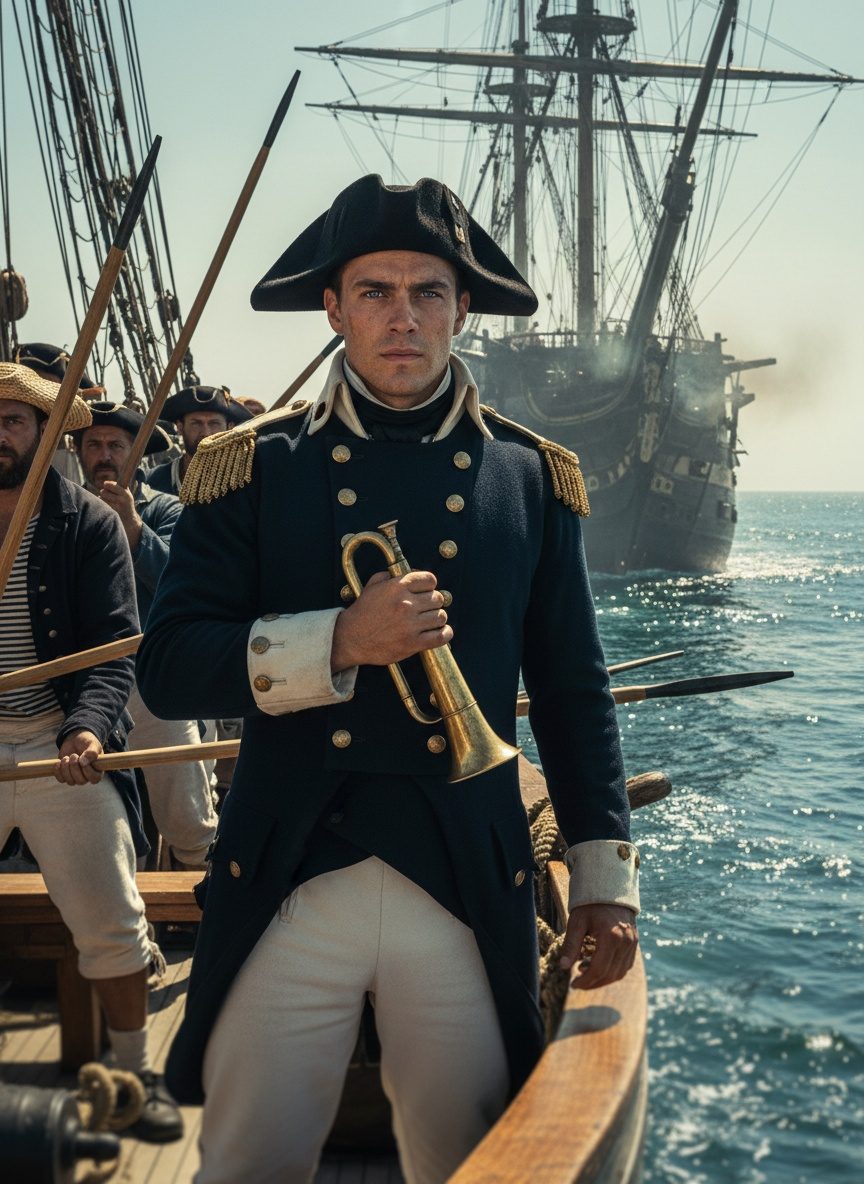
He was twenty-five years old. By the end of that day, he had outsmarted and outmaneuvered a ship more than twice the size of his own.
A David Against Goliath
It was the 6th of May, 1801, and the Mediterranean sun shimmered on the horizon, marking another day of naval conflict. The Napoleonic Wars raged on, with ocean battles where British Royal Navy ships crossed paths with formidable adversaries. In those perilous waters, the HMS Speedy, a mere brig with just fourteen guns, became a legend under the command of Captain Thomas Cochrane.
Standing at just 80 feet in length, the HMS Speedy was easily dwarfed by the imposing Spanish frigate Gamo. With thirty-two guns projecting their metallic glare and a crew exceeding three hundred men, the Gamo was a floating titan, capable of raining destruction on smaller vessels. But for the audacious Cochrane, its very size presented a challenge and an irresistible opportunity. Facing this behemoth with his reinforced bravado and a crew of only fifty-four, the young captain was undeterred.
Cochrane knew that Strategy was to be their most lethal weapon. Raising the American flag, he tricked Gamo into revealing her true identity as she approached, unsuspecting of the ruse. With the enemy momentarily puzzled, Cochrane's crew unleashed a succession of well-timed broadsides, each salvo targeted with near mathematical precision to disable the frigate's mast and rigging. This wasn't just naval warfare; it was Napoleonic chess on the high seas, with life-or-death stakes.
As Speedy closed the gap, grapples flew across the gap between the vessels, allowing Cochrane and his men to initiate a boarding maneuver. What followed was mayhem, as British sailors scaled the decks of Gamo. Armed with swords and pistols, their agility and surprise compensated for lack of numbers. The Speedy’s men went in with utter commitment, knowing that the only way to outweigh their enemy's advantage was to bring the fight directly to them.
Boarding the Gamo
The boarding of the Gamo remains an exceptional example of audacity and skill, an episode that unfolded in moments but left an indelible mark on naval history. As the British seamen poured over the side of the Spanish frigate, screams and clashes of steel filled the air. Despite what seemed overwhelming odds, Speedy’s men remained undaunted. They were no strangers to peril; rather, they thrived in it.
Cochrane had a keen understanding of psychological warfare. As soon as he and his men were aboard Gamo, they used every trick in the book to incite confusion and disarray among the Spanish crew. His booming voice cut through the chaos as he ordered his men on Gamo to shout orders in Spanish, misleading the crew into thinking they were vastly outnumbered. It was a tactical move worthy of mastermind—spreading psychological terror to disrupt opponents before they could rally to a defense.
In the chaos, Cochrane himself took command by seizing the enemy's wheel and asserting control of the ship. Legends say he was seen leaping from place to place on the deck, a one-man symphony orchestrating a frenetic battle dance that seemed all the more improbable against such overwhelming numbers. Skillfully leveraging the classic attack strategies of surprise, speed, and shock, he and his tiny crew rapidly subdued their adversaries.
Pushing through the pandemonium, it soon became apparent that Speedy’s men had something of an advantage: unity. Where the Spanish commanders struggled to rally their divided and unsuspecting crew, Cochrane's compact team advanced in disciplined cohesion, efficiently neutralizing individual threats. In a mere hour, a scene of near-unthinkable conquered territory unfolded. Victory belonged to them, at the cost of just three lives on the Speedy's side.
Victory at a Price
As Gamo fell under the force of Captain Cochrane’s resolve, so too did the sun dip below the horizon, signaling an astonishing end. Word of the victory spread quickly—a diminutive brig besting a gigantic frigate was the kind of tale that both defied odds and fired the imaginations of fellow seafarers and the incredulous public beyond. To the British Empire, this was not simply another victory on the tally of nautical conquests; it was a symbol of ingenuity, bravery, and determination.
For Cochrane, recognition awaited, but so too did a reputation that would become both boon and bane. His career, marked by a series of daring exploits, brought glory and a fair measure of controversy—a destiny echoing the fortunes of a maverick. His later endeavors would see him entangled in political snares and visionary experiments, forever oscillating between hero and rebel, yet never far from the legacy of that audacious day aboard the HMS Speedy.
This tale of maritime valor serves as a timeless reminder of strategic brilliance matched with courageous action. The event remains a beacon of strategic thinking where courage met cunning, proving that size alone does not dictate the spoils of war. The triumph of HMS Speedy underscores the essence of resilience in the face of adversity—an ageless story of how, when best laid plans and bravery intertwine, even the smallest of David-like vessels can find triumph over their Goliath counterparts.