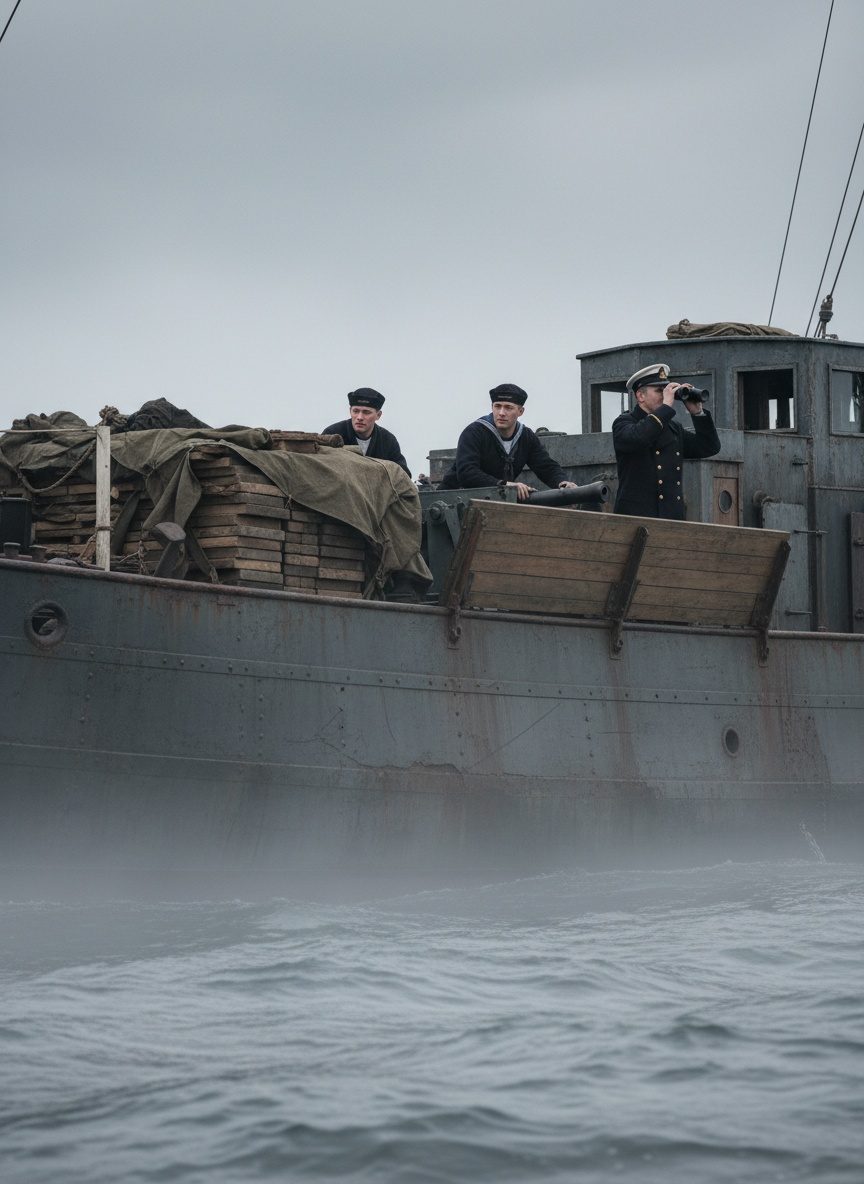
The North Sea in 1918 was as treacherous as glass beneath the moonlight, with waves that whispered secrets of lurking threats below. A ship lumbered through these icy waters, its silhouette a blur in the mist, appearing as nothing more than a harmless freighter. But the dim haze concealed a perilous deception, one that would catch the eye of any lurking U-boat captain ready to strike at yet another merchant ship. To await this inevitable encounter was HMS Saxifrage, a wolf cloaked in the wool of a seemingly unassuming vessel, a cunning contraption in the British Royal Navy’s fleet fashioned specifically for anti-submarine warfare.
A Cunning Stratagem
In the throes of the First World War, the German U-boat menace was one of the most formidable threats to Allied control of the seas. These submarines stalked merchant routes with silent precision, their commanders ready to unleash torpedo hell upon unsuspecting vessels. Without warning, a torpedo strike could transform a bustling cargo ship into a watery tomb. It was in these dire times that HMS Saxifrage embarked on her lethal masquerade.
The Royal Navy's answer to this hidden assault was an audacious subterfuge known as the "Q-ships." Rather than overt displays of power, these vessels employed a more seductive, less visible strength — appearance. Disguised as fragile merchant ships, they invited U-boats to come to the surface and attack, revealing themselves in the process. Once the enemy submarines were fooled into lowering their defenses, hidden weapons would spring into action from behind cleverly constructed false panels.
Unveiling the Trap
Outwardly, HMS Saxifrage presented the quintessential image of a merchant ship — rust-streaked hull, tattered rigging, and cluttered deck. No imposing superstructures or conspicuously lethal artillery betrayed her true purpose. Her transformation into a formidable Q-ship was meticulous; her hull, deceptively dilapidated, concealed rapid-firing deck guns that lay hidden under dummy wooden structures and tarpaulin.
When a U-boat captain set his sights on Saxifrage, the crew would enact their roles in this lethal theater. The ship's speed decreased, as though nervously attempting an escape, her crew visibly "panicking" on the deck. Enticed by such vulnerability, the U-boat would ascend, eager to sink yet another Allied ship with its weaponry.
At the perfect moment, when the predator approached close enough, the hidden weapons would be unveiled. Panels would fall away and reveal guns primed and ready. The hunter would swiftly transform into the hunted, caught in a deadly web of deception that left little room for escape. One shot, well-placed, was often all it took to ensure the U-boat beneath the waves would never see the surface again.
An Odyssean Gamble
While the strategy was daring, the stakes were nothing short of monumental. Each mission that HMS Saxifrage undertook was a game of cat and mouse played on a deadly stage. The brave crew tasked with her operations knew well the danger they faced. In maintaining their elaborate ruse, sailors often had scant seconds to execute the transformation from prey to predator, the thin veil of subterfuge offering scant protection against a torpedo's wrath.
This high-stakes gambit wasn't without its controversies. The anonymity and calculated deceit employed by Q-ships raised eyebrows among those who considered it a breach of the chivalrous conduct supposed to govern the realm of naval warfare. Yet, in the ruthless theatre of World War I, where survival often hinged on unorthodox methods, the ends were seen to justify the means.
A Day Not Remembered
Today, the ghost of HMS Saxifrage resides in the shadow of a scrapyard threat. As the last surviving hull of its kind, the Saxifrage — later rechristened HMS President — is a singular monument to one of the war's most extraordinary inventions. Built to deceive and designed to destroy, her existence offers a tangible connection to a nearly forgotten dimension of naval warfare.
Earlier this century, she sat quietly along the Thames, a relic amid the currents of progress and modernity. For many, she was just another piece of the venerable history of London's docks. But to those who dared to delve deeper, Saxifrage told an intricate story of innovation born out of desperation, a bridge to an era when survival demanded devilishly clever tactics.
A Legacy in Disguise
Though the world stands on the brink of losing this enduring ghost of ingenuity to the scrapyard, HMS Saxifrage's legacy endures beyond her physical form. Her story challenges us to contemplate the moral complexities and technological strategies that shape warfare's evolution. During a war where human ingenuity matched destructive potential, Saxifrage epitomized the unexpected: an unassuming vessel with a deadly secret.
In recalling the cunning of HMS Saxifrage, we learn that sometimes, what lies beneath the surface speaks volumes. This lesson, embedded within the deceptively simple exterior of a seemingly innocuous ship, invites us to ponder not just the military innovations of the past but the nature of warfare in disguised forms — and how those forms continue to evolve as shadows do across an ocean's surface.