He was only a midshipman. Yet, Lieutenant Commander Salmond found himself commanding the lives of hundreds aboard the HMS Birkenhead that deadly night. It was in the dark hours before dawn on 26 February 1852 when the world beneath the HMS Birkenhead turned treacherous. Cruising along the coast of South Africa en route to Port Elizabeth, the steamer, the pride of Victorian naval engineering, struck an unmarked rock formation off Danger Point — a moment that would etch courage through tragedy into maritime history forever.
The Birkenhead had been a marvel, a state-of-the-art troopship devised to ferry armies of the British Empire swiftly across oceans. Her iron hull was striking; her steam-powered engines a symbol of burgeoning Empire prowess. Yet, hidden beneath this veneer of naval superiority lay a truth unknown to the passengers that night — the ship's lifeboats could only accommodate a fraction of the souls onboard. A bitter irony that would unveil itself in those grueling moments when fate demanded valor from the men asking more than arms in hand, but sacrifice of enormous proportions.
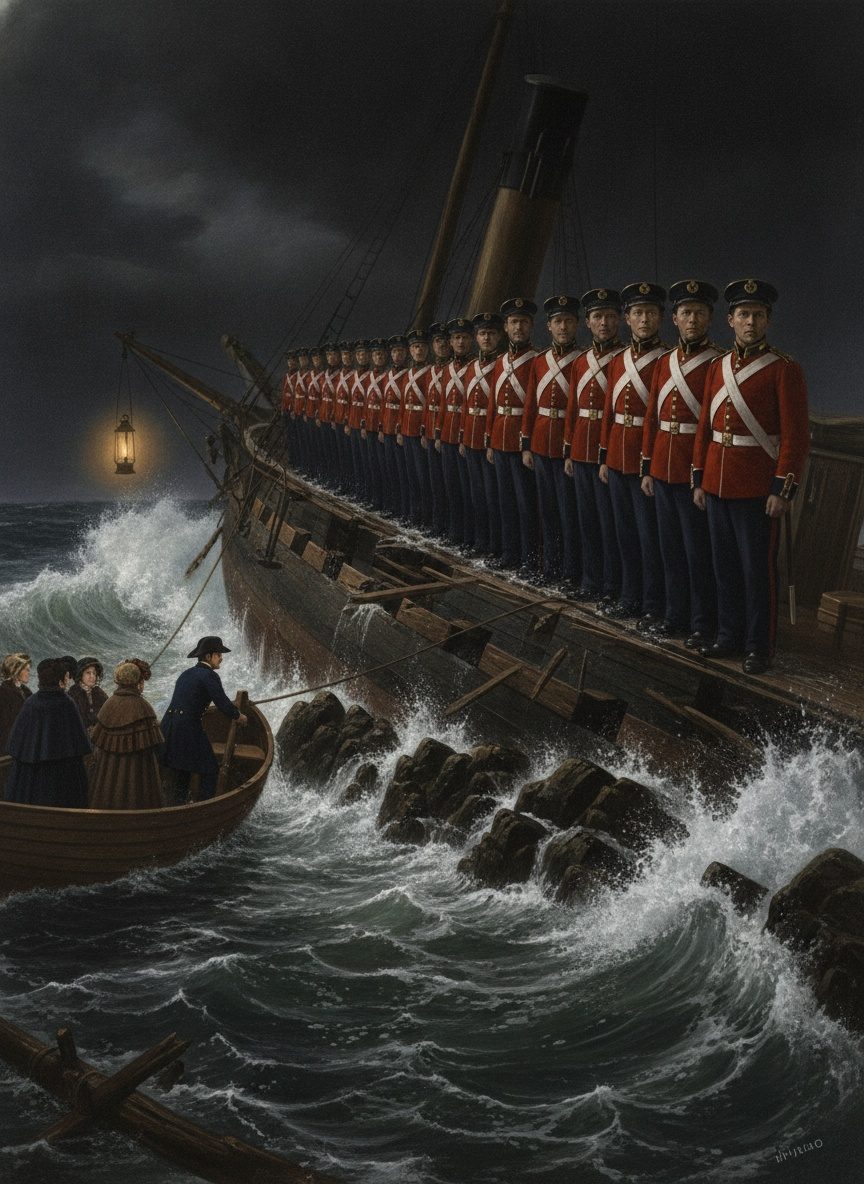
The collision was a cruel whisper, a scrape and then a sickening crunch as if the very ocean had given birth to catastrophe. Water rushed hungrily through the ruptured hull, devouring decks at a pace faster than the crew's attempts to stem its insatiable advance. As panic unfurled its claws across the vessel, a composed yet urgent voice cut through the mist — the women and children first. This was an edict unerring in its focus, forged in horrific clarity by the highest ranking officer Lieutenant Colonel Seton. The men heeded unwaveringly, organized not by fear but by the indomitable discipline the services had instilled in them.
In the face of icy water lapping at their feet, soldiers from six proud regiments maintained their ranks in impossible order, their formation a stark contrast against the chaos. Each stood fast, a bastion of stoic duty against the harrowing tide. As lifeboats were hurriedly lowered, each carrying the precious cargo of life — mothers clutching infants, children seeking the warm embrace of survival amidst seafaring chaos — the men knew salvation was not their destiny. They embodied the very essence of selflessness, choosing unspoken death over frenzied survival.
The Birkenhead soon listed perilously, her iron bones groaning as if lamenting the souls she could not protect. Yet, even as she buckled, she bore witness to an act of astonishing sacrifice — the Birkenhead Drill. It wasn't merely about following orders; it was about redefining them in the face of certain doom, an unyielding devotion to principle taking precedence over instinctive preservation.
And then the sea came for them — a leviathan swallowing the brave whole, as soldiers stood shoulder to shoulder watching life fade into distance and waves with every escaped lifeboat. Amidst this doom, a small cohort found themselves swept to safety by wreckage or sheer chance, emerging as the testament to this human tenacity immortalized in the narratives that sailed beyond horizons.
The news of the disaster swept across continents like a gale. The unheard of discipline displayed by these soldiers inspired a paradigm of conduct, reverberating through the corridors of British Empire schools and tribunals. The Birkenhead Drill seeped into maritime tradition, a mantra that prioritizes the vulnerable, a principle cast in the blood of those who did not live to witness the world laud their longevity of spirit.
Yet, the story of the Birkenhead is more than a tale of gallantry; it stirs the enduring musings about the extent of human courage, the nobility nestled within duty against insurmountable odds. It also casts reflections onto the broader maritime stewardship during its age, interrogating preparedness amidst advancing naval technology in an expanding empire.
Today, it stands not only as a lesson in ethics but as a stirring invocation of humanity’s capacity for altruism. The narrative of frozen ranks and courage birthed upon that perilous night continues to echo beyond history’s veil. Through these acts of astonishing bravery, the legacy lives on, urging generations to value moral imperatives over mechanized might. A reminder that sometimes stillness in chaos is the most profound revolution of all.