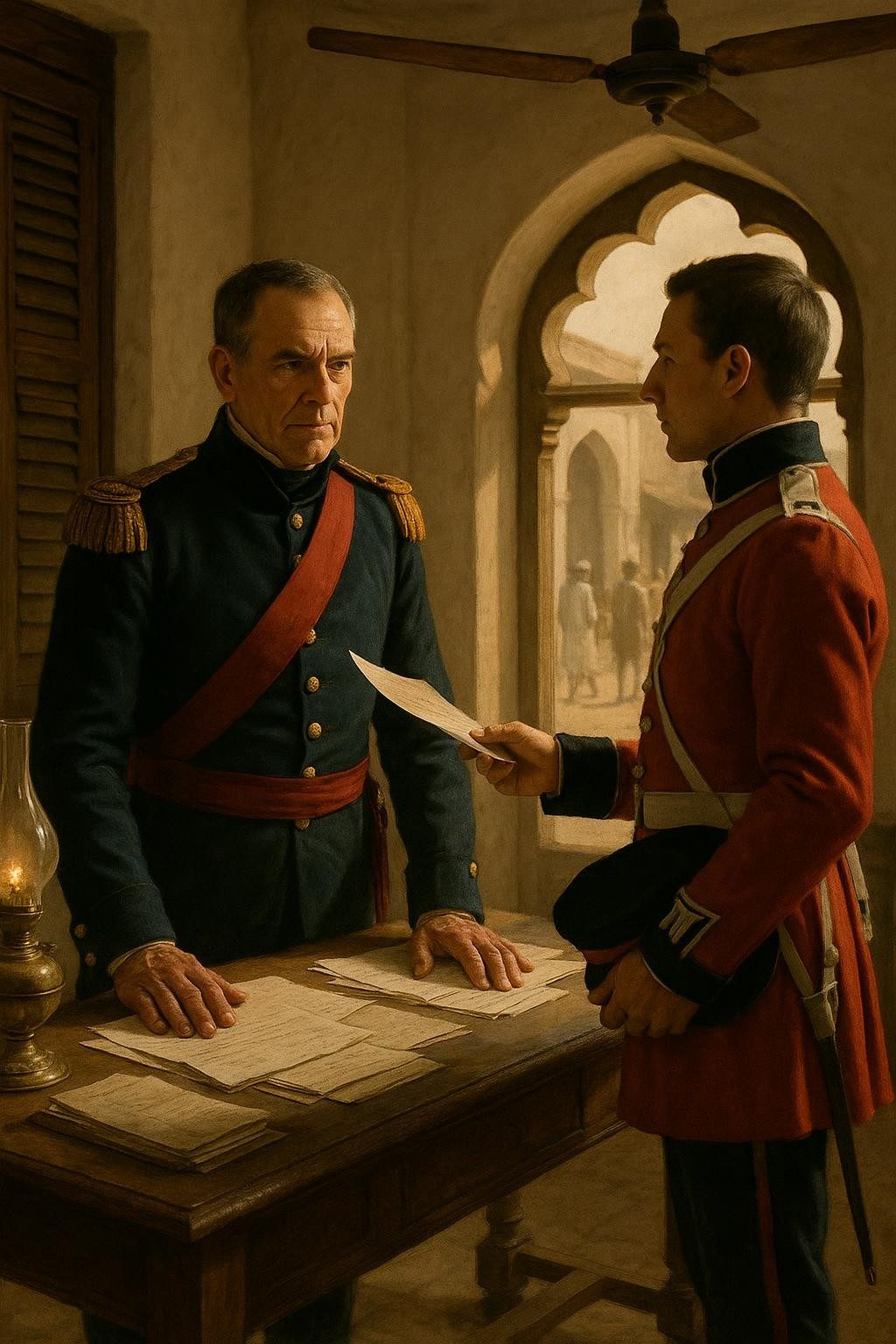
The air was thick with the acrid smell of desperation, the cries of the hungry echoing through the sun-baked streets of Punjab. It was 1849, the year of famine. The once-verdant fields lay parched under the relentless gaze of the sun, their crops reduced to shriveled remnants of what might have been. Sir Henry Lawrence, administrator and champion of the people, stood amidst the chaos, his mind a battleground between orders received from above and the cries for justice coming from the very soil he had sworn to govern.
Henry Lawrence, known more for his diplomacy than defiance, found himself at a crossroads that would seal his fate and, possibly, his soul. Appointed the Agent to the Governor-General in the newly annexed region of Punjab, Lawrence was in charge of cementing British rule in this vital part of India. But as the famine loomed, sending death and desperation to every village, his conscience could not abide by the cold directives from Calcutta: collect taxes at all costs. The ink had hardly dried on the treaty of annexation, and the British East India Company, ruthless in its calculations, demanded its pound of flesh, showing no mercy, even from the hungry and helpless.
The Punjab of 1849 was not just the frontier of the British Raj; it was the Jewel in the Crown, a position cemented after the hard-won victories of the Anglo-Sikh wars. To many officers of the Company, these broader ambitions were the only focus. But to Lawrence, the region teemed with human stories, full of faces whose eyes carried fear and hope in equal measure. They were farmers, artisans, and traders—each thread contributing to the rich tapestry of Punjab. In their suffering, Henry Lawrence saw the shattering of not just social structures, but of humanity itself.
Lawrence's decision to defy the orders was nothing short of revolutionary. Instead of increasing hardship, he opened the granaries, offering their wares freely to the famished. The act was not just administrative but deeply human; Lawrence, standing against the monolith of colonial rule, chose compassion over compliance. It was a decision that reverberated through the length and breadth of the land, saving tens of thousands from the brink of starvation and re-invigorating a spirit on the verge of breaking.
The risk was immense, as Lawrence well knew. Calcutta’s reaction was swift, and the Company’s fury was nothing if not predictable. To them, Lawrence was an anomaly—a cog in their imperial machine who refused to turn. His decision to redistribute the resources rather than hoard them went wayward of the governance playbook defined by the Empire. Punishment came in the loss of his prestigious role, a not-so-subtle reminder of what defiance costs those who dare to stand against the grain.
But what the Company saw as a dereliction of duty, the people saw as deliverance. Word spread through villages and towns, over riverbanks and marketplaces: Sir Henry Lawrence had chosen them over profit. The tales of his action, carried across the plains, instilled hope amidst despair, and hope, they realized, was a currency more valuable than any gold the Raj could ever promise.
Lawrence left Punjab but did not leave India. His dedication to the land and its people only grew stronger. He was redeployed within the complex gridwork of colonial India, his reputation no longer merely that of an administrator. He was whispered about in tales by the Punjab firesides, as the white man who wore the cloth of a sahib yet spoke with a heart full of Punjab. He became a symbol of a different possibility, of an empire that could be shaped not by iron and steel but by empathy and action.
What might have been a tale of rebellion became a fragment of legend across India, sparking debates about governance under the Raj. At dinner tables and durbars, the audacity of Lawrence's actions begged the question of whether true leadership could ever align with moral courage in a hierarchy defined by power and profit. His act of insubordination was dissected, critiqued, but undeniably respected, even by some who sat in polished chairs at the Company’s helm.
In the larger scope of history, it's easy to dismiss the actions of one man against the enormity of an empire as inconsequential. Yet, in stories left untold, like that of Sir Henry Lawrence, we find the seeds of transformation. His legacy remains a chapter rarely elaborated upon in textbooks filled with dates and decrees, but alive in the spirit of the people who passed down stories of a compassionate defiance, storytelling itself an act of resistance. It was history telling itself not with battles and treaties, but with deeds of courage and candor.
Today, the famine of 1849 is often overshadowed by broader narratives of the British rule in India, yet the haunting question remains as relevant as ever: What is a ruler’s duty? It prompts reflection about the moral compromise that governments and corporations often embrace, and about the unexpected heroes who choose to stand with integrity rather than authority. The story of Henry Lawrence in Punjab is not just about the past, but a reminder of how individual choices can ripple through the pages of history, where the cries of the many may be answered by the conscience of the few. In the end, it’s a lesson worth remembering—that sometimes the bravest thing to do is the simplest: to listen, and to act, with a heart as one’s compass.