Mount Everest is the world’s highest peak. Ironically, the man whose name it carries never laid eyes on it.
The Long Shadow of the Raj
In the bustling era of the Victorian age, the British Empire was spreading its influence across continents. The jewel in the crown of this imperial grandeur was undoubtedly India. A land of immense diversity and scale, it beckoned the curious and the bold. Yet, beneath its vibrant tapestry lay a challenge as colossal as the Himalayas themselves—understanding and mapping this vast territory. It was in this age, in 1856, that an enormous mountain awaited its christening. A mountain that would soon rise to unprecedented fame under the name of a man who never gazed upon its summit: George Everest.
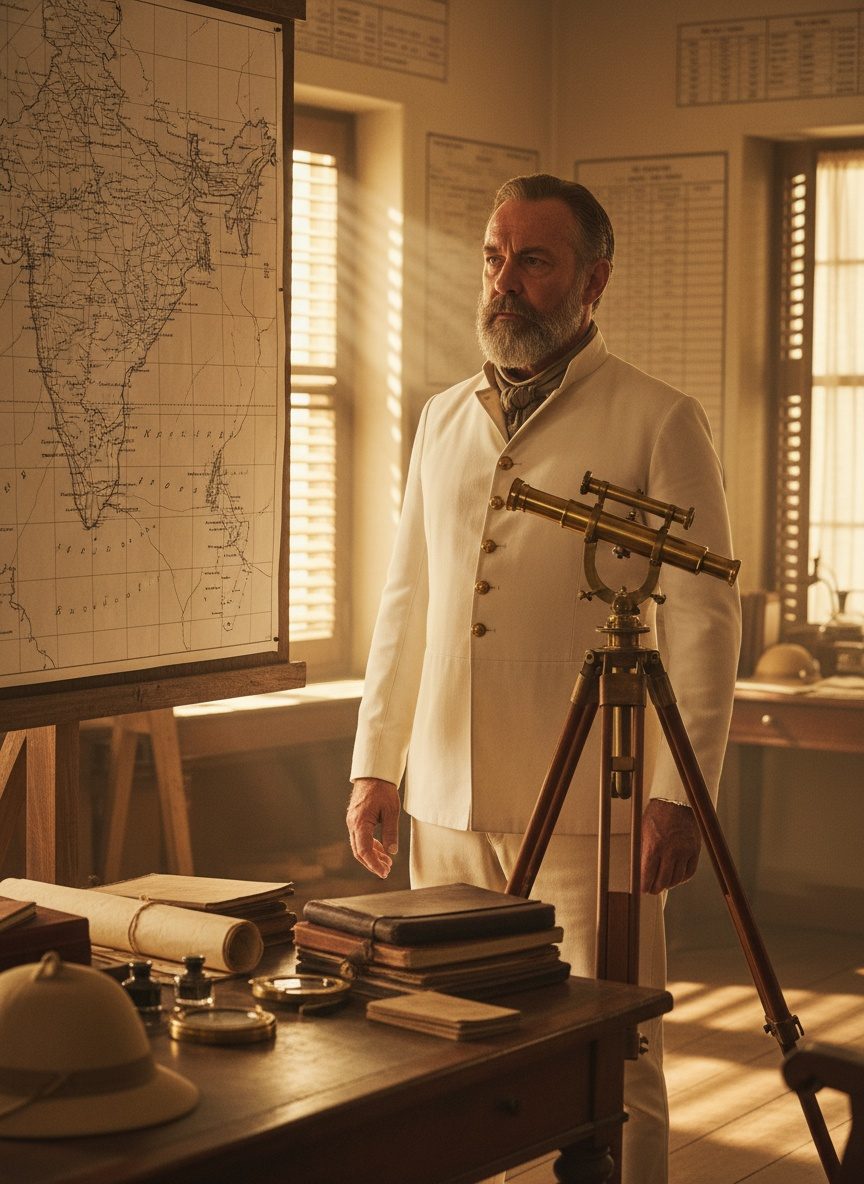
George Everest, a meticulous Welsh surveyor, had been the driving force behind the Great Trigonometrical Survey of India. It was an ambitious project—an audacious endeavor to measure the length and breadth of India with scientific precision. Such was its scope that it spanned decades, and the men who partook in it battled against nature's fiercest elements along India's spine. Their work required them to traverse dense jungles, endure monsoon deluges, and confront malarial fevers, all to fix a “roof” atop the world that no one had yet clearly identified.
The Man Behind the Needle
Who was this George Everest? Born in 1790 in Wales, Everest was a man both revered and reviled. His uncompromising attention to detail earned him a formidable reputation as Surveyor General of India. His work was methodical, his expectations exacting, and his persistence relentless. If patience is a virtue, then Everest was a paragon, as patient as the mountains themselves. Perhaps it was this enduring quality that fueled the monumental achievement of the Great Survey.
Everest joined the Survey of India in 1818 and quickly scaled the ranks. By 1843, his work had profoundly transformed our understanding of subcontinental geography and had set benchmarks in geodesy, the science of measuring Earth’s shape and features. Yet, he never set foot on the very peaks that his surveys brought to global consciousness, including Mount Everest, then known only as "Peak XV." Everest's legacy was not built on summiting mountains but on accurately determining their heights from afar.
Mapping the Spine of India
The Great Trigonometrical Survey was more than just a mapping project. It was a marvel of Victorian engineering and endurance. The survey sought to triangulate the entire Indian subcontinent, a task which demanded the creation of a network of triangles stretching from the southern tip of India to the northern plains. The surveyors employed massive theodolites, weighing several hundred pounds, to conduct their measurements. Transporting these instruments across such inhospitable terrain was in itself a Herculean task.
The unknown peaks of the Himalayas loomed large in the minds of these indefatigable surveyors. The mystery of which peak stood tallest would not be solved by a simple glance; it required years of precise calculation and adjustment. Through hills and hollows, jungles and cities, they charted the uncharted, bridging the known with the unknown through the power of mathematics.
Peak XV: A Name is Given
By 1856, the efforts of these tireless surveyors bore fruit. The peak which cast its hushed shadow over the plains of India emerged as the tallest known point on Earth. Peak XV was calculated to stand at a staggering height, dwarfing all others. Andrew Waugh, Everest's successor as Surveyor General, decided to name the peak after George Everest, honoring his life's work which made the measurement possible. It was fitting; without Everest's mathematical groundwork, the towering majesty of the Himalayas might have remained a nameless silhouette against the sky.
Yet, Everest's naming was not without controversy. There was debate about adopting a native name instead, respecting local traditions. However, Waugh insisted on Everest's name, arguing it was more readily recognizable by the educated classes of Europe. Thus, Peak XV became Mount Everest, a name both iconic and noble.
The Measure of a Man
In today's world, Mount Everest symbolizes the ultimate challenge, drawing adventurers from across the globe. Its name, however, tells another story—a tale not of conquest but of human perseverance, precision, and the pursuit of knowledge. George Everest's life work was not simply about mapping landscapes but deciphering the world through discipline and science. Though he never saw the summit that bears his name, his story is stitched into every inch of its towering form.
George Everest's contribution to geography reflects the indelible impact one individual's obsession can create. It speaks of the silent triumphs—the peaks we may never scale physically, yet leave our mark upon through ingenuity and indomitable will. As one stands at the base of Everest today, it isn't just a marvel of nature; it is a testament, not in stone, but in numbers and names, that resonate across time and tide.