Frederick Russell Burnham's name may not echo through history textbooks. Yet, his daring rescue in Matabeleland deserves a closer look.
Riding Into the Lions' Den
Deep in the heart of Matabeleland in 1896, beneath the vast African sky, the air was thick with tension and the scent of conflict. The Matabele, also known as the Ndebele, had risen against British rule, igniting a rebellion that churned through the land like a wildfire. It was an uprising born of desperation, as indigenous people fought against the encroachment of foreign forces. Amidst this chaos, Frederick Russell Burnham, an American scout working for the British, embarked on an unprecedented mission.
The Ndebele rebels were formidable, emboldened by their determination to reclaim independence. British forces, however, stood firm, pinned down in this violent chess match over a land of sweeping savannas and dense bush. Burnham was tasked with a mission that seemed destined for failure: to secure the release of a high-value captive held by the Ndebele, an impossible negotiation in times of war. Unarmed and alone, he rode straight into the heart of the storm, carrying only his wits and a tenuous hope of diplomacy.
The Rebel Camp: A Place of Danger and Decision
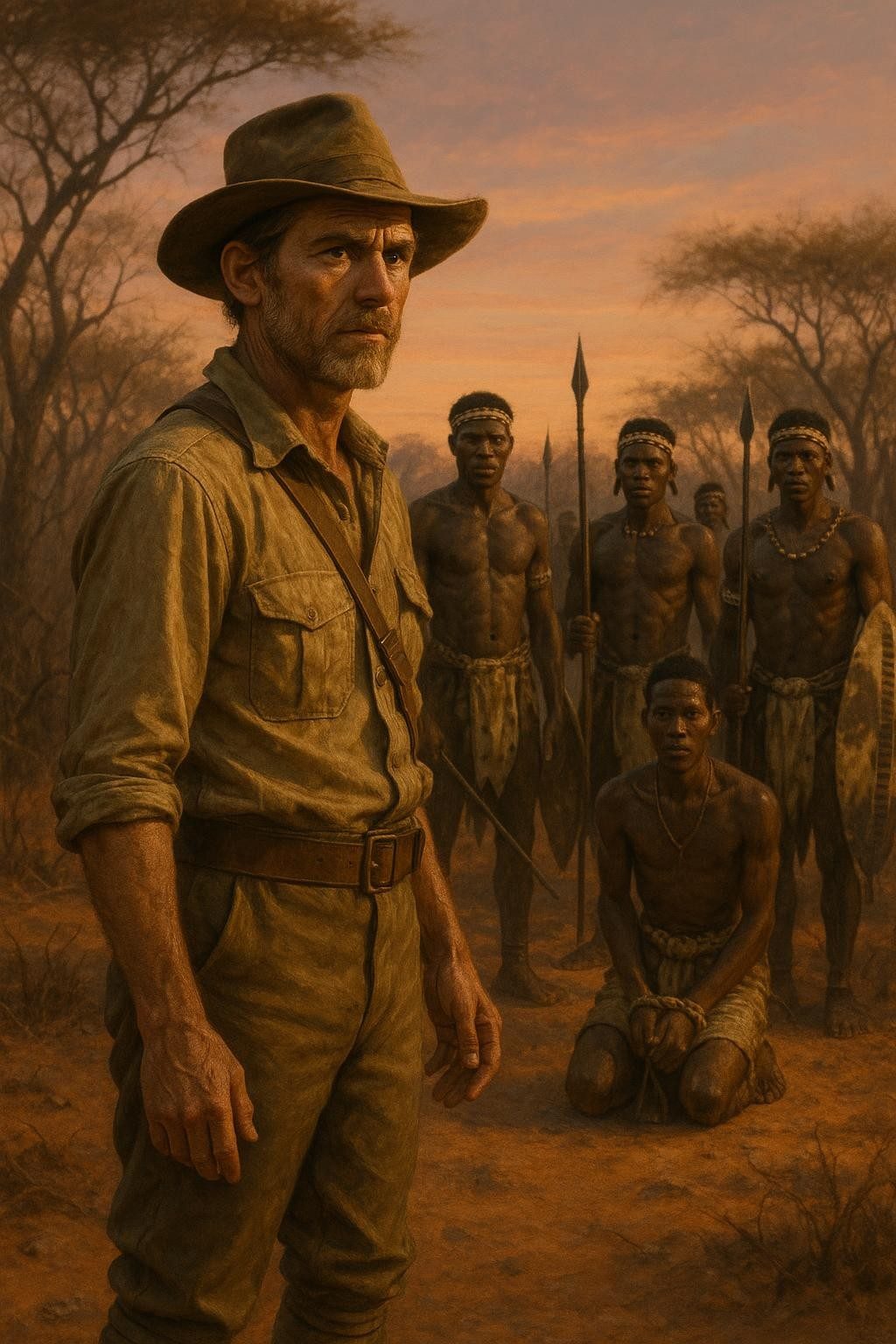
As Burnham entered the rebel camp, the scene was one of stark contrasts. The warriors, cloaked in traditional attire and hardened by recent skirmishes, eyed him with suspicion and barely-contained hostility. In the center of this human tempest was the captive he had come to rescue — a chief's hostage, whose fate hung in the balance like a thread in the wind.
With each step he took, Burnham knew the gravity of his mission. The rebels had sworn to kill the captive, a declaration as clear as the sky above. Yet, Burnham bore no weapon, only an extraordinary brand of fearless negotiation that would soon unfold in the clearing. He had to convince these men, whose trust had been shattered by colonial ambitions, to release their prisoner — an act that required an uncommon blend of resolve and diplomacy.
An Audacious Gamble
The heart of Burnham's negotiation lay not in bargaining power nor in numbers. It was a gamble of human connection, an attempt to find strands of common ground amidst a sea of conflict. Approaching the rebel leaders, he cast aside the veil of the foreign conqueror and spoke as one human to another, striving to touch the core of shared humanity.
This was no easy feat. Standing unarmed among the rebels, surrounded by men who considered him and his kind the enemy, he relied on a profound understanding of their culture and traditions. His approach was not one of superiority but one of respect and empathy. No archival records capture the exact words exchanged, but what is clear is the miracle of his success. Against all odds, Burnham managed to negotiate the release of the captive, walking him out of the camp towards freedom.
Back Across Enemy Lines
As Burnham and the captive made their way back to British lines, the atmosphere in the rebel camp shifted subtly. It was a moment that teetered on the edge, one where expectations were defied. With each step further from the hostile encampment, the weight of the accomplishment grew more tangible. What an army could not achieve through might, Burnham had accomplished through sheer audacity and the power of negotiation.
The landscape of Matabeleland, often seen as a backdrop of unyielding conflict, had borne witness to a fleeting moment of peace. It was a reminder that even amidst war, there existed a glimmer of hope that could shine through the darkness, achieved not through conquest but through comprehension and reframing of relationships.
The Quiet Legacy of Courage
In the annals of history, heroism is often equated with the clamor of battle, the charge of cavalry, or the boom of cannon fire. Yet, Burnham's expedition into the rebel camp in 1896 presents a different narrative — one where the strongest weapon was the courage to engage without a shield, where the greatest victory was measured in lives saved rather than lost.
Frederick Russell Burnham's venture is a legend untold in many textbooks, a tale where diplomacy dared to tread where soldiers could not. It serves as a powerful reminder that in a world often dominated by the clashing of swords, sometimes the most profound changes come from a simple act of understanding. Such stories matter, not just for their historical merit, but for the lessons they impart about the enduring power of courage and the human spirit.