He was an adventurer entrusted with one of England's most daring naval expeditions. And yet, he would rather kneel than betray his principles. Such was the nature of Sir Francis Drake, a man whose legendary voyages are often heralded, but whose complexities are seldom understood.
The Fracturing Expedition
In 1578, Sir Francis Drake and his crew were a long way from home, cutting through the world’s waters with the Pacific just beyond their horizon. The air was thick with anticipation and the pungent scent of salt, but beneath the surface, the expedition was seething with discord. This voyage, entrusted to Drake by Queen Elizabeth I herself, was no mere exploration. It was an opportunity for wealth, glory, and the expansion of English influence, territories that had long been dominated by Spain. Thus, every eye in the court watchfully traced the wake of Drake's fleet.
Among Drake's closest companions was Thomas Doughty, a distinguished scholar and a man who, like Drake, knew the taste of adventure. With his refined eloquence and sharp intellect, Doughty was a natural leader and trusted advisor. But seas breed suspicion as rapidly as waves, and soon allegations of mutiny seeped through the decks. Accusations whispered clandestinely in the moonlit hours suggested that Doughty was conspiring to take control of the fleet, a charge as grave as treason in those perilous waters.
Justice on the High Seas
With no tribunal but his own word, Drake decided that a trial was necessary — an unusual step for a situation that could end swiftly with the sharp edge of a sword. About forty men gathered to witness the proceedings, the raw wind whipping at their faces as they faced the solemnity of the situation. Among eyes both sympathetic and steely, Doughty stood, acutely aware that this impromptu court on the endless ocean would decide his fate.
The gravity of the situation bore heavily on Drake. It was his duty to maintain order, yet one could argue that justice under such circumstances seemed a figment. His friendship with Doughty was well-known among the crew, and it cast a long shadow over these proceedings. Yet, Drake’s loyalty to the Crown had to outweigh personal bonds, and thus, the weight of leadership ground on his shoulders. In his heart, Drake grappled with the riddles of power and responsibility.
The Last Supper
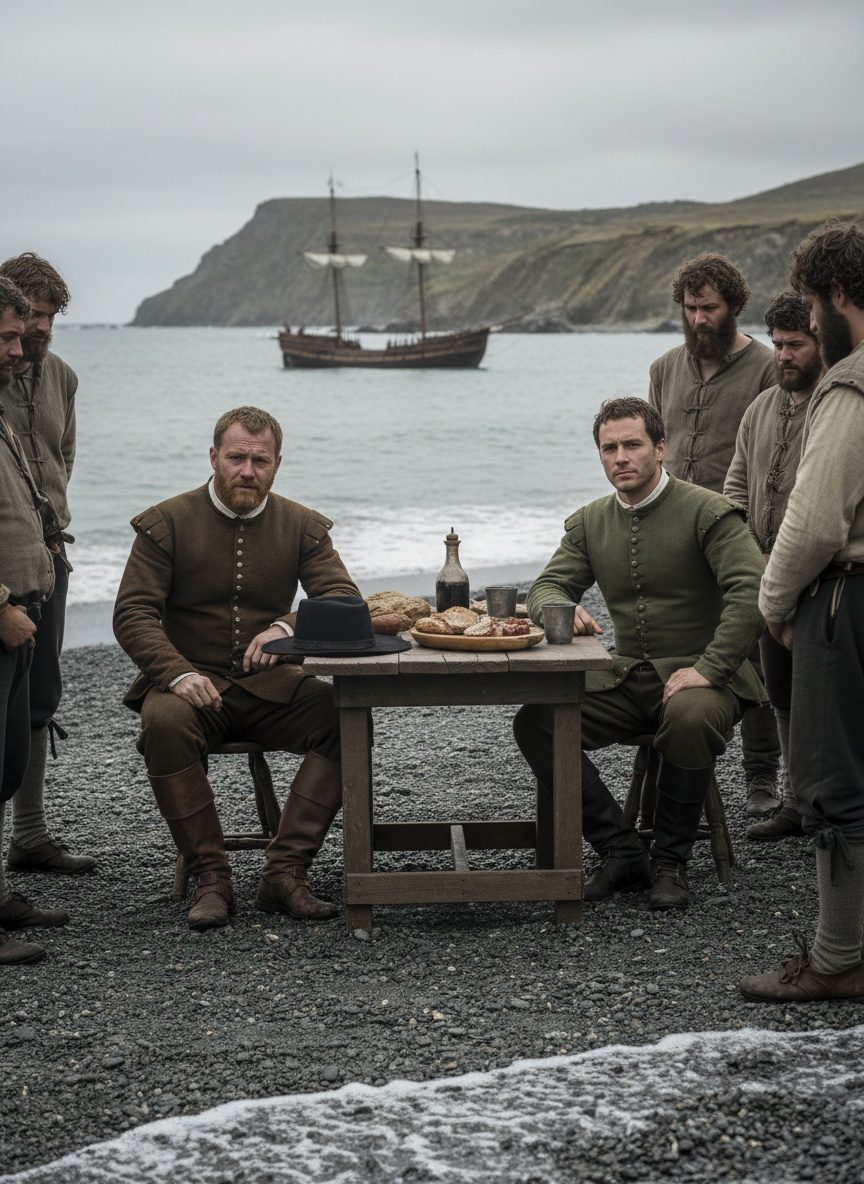
The verdict — guilty of mutiny — carried the inevitable penalty of death. But the humanity within Drake sought to temper steel with grace. He extended to Doughty the greatest mercy he could muster: a final meal shared, not as a superior to the condemned, but as friends. The setting was humble, a stark contrast to the lush banquet halls back home. Yet, in the uncertainty of that endless blue, it was perhaps the greatest comfort one could extend. They broke bread together, a signal pause amidst turmoil, each morsel a tribute to shared memories and a farewell to camaraderie.
During the meal, possibly overshadowed by the impending reality, we find little recorded of their conversation. Was there silence? Did they reminisce? Or did they speak of things beyond the reach of time and tide? It is here that history moves from documented fact into the realm of speculation. What remains undisputed is that Drake then allowed Doughty his final dignity: the choice of how to meet his end.
Doughty’s Choice and Drake’s Conundrum
Doughty, steadfast in dignity even when faced with his mortality, accepted a soldier's death. The knot of men who formed the jury now found themselves reluctant executioners. As the processional machinery of English justice was unwieldy at best on the open sea, it was this very decision — the manner in which Doughty would die — that brought an unexpected gravity to the entire sad affair.
Drake's men could not have missed the cloud that darkened their commander's visage as he prepared to enforce the sentence. It raised the troubling question of power: could a mission's success justify such a merciless display? In Drake's era, the captain’s word was law, but here he knelt not just before Doughty but also before the ideals of loyalty and duty — the gnawing duality he was forced to embody.
As the moments unfolded like grim poetry, it becomes clear how Drake’s actions, viewed through the prism of modern eyes, might be seen as profound. In great voyages, we often exalt the discoverer’s triumphs and trials, but here, Drake confronted not the treacherous sea nor the enemies of his nation, but the deepest shadows within himself. That Drake chose to honor his friend with the intimacy of a shared supper and a thoughtful death amid charges of mutiny remains a pointed meditation on justice untethered from land’s laws.
The waves whispered a eulogy — a testament to Drake's respect for order as much as to the crushing weight of command. This story, a brief candle flickering amidst the tempest of history, reminds us even the most celebrated figures must navigate the tumult of integrity, the burden of leadership, and the storm-lashed seas of their own souls.