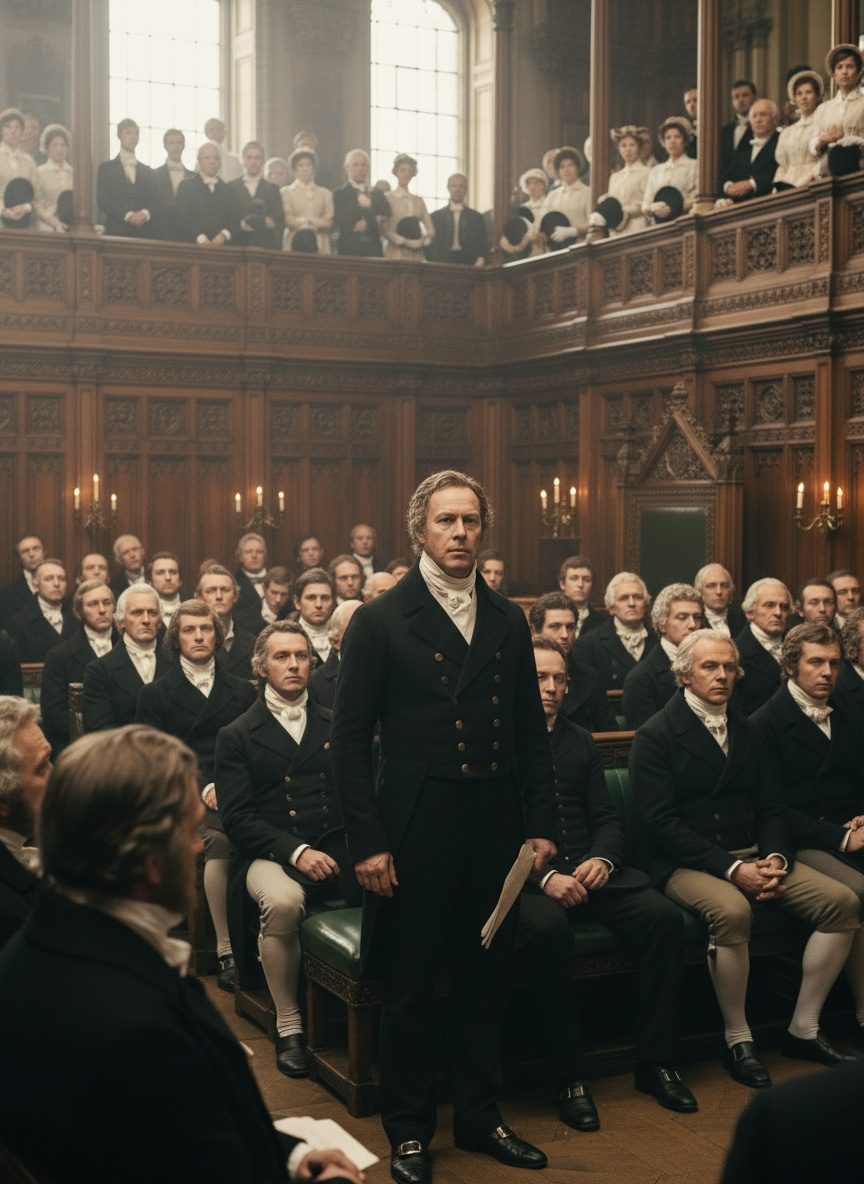
The galleries fell silent, holding their breath collectively. Thomas Fowell Buxton, his voice steady yet charged with the gravity of history being made, paused momentarily before uttering the words that would forever alter the British Empire. Thousands packed into the House of Commons, every eye fixed on the man whose next sentence would ripple across continents. And then, a declaration cut through the expectant hush: 800,000 enslaved souls—free. The weight of it hung in the air for a moment, suspended like a solitary note before the crescendo of humanity. Cheers erupted, a seismic wave of joy rolling through the hall and into the streets of London. The Slavery Abolition Act of 1833 had passed, an act that extinguished the empire’s long-entrenched endorsement of human bondage.
The Winds of Change
In the decades leading to that august afternoon, the winds of change had been gathering force. Across Britain, ordinary men and women had risen to demand the end of slavery, emboldening and amplifying the calls for reform. Religious groups, particularly the Quakers, led an impassioned crusade against the inhumanity of slavery. Pamphlets and petitions flowed through the streets like lifeblood, stirring the hearts of thousands. The eyes of these reformers were wide open to the contradictions of an empire priding itself on liberty while shackling countless lives across its territories.
One pivotal figure in this movement was William Wilberforce, whose life was a testament to tireless advocacy for the enslaved. His fervor sparked a flame that would burn through generations, lighting Buxton’s path to that decisive moment in Parliament. But rather than a singular hero, the abolitionist movement was a vast chorus of voices demanding change. From Parliament to the pulpits, from the corridors of power to the kitchen tables of humble homes, Britain awoke to the moral imperative that slavery could no longer be ignored or justified.
The Letter of the Law
The Slavery Abolition Act was formally introduced in April 1833, marking the culmination of years of strategizing, debate, and moral reckoning. Its vehicle through the legislative battle was Thomas Fowell Buxton, a parliamentary stalwart and social reformer whose commitment was unyielding. As Buxton presented the Bill to the Commons, the text was a detailed manuscript of societal change. It laid the groundwork not only for freedom but also for an empire grappling with the unprecedented financial implications of emancipation.
While the Act proclaimed the emancipated status of 800,000 individuals, it paradoxically demonstrated the entanglement of economics with human lives, providing substantial financial compensation not to the freed individuals but to the slave owners. This provision, fiercely debated, underscored the complex realities of abolishing an institution deeply embedded in the empire's economic framework. Yet, the Bill's passage, set for August 1833, foretold a ceremonial and significant beginning for those long denied freedom's light.
The Chain Breaks
When the Act came into force on August 1, 1834, the day was celebrated by many as a new dawn. Across the Caribbean and other British territories, enslaved individuals either woke to or were informed of their freedom. The change was palpable—an enormous wave of human spirits unshackled after generations of oppression. However, the journey to a true societal transformation was fraught with challenges. Transitioning from enslavement to freedom was not instantaneous; instead, former slaves entered a period known as "apprenticeship," which ostensibly continued the system under a new guise until it was abolished in 1838.
The pressure to abandon the apprenticeship system was borne from the insistent voices of both the former enslaved and their allies in Britain, who called out its inherent deficiencies and its perpetuation of inequality. The echoes of jubilation from the Act's passage in 1833 rallied support anew, allowing the full promise of emancipation to be realized, incrementally dismantling the remnants of the old order.
The Aftershock
The legislative stroke of Buxton’s pen in 1833 did more than liberate the enslaved—it redefined the moral compass of an empire reshaping its legacy. The foundational rock of the British Empire had shifted, casting ripples that would sweep through colonies and nations worldwide, challenging other nations to confront their own complicity in slavery. Yet, amidst this victory, the specter of colonialism still loomed, and the journey toward genuine equality remained perilous and incomplete.
The abolition of slavery was a triumph of human dignity over a brutal legacy, an assertion of humanity amidst the shadows of greed and exploitation that once bound an empire's conscience. In remembering 1833, we are reminded of the power and necessity of activism, of voices raised against injustices long deemed unchangeable. As history marches on, the Slavery Abolition Act stands as a testament to the possibility of societal transformation—proof that the echoes of justice, once found, can break any chain.