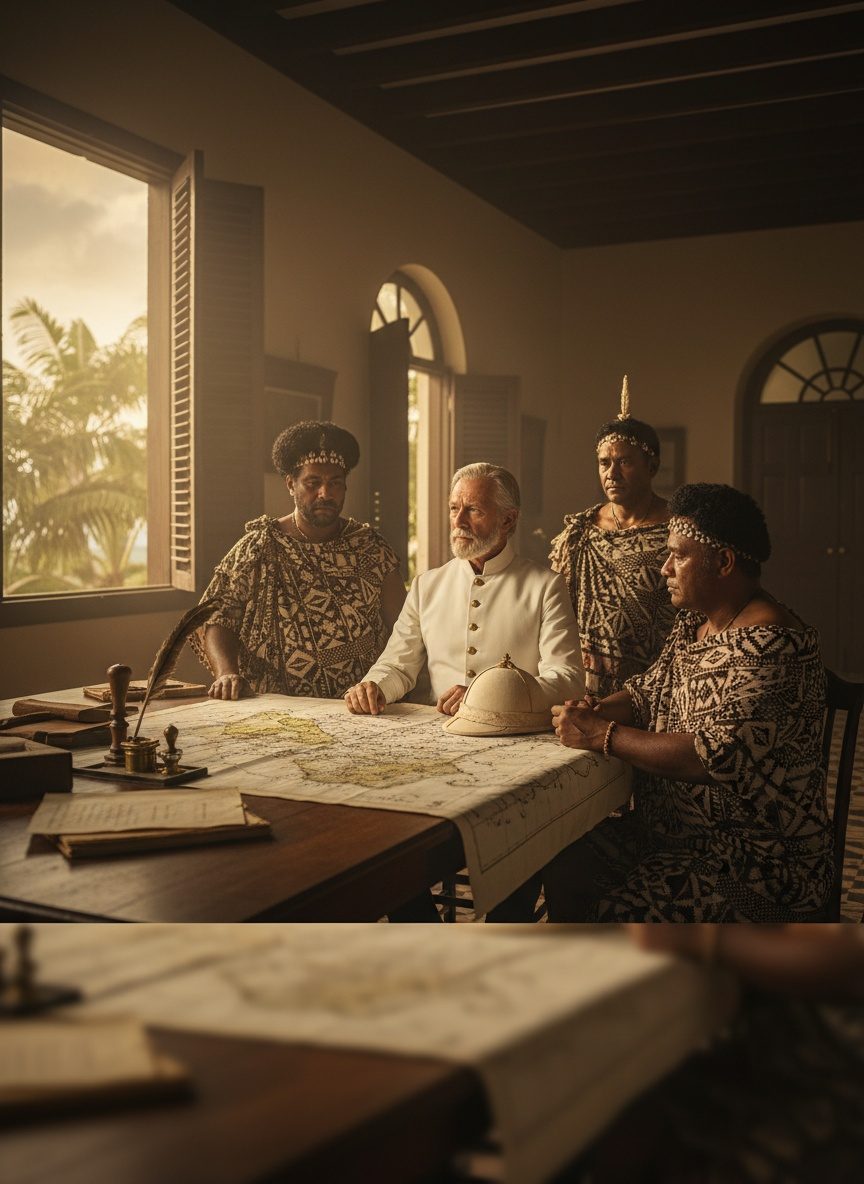
English law crossed many seas, but when it landed in Fiji, it did not follow the usual course. It adapted, influenced subtly by those it sought to govern, rather than imposing its will with an iron fist.
The year was 1875, and Fiji had recently become a jewel in the expansive British Crown. The islands were poised at the delicate juncture of their own cultural crossroads and colonial intentions. Sir Arthur Gordon, fresh-appointed as the first Governor of the newly minted British Fiji, found himself facing not just the administrative demands of a newly acquired territory but a swift and unforgiving smallpox epidemic. Thousands of lives were at risk—both from disease and the political machinations typical of colonial rule during this era.
One might expect Gordon, a representative of the powerful British Empire, to employ familiar colonial tactics: dismantling existing power structures and replacing them with the iron bars of British authority. However, he went against the grain of the time’s expectations. Gordon chose cooperation over coercion, seeking to govern in conjunction with the existing Fijian social framework, the intricacies of their societal norms, and notably, the venerable Fijian chiefly system. This decision rippled far beyond its immediate effects, leaving a legacy that continued to shape Fiji long after the 19th century passed into memory.
Imagine the scene: traditional Fijian canoes gliding over azure waters, carrying news of the colonial presence not as conquerors, but as allies. The chiefs, adorned with vibrant garlands and traditional masi cloths, convened under the swaying palms. For them, their customs were not simple cultural artifacts but living, breathing institutions that were central to Fijian identity and governance.
Sir Arthur Gordon, fresh from the architectural splendour of Westminster, must have appeared an odd fit among the simplicity of island life, yet he displayed a rare comprehension of the colonial dynamic. Instead of disregarding the chiefs, or imposing draconian statutes, he integrated their authority into his governance model, understanding that their influence was not only invaluable but irreplaceable in maintaining peace and order. By respecting and revitalizing the chiefly system, which many other colonial administrators might have been eager to dismantle, he fostered a government that allowed Fijians to maintain their unique identity while adapting to the colonial presence.
In the midst of this integration, the smallpox epidemic roared through the islands, a tragedy neither indigenous to Fijian shores nor one that differentiated between native and foreign. Gordon's innovative approach was tested thoroughly as the epidemic threatened livelihoods more intimately than did political change. It was a pivotal test for his unorthodox approach—one where indigenous practices, colonial medicine, and the overarching need for organized leadership via the chiefly governance held sway. Countless lives hinged on the decisions made in these tense days, under Gordon's watchful eye and through the chiefs' communal wisdom.
Those familiar with colonial histories might find themselves taken aback by this harmonious engagement; after all, it defied the inconvenient reality of many colonial enterprises, which often valued domination over negotiation. The juxtaposition of British legalism with Fijian customs could have been a recipe for cultural erasure. Instead, it became an exemplar of nuanced colonial interaction, where diplomacy and tradition bore governance that truly resonated with those it sought to control.
Gordon’s respect for the Fijian chiefly system inadvertently preserved a cultural heritage fast eroding in other parts of the colonized world. His efforts bound the islands more closely to their inherent identities while nurturing a composite governance model that neither completely assimilated Fijian tradition nor left it untouched in the face of modern laws. Harmonizing British order with Fijian identity proved to be neither disaster nor utopia, but a pragmatic approach that laid a sustainable groundwork for future leaders of the islands.
It's worth pausing to reflect upon the implications beyond the immediate context. The legacy of Sir Arthur Gordon’s choice extends into modern times, where Fiji's democracy still leans into the trust and structure of its chiefly heritage. In a world affected by unsettling colonial sagas, the Fijian tale forms a compelling narrative of cultural synergy. Herein lies the true lesson from this chapter in the Pacific: that sometimes the best governance models are not prescribed from elsewhere but are those which embrace and evolve the local traditions that exist.
As the sun sets over the tropical horizon, casting hues of amber and crimson across the Pacific sky, one cannot help but ponder what other stories history has obscured when ancient systems and colonial powers met. Fiji's past prompts an examination of the legacies that we inherit and the new paths we might choose—the enduring dance between preserving the intrinsic and embracing the inevitable change.