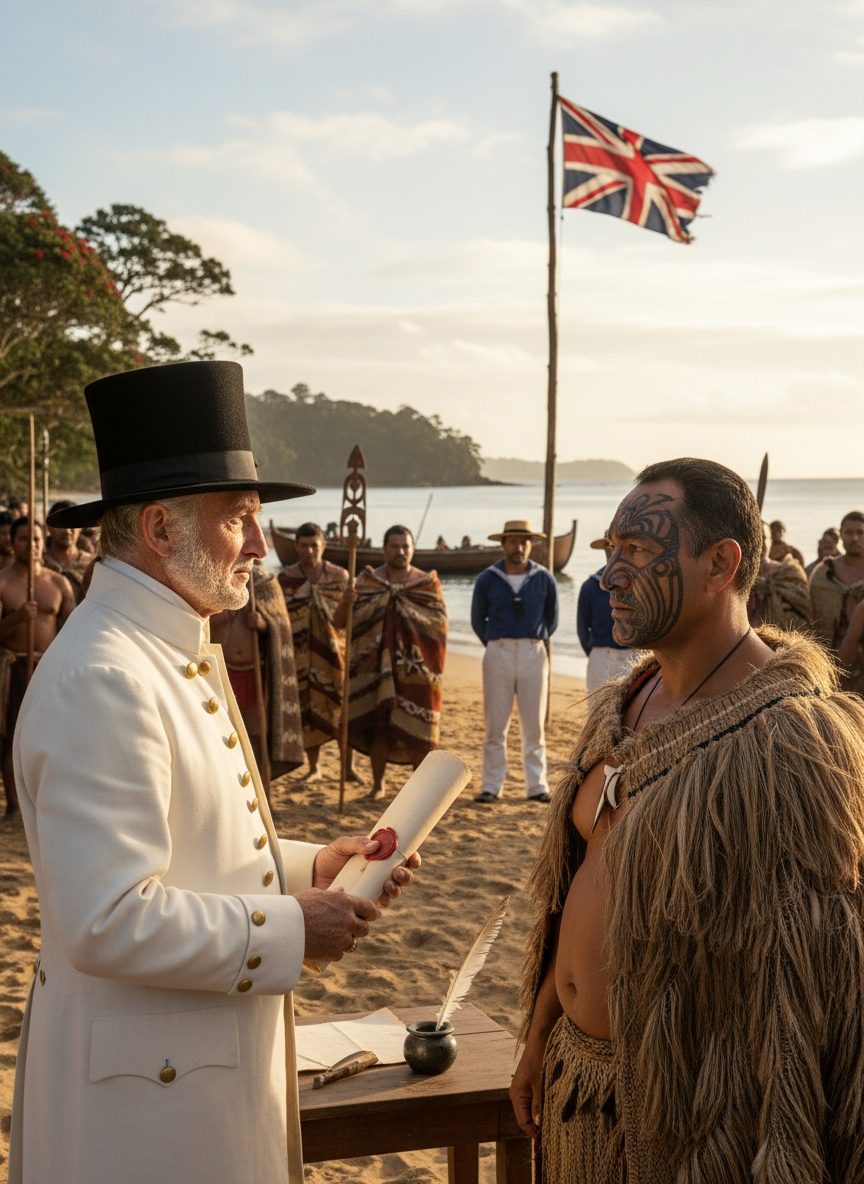
February 1840. The salty breeze whipped across a remote beach, fluttering a parchment in the hands of a British Crown representative. Nearby, the vast Pacific waves crashed gently upon the shores of what would soon be known as New Zealand. Over five hundred Maori chiefs and elders gathered under the sun, poised to wield their influence over the fate of their homeland by pressing their marks to a document that would echo through the generations.
The Waiting Winds of Waitangi
The Treaty of Waitangi was not born in a vacuum; it emerged at a time when the British Empire was expanding its reach across the globe. The first footprints left by Europeans on New Zealand’s rich and rugged soil belonged to whalers, traders, and missionaries. However, by the 1830s, the unregulated and often chaotic presence of these outsiders necessitated a more structured governance.
Maori society at this time was complex and vibrant, organized into tribal units known as iwi and hapu, each with its own chief, or rangatira. Their world was intertwined with spiritual beliefs and a deep connection to the land. When the British approached the Maori with the Treaty of Waitangi, it arrived as a promise—a commitment to protect and respect Maori rights while facilitating the settlement of British subjects.
On the morning of February 6, 1840, Maori people arrived by canoe from various corners of the land, dressed in their finest traditional attire, bearing the weight of their people's expectations. The scene was one of juxtaposed anticipation and apprehension. Chiefs debated passionately on the merits and pitfalls of placing their faith in British assurances. For many, it was not a surrender, but a negotiation.
Promises Inked with Conviction
The treaty itself consisted of three key articles. The first conveyed the cession of sovereignty to the British Crown—at least in the English version. However, in the Maori text, the term used, "kawanatanga," loosely translated to the notion of governance, which was perceived differently from the absolute sovereignty depicted in English. This subtle yet pivotal difference sowed seeds of future discord.
The second article assured Maori chiefs and tribes the "full, exclusive, and undisturbed possession of their lands and estates, forests, fisheries, and other properties." The Maori equivalent offered a safeguard for their tino rangatiratanga—the literal interpretation being the unqualified exercise of their chieftainship.
The final article promised the Queen's protection and granted Maori the rights and privileges of British subjects. This, many Maori believed, would place them on equal footing with settlers, creating a legal framework where both cultures could coexist.
As the chiefs took hold of quill and ink, the treaty transformed from a vision to a promise. Each carefully placed mark was an act of faith—a startling moment where ancient traditions intersected with burgeoning modernity.
A Delicate Balance
The days following the signing were marked by a cautious optimism, but underlying tensions smoldered beneath the surface. The introduction of British law was swift; settlers saw an influx of opportunities, while Maori communities observed the changes with varying degrees of acceptance and resistance.
The discrepancies between the English and Maori versions of the treaty became apparent in the conflicts that followed. Sovereignty and governance were interpreted differently on each side, leading to land disputes that would mar the 19th and 20th centuries. Nonetheless, the Treaty of Waitangi remained a living document, invoked in debates and discussions, a testament to the Maori commitment to retaining control over their culture and lands through diplomatic rather than martial means.
As the settlements grew and landscapes evolved, the Maori’s initial caution proved astute. Their chiefs, pragmatists many a time at odds with the settlers' short-sighted ambitions, secured a future for their people that, while rocky, allowed their voices to be continually heard through the changing winds of time.
The Enduring Legacy of an Island Treaty
Today, the reverberations of that day in February 1840 are not mere echoes of the past; they resonate in contemporary New Zealand society, culture, and politics. The Treaty of Waitangi stands as a foundational document that is annually commemorated, questioned, and reaffirmed. It represents a solemn promise—a living contract whose significance is woven into the national fabric.
This treaty serves as a mirror reflecting both the triumphs and trials of an evolving relationship between two peoples bound by history. It calls into question the nature of governance, the interpretation of sovereignty, and the philosophy of coexistence. Much like the Maori chiefs who dared to negotiate on the sands by the sea, New Zealand continues to journey toward a balance—where the spirit of partnership and respect strives to fill the space between black ink on paper and the colorful tapestry of its diverse society.
The Treaty of Waitangi invites us to ponder the complexities of colonial legacy and the ever-transforming identity of nations. It reminds us that the stories left out of textbooks are not only significant threads of the world’s past but vibrant colors in its ongoing narrative.