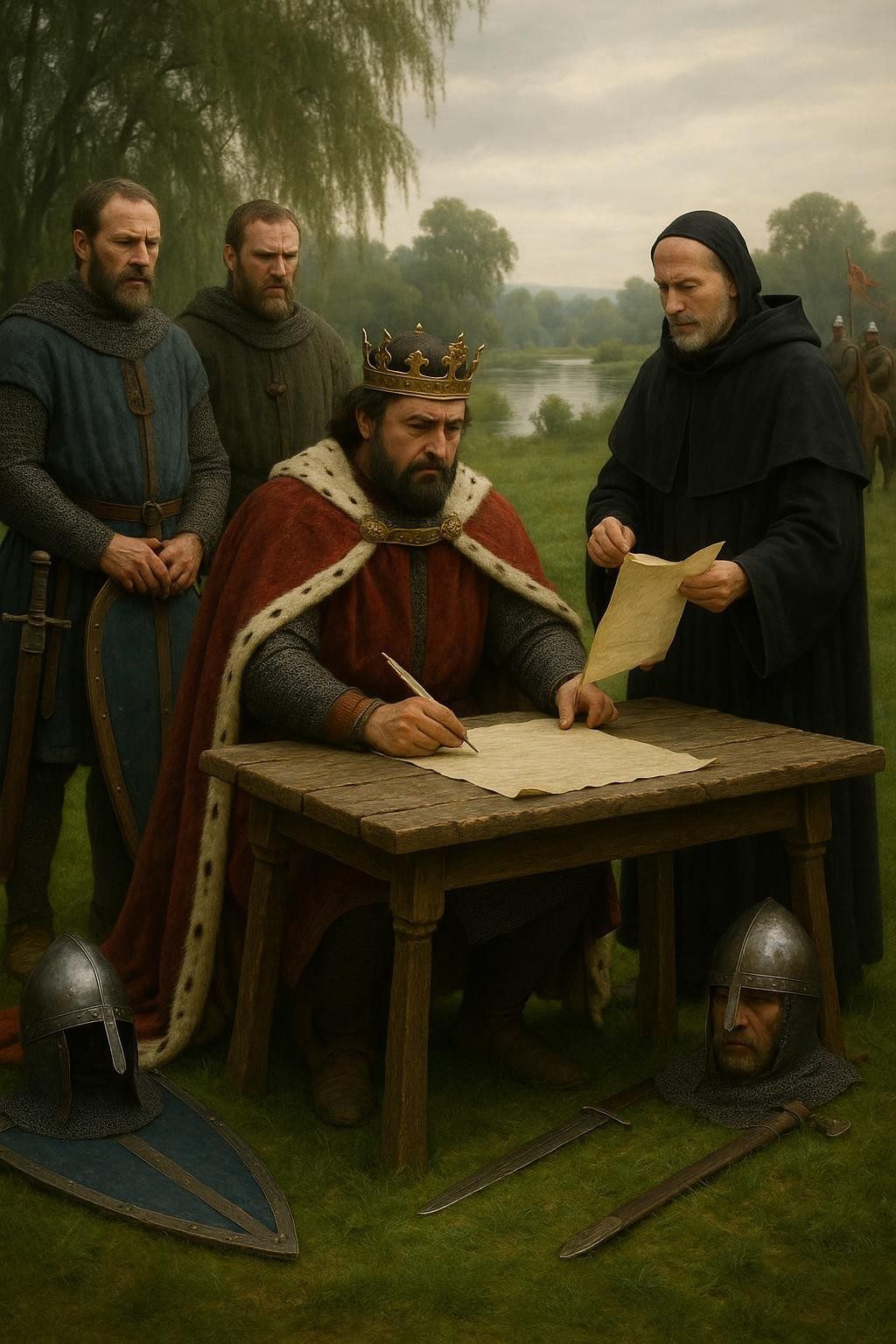
A meadow by the Thames is just a stretch of land. Runnymede changed history.
The King Who Knelt
In the thick of June 1215, a reluctant King John of England found himself kneeling on a plain meadow known as Runnymede. This was no peaceful pastoral scene; it was the stage for a tense showdown between the monarchy and its discontented barons. They had been pushed to the limit, demanding that the sovereign adhere to a set of principles that would protect their rights and curtail the arbitrary use of royal power. King John, known for heavy taxation and unsuccessful military campaigns, was out of options. He was faced with a stark choice: seal the Magna Carta or face an uprising of formidable nobles.
The air buzzed with anxiety as ink met parchment, the seal impressed upon a document that captured the hopes and grievances of the moment. To John, this agreement was a temporary fix, a minor concession to return stability to his crown. He believed he could renege once the nobles dispersed. But the document, now simply referred to as the Magna Carta, would outlive the immediate conflict. It was the codification of a radical concept—the law is above the king.
A Document of Unforeseen Power
The Magna Carta, or the "Great Charter," was unlike any document England had seen. It was not the first attempt at reining in a monarch's powers, but it crystallized revolutionary ideas in writing. Its sixty-three clauses touched on everything from church rights to protections against illegal imprisonment—a tapestry of demands integrating traditional rights and new governance notions. However, what began as a remedy for a specific political crisis soon became something far more significant.
Initially, this document did not promise immediate justice. Much of it centered on protecting baronial privileges rather than noble intentions for a fairer society. But the tiny seed of common law principles lay waiting for fertile soil. The Magna Carta's greatest contribution may have been its assertion that the king could not act alone—that his decisions were subject to a council's approval, a nascent idea reminiscent of what we today consider democratic governance.
From Meadow to Global Blueprint
Remarkably, the Magna Carta would echo through the centuries, leaving its imprint well beyond the banks of the Thames. As England's political landscape evolved, so did the interpretation of the Great Charter. The principle that no ruler is above the law gradually became entwined with the development of a legal system rooted in fairness and equity. Common law emerged, shaping judicial processes that emphasized case law and the rights of individuals—concepts that carried across the Atlantic with English settlers into the New World.
When the American colonists clamored for independence, they looked to the Magna Carta as a cornerstone document that affirmed their rights against tyranny. The enduring clause that promised justice through due process became enshrined in their emerging legal framework. Fast forward to today, more than 100 constitutions around the globe owe a philosophical debt to King John's reluctant accord in Runnymede—embedding the rule of law as foundational to nation-building.
A Meadow's Whisper Through Time
Runnymede remains an unassuming stretch of grassland, fringed by the ebb and flow of the River Thames—a landscape whose significance belies its tranquil appearance. It serves as a poignant reminder that often, the most dramatic shifts in human history have humble beginnings. What transpired there in 1215 underpins modern legal systems and democratic principles; it underscores the idea that no individual, regardless of their power, is beyond accountability.
Today, in an age increasingly defined by rapid transformation and complex global challenges, the message from that distant meadow is clear: the principles of fairness, justice, and accountability are timeless. As our world continues to evolve, the Great Charter endures, a beacon guiding the inalienable rights that shape societies. And so, the king's loathed parchment became the compelling promise of a civilization where everyone, both the rulers and the ruled, must answer to the law.