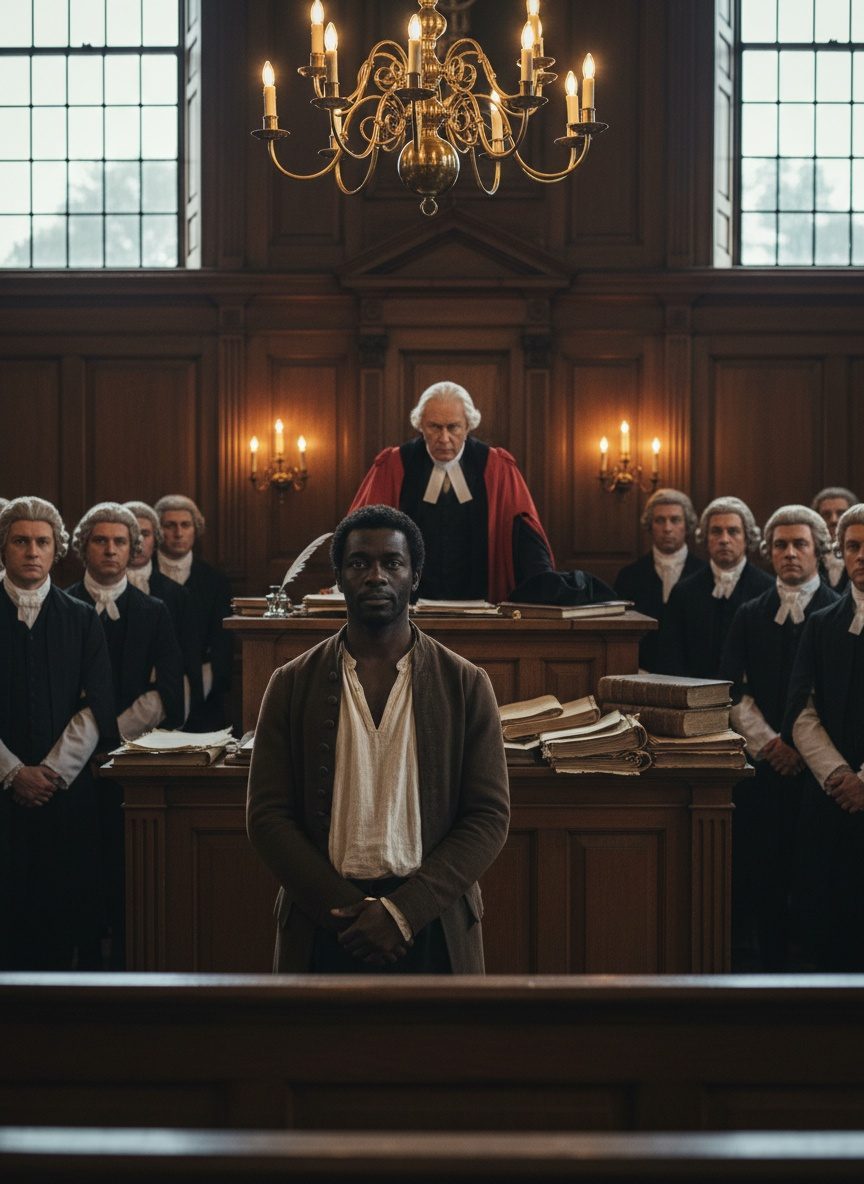
The courtroom was stifling, the air thick with the anticipation of the verdict that would decide not only the fate of one man but perhaps the course of history. James Somerset stood, his heart drumming a relentless cadence in his chest, as Lord Mansfield entered the chamber, the crowd falling silent at the swish of judicial robes against the polished floor. All eyes were on the judge, whose pronouncement would ripple far beyond the walls of the Old Bailey, into the very conscience of an empire grappling with its own humanity.
In that London courtroom of 1772, what was meant to be a personal legal quarrel had transformed into a profound commentary on slavery and freedom. Somerset, a Black man who had been brought to England against his will by his master, Charles Stewart, had tasted a freedom he could not reconcile with his status as property. When Somerset fled, Stewart sought the law’s iron hand to reclaim him. Yet, as the gavel came down, it was not Stewart's claim that resounded through time, but the words of Lord Mansfield: no man can be a slave on English soil.
James Somerset became a symbol—intentionally or not—for a burgeoning dialogue about human rights. Though the decision didn't eradicate slavery across the British Empire, its power lay in its assertion that the land under English law could not countenance the shackles of bondage. Mansfield's ruling served as a lodestone, drawing the attention of philosophers, abolitionists, and the very colonies that formed the backbone of Britain's imperial wealth.
The seemingly simple legal determination of whether a man could be forced back into captivity on English soil sparked a debate about the moral underpinnings of a society deeply entwined with the commerce of human lives. At its heart, Mansfield’s ruling was an assertion of English common law standing firmly in opposition to the dehumanizing institution of slavery. The ruling’s reverberations pierced beyond the English Channel, whispering of freedom to the 14 colonies in America, where the stirrings of revolution and the question of human liberty were beginning to entwine.
Among those listening intently to the echoes of the Somerset case were the architects of the American Revolution. The idea that English soil granted freedom to those who reached it did not only embolden the enslaved but also cast doubt on the legitimacy of slavery in the colonies. The colonies were burgeoning with Enlightenment ideals, questioning longstanding institutions and daring to envision a society built on liberty and justice. The Somerset case exemplified this dichotomy; while not abolishing slavery outright, it challenged colonists and British citizens alike to confront the inconsistencies of their own moral and legal frameworks.
What made the Somerset case particularly compelling was not solely the legal precedent it set, but its profound cultural and philosophical implications. It fed into a larger Enlightenment discourse on human rights and the fundamental dignity that belonged to every individual by virtue of their humanity. Somerset, unwittingly perhaps, stood at the confluence of these dynamic forces, his case a prism refracting the intense debates of liberty and intersectionality of light and darkness, freedom and enslavement, across the globe.
Public reaction to the Somerset ruling varied dramatically. Abolitionists in Britain cherished this victory as a moral beacon, a small but poignant advance in their relentless campaign against slavery. Yet, it was precisely this spark that troubled slaveholders both in England and across the Atlantic. The ruling cast a looming shadow over an institution they had long considered unassailable, questioning the legal foundations upon which their economic fortunes were built.
The ruling compelled a societal reassessment in the colonies—a place where the rhetoric of freedom conflicted starkly with the realities of entrenched slavery. Massachusetts, the cradle of American liberty, became a hotbed of discussion about human rights, and it wasn't long before Somerset's echoes were articulated in movements and legislations pressing towards emancipation. Here, the seeds were sown for abolitionist movements that would outlast Mansfield's own era, growing into a thundering demand for justice and equality.
In an empire where the sun never set, Lord Mansfield's courtroom decree set into motion a set of unprecedented legal and moral equations. Slavery's roots were deep and pernicious, yet the fractures in its foundation had been exposed, inviting questions about the legitimacy of binding one man to the service of another. Though the Underground Railroad and emancipation movements lay decades in the future, the trajectory towards liberty had indeed shifted.
The Somerset case remains a pivotal moment, not just in legal history but in the universal and ongoing struggle for human rights. It illustrates how a single judgment can transcend the narrow confines of a courtroom to become a clarion call for justice, equality, and the fundamental dignity of every individual. The quiet of that London courtroom belied the magnitude of its impact—a testament to the power of law to reshape narratives and awaken the spirit of reform across borders.
We are left reflecting on the complex legacies that the Somerset decision represents. It is a reminder that progress, however incremental, can begin with a single, courageous act of defiance against established norms. The decision in 1772 did not dismantle the institution of slavery, yet it articulated the futility of moral blindness and set the stage for the myriad voices that would, in the centuries to follow, demand change. The enduring power of Lord Mansfield's decision lies in its affirmation that no soil, however distant, can claim to be just while shackled by the chains of slavery. It's a story of where we have been, and a beacon for where we must go—a continuous journey towards justice that daily seeks the courage to uphold the rights that belong to each and every human being.